Alaska Skiing Trip Round-up

My best friend’s wedding and a gross food intolerance (projectile, messy everything and everywhere) intervened with this write-up. Perhaps more current commentary would lend insight into how I am feeling in/closer to the moment. But allowing for some time to pass might not be such a bad idea as it allows me to see myself and the situation in a more objective light. For example, after my first day of skiing at Alyeska, I thought, this trip cannot be over soon enough. It was raining from the base to mid-mountain, and the snow higher up the mountain was super heavy, wet cement. I was on my wider ski which I had only skied one day on beforehand, is a lot more ski to push around and just being tossed about as my ski, outriggers and left leg got caught on what seemed like every turn/bump. The person I was skiing with basically offered nothing in the way of instruction, saying, I have no idea what I would do with one ski and outriggers. I thought, great. What. The. Fuck. I was close to tears by the end of the day, thinking that I just totally sucked and would never be able to ski any/all kinds of terrain again. Every one around me reassured me that these were very challenging conditions for everyone, not just me; and it is true, many people were falling left and right around me. But, as usual, I took no solace in this knowledge. The bottom half of the mountain consisted more of water-skiing back to the Challenge Alaska building. And, I also found myself quite stressed out by all the people around me, all the time, as I am introverted by nature.

At the end of that first day, I spoke with Jeremy, the director of the Adaptive Ski and Snowboard School at Challenge Alaska, saying, look, I really appreciated having someone show me around the mountain, but I had gotten absolutely nothing out of the day. I think he saw how glum I was. But, he also said, today was about you guys getting used to these conditions and me getting a baseline for where every one is at. He also said, I think it would be really helpful for us to figure out a system to hold your left leg up so that it is out of the way, you don’t have to waste your energy holding it up, and it also isolates your good leg so that it is completely free to move on its own (which eliminated my velcro between the knees idea). We played about with a piece of webbing looped around my left snow boot (Sorels) with a knot tied at the end of that, another piece of webbing threaded through a super dinky loop for the detachable braces on my ski pants and connected the two with a carabiner. Jeremy said, okay, lets go out and do one run off the beginner chair to test this out, just one run. I was in my boxer short pyjamas already, but said, okay, put my waterproof pants and jacket over my PJs, and went out. Well, that one beginner run turned out to be a bit longer, as we figured out how I could clip and unclip the webbing depending on whether I was getting on/off a lift (obviously, having my left leg free as I get on a chair is useful), but then clipping my left leg up as I started a run at the top of a chair. My left leg is a bit flaccid, so it takes some man-handling on my part to raise the heel back and high enough to clip it out of the way. It was certainly a very different feeling, but Jeremy thought it looked a lot better and asked if I would give it a try the following day. I agreed. I really appreciated him just taking a few runs with me at the end of his day.

The next day, Jeremy arranged for me to be paired with him for the day (I only later learned that his nickname, JAHA, stood for Jeremy Anderson Hard Ass – my kinda guy). The difference between my second day and first day were like night and day. Jeremy really knows what he is doing. We focused on just two things: (1) Flexion and extension at the proper place in a turn (and turn-shape – really finishing my turns), and (2) having my left hip open (i.e. facing down the fall-line) when I am on my uphill edge and letting it hang and do whatever when I am on the downhill edge. The first thing is simply a function of how tired my right leg is. The second is slightly trickier as I do not have good proprioception in my left leg/hip. So I would have to look down and see where my left quad is, adjust my core and weak left hip flexor muscle and recognize that sensation and remember it. We started off on the groomers and just did laps on that to work on these two (okay, maybe two and a half) things. We then progressed to deeper crud/off-trail stuff. Having my left leg pinned up when I stopped took some getting used to. My usual thing has been to just drop my left leg/foot when I stop; but obviously, now this results in a big THUD when I do so, and I also need to use my outriggers more to pole myself out if I am in a pickle. I was (and still am) a bit nervous about not having protection around my left knee (my usual left leg brace limits the range of motion); I will at least be wearing my old telemarking knee pads on that knee so that it doesn’t end up as messed up as it looks (hopefully not how it actually is, since I don’t have much sensation there).
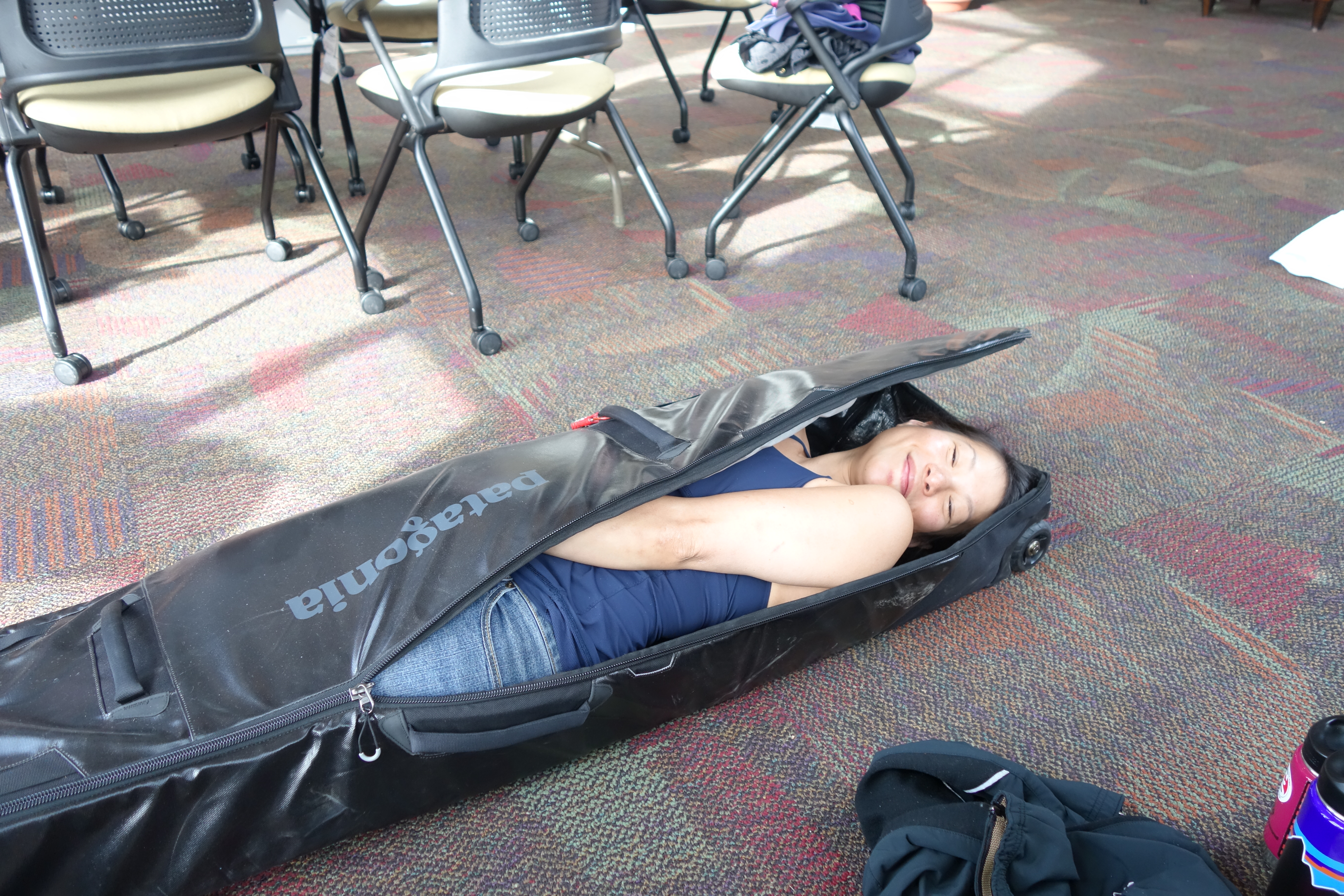
My rolling ski bag *almost* doubles as a body bag.

My rolling ski bag *almost* doubles as a body bag.

Day Three was perhaps my best skiing day. The snow wasn’t super sticky/wet in the morning, but also not super deep (which I don’t have any familiarity with as a three-tracker). It was the Challenge Alaska Fundraiser, so the building was pretty packed. It was a really nice event to witness and be a part of, and see the wonderful community of folks. I had a mono-skier, Nathan, who totally rips, show me around the mountain. Nathan makes beautiful turns in all conditions, with great outrigger use; but, more importantly, just has a great attitude, it seems. He was living in Kansas to play college football, and was working some kind of job involving manual labour. A fork-lift accidentally dropped a heavy load on top of him and made him a T9-complete SCI. He did not ski before his injuries, and only took up mono-skiing after he returned to Alaska (after returning to finish college after he was done rehabilitating). Skiing with him was just like having fun skiing with any ski buddy. At the end of the day he asked, “How is your leg feeling? It must be so tired!” And this is a guy whose lower body is completely paralyzed! I was touched by that comment.

Saturday's setting light. It was only just before 9pm here, and the clearest it had been in Girdwood, AK.

Saturday’s setting light. It was only just before 9pm here, and the clearest it had been in Girdwood, AK. It is hard to capture the steep, sick chutes and scale of these mountains rising up from sea-level.

Scott and I did are own thing on Sunday (Day Four), getting on first chair to take advantage of the cooler mornings and lighter/less heavy snow. I was happy to be on our own as I appreciate the solitude and not being around people all the time. Being pretty much at sea-level, Alyeska gets this very thick pea-soup fog that rolls in; but conditions really seem to change from minute to minute. I became more proficient at clipping and unclipping my left foot up below my butt. Even though when Nathan and/or Scott helped me I would joke, Man, I’ll try not to fart, being independent here is (psychologically and otherwise) very important to me. I do not want to have to rely on having someone around to help me with lift-served terrain.

Here I am, looking like Kenny (ala South Park), as usual. My left leg is dropped down because I have not clipped it up while we are standing around. I only clip it up when I am skiing.

Here I am, looking like Kenny (ala South Park), as usual. My left leg is dropped down because I have not clipped it up while we are standing around. I only clip it up when I am skiing.

Outriggers flipped up

Outriggers flipped up

There was some uncertainty over whether my deep snow skiing abilities were good enough for me to get on the heli-skiing on Monday. It was clear that my deeper snow skiing abilities had improved considerably since my arrival at Alyeska, but the question was, had they improved enough? I am probably the least confident person in my own abilities, and the last thing I want is to be a safety liability to others. This is something I am very conscious about. But folks who had been with me skiing decided that I was a go. The party was going to consist of two able-bodied skiers, and myself and another one-legged skier (Vasu Sojitra). A restless Sunday night and Monday morning were spent feeling very ill with nervousness.

Clear skies were a rarity on this visit; unfortunately, the moon did not allow for Northern Lights sightings this one clear night.

Clear skies were a rarity on this visit; unfortunately, the moon did not allow for Northern Lights sightings this one clear night.

Monday morning was the first clear morning of our entire trip. It looked like the weather gods were cooperating and a heli-skiing weather window was a possibility. Chugach Powder Guides gave a good safety orientation early Monday morning and we were on 10am weather standby. The standby was pushed to noon, then 1pm, then 2pm. All the while, we skied in-bounds at Alyeska in order to warm up/get our skiing legs (or leg, in my case) under us, but also not get so tired that we would be totally gassed for heli-skiing. At 2pm, CPG ended the standby and cancelled all trips for the day. We were only slightly bummed. On the one hand, it would have been an amazing experience. But, I had gotten a lot out of this trip already; namely, devising and iterating a new system for getting my gimpy leg out of the way, and improving my skiing in challenging conditions. Plus, next year I will be a better skier and be able to ski more challenging terrain and snow.
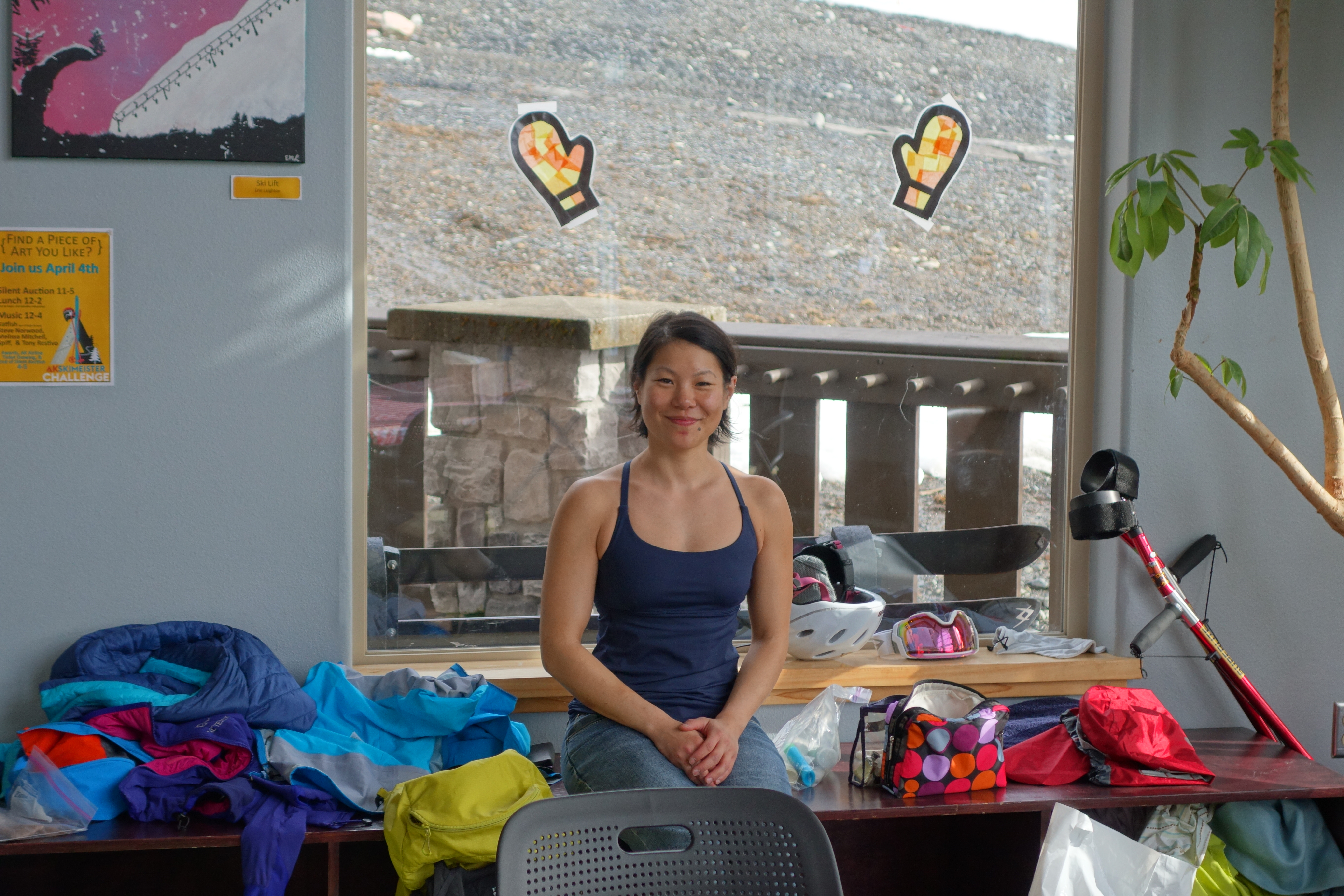
My soul-patch under my lip from the numerous face-plants . From the window, you can see how little snow there is at the base of the mountain

My soul-patch under my lip from the numerous face-plants

My last runs of the trip did not end on a good note. I was tired, perhaps from that day as well as the accumulation of five days of skiing in heavy snow and the repeated tumbles with a very high DIN setting on my bindings, really hurt my (good) knee. Before, I used to be of the mindset that it was important for my right ski not to release if I fall, because retrieving a ski is more difficult for me these days. Now, I am a firm believer that wrecking my good knee isn’t worth it; I will be dialing my DIN setting down to something a bit more appropriate for my weight (say, a 6 – which is very aggressive for someone weighing 112 lbs – instead of an 8!) In any case, I was, yet again, in tears, as I gingerly skied through the slush back to the Challenge Alaska house. We had a reservation at Jack Sprat, a fantastic restaurant in Girdwood, that evening; and, like Gijon, I had to actively go against the voice in my head that said “You do not deserve this meal.” :( For anyone in Girdwood, I highly recommend the restaurant.

A lovely stroll along the meadows between the Challenge Alaska house and the Alyeska Hotel

A lovely stroll along the meadows between the Challenge Alaska house and the Alyeska Hotel

I was particularly impressed with a blind member of the Paradox crew. I was very curious about how he had adapted to going about daily life being blind and asked him all sorts of basic questions. I became aware of the term “lights out”, which means that a person is completely blind. His active pursuits were impressive; say, kayaking the Grand Canyon. But, I was even more bowled over by the fact that he had raised three girls as a single father. That is the ultimate in bad-assery, in my opinion.

One cool thing is that Scott learned a lot from the coaching I was receiving, even as someone who skis with both legs, and his skiing improved as the trip progressed. The morning of our departure, as we were looking up at the north facing headwalls at Alyeska, Scott said, to go from falling off a green chair-lift, to skiing black diamond runs in Alaska and possibly heli-skiing (save for Mother Nature) in three months, is pretty incredible. I am inclined to agree with him, despite my initial dejection and disappointment with myself. While this disappointment stayed with me even a few days after my return from Alaska, looking back, I can say that I got a tremendous amount out of the trip, including meeting some wonderful people in the Paradox crew and the Challenge Alaska volunteers. Fingers crossed, I am very much looking forward to a return visit next season.
En route to Alaska, and other anxieties

I am sitting at Chicago’s O’Hare airport passing the 4+ hour layover, en route to Anchorage, AK. While skiing in the Chugach is a wonderful opportunity, I was/am having all my usual anxieties around air-travel, pain, and what five days of skiing will do to my body.

Air-travel just plain sucks for every body, I know. But, the effects of extended sitting in an airplane seat, and even at airports, are not pleasant for me. The back pain blows. Even with diabetic compression socks, my left foot/leg in particular swells up, the neuropathy is aggravated, and my foot/ankle mobility on that side worsens considerably – all making for sleepless nights and even gimpier gimpiness.

I am also worrying about the back-pain that arises from skiing. The lack of free, un-fused vertebrae to absorb impact is problematic, and I am also worried about not being good enough to heli-ski because my left leg catches in deep snow. I am hoping these are problems that can be solved before we go heli-skiing (if that indeed happens). The original plan was to go cat-skiing, but rain/lack of snow at the base made this a non-option. I also have to be super-light on my outriggers, because I have developed nerve pain in my hands from that and am now sleeping with a hand-brace at night to help alleviate those symptoms.

I know this trip is meant to be FUN. But, as usual, I am placing pressures on myself to ski “well”. I am sure it will be a wonderful experience. But, this does not stop me from fearing the physical effects during and after the trip, even though I know fearing pain is the worst way to deal with pain. It induces a terrible cycle of fearing pain, fighting it, making the pain worse, and so on.

I also have not climbed regularly/at all since the start of ski season. I know the training cycle is just that: a cycle. While I enjoy training, starting from “scratch” always feels crummy. The story of my life…

Ouray, CO – Too much to summarize

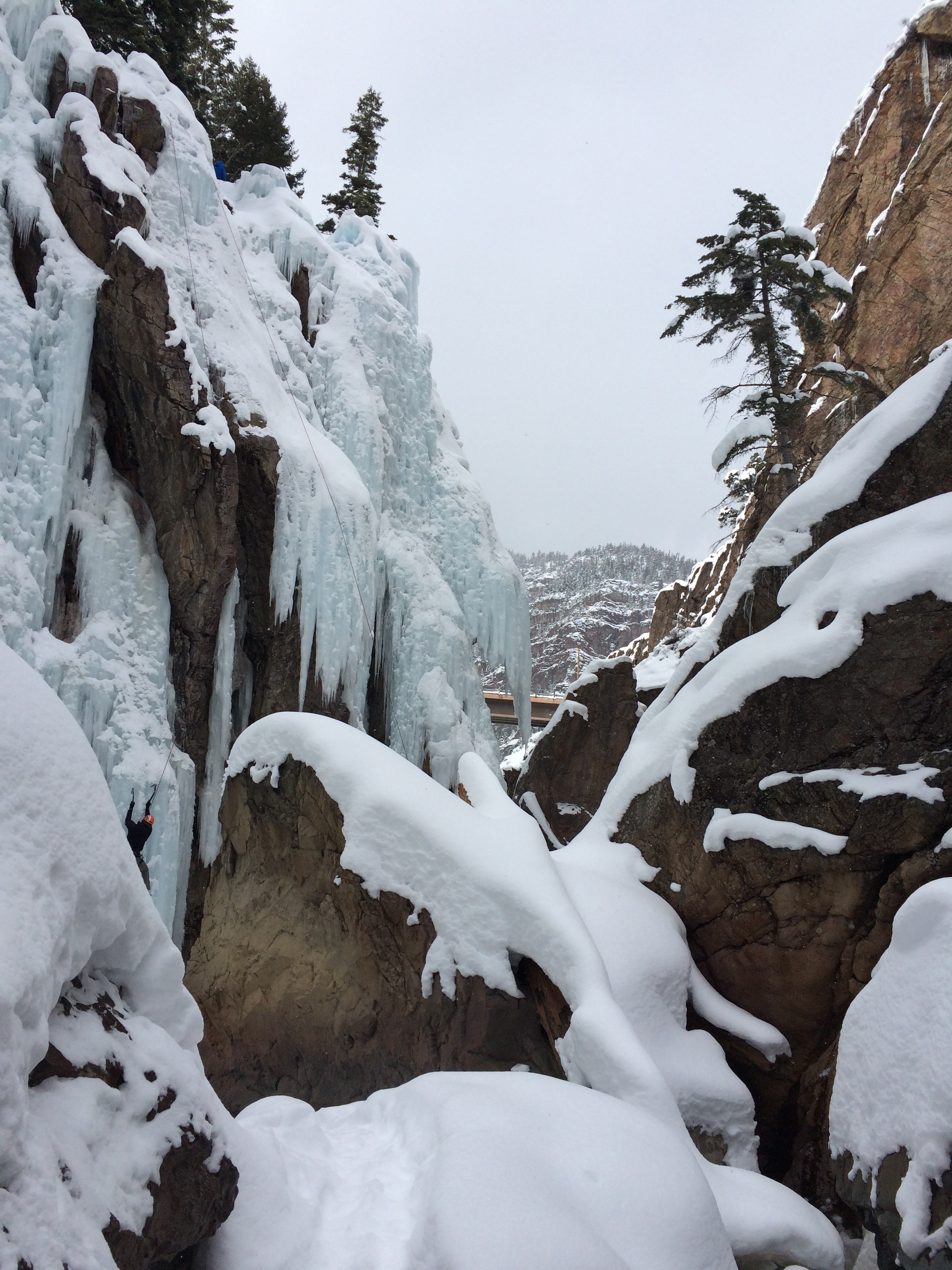
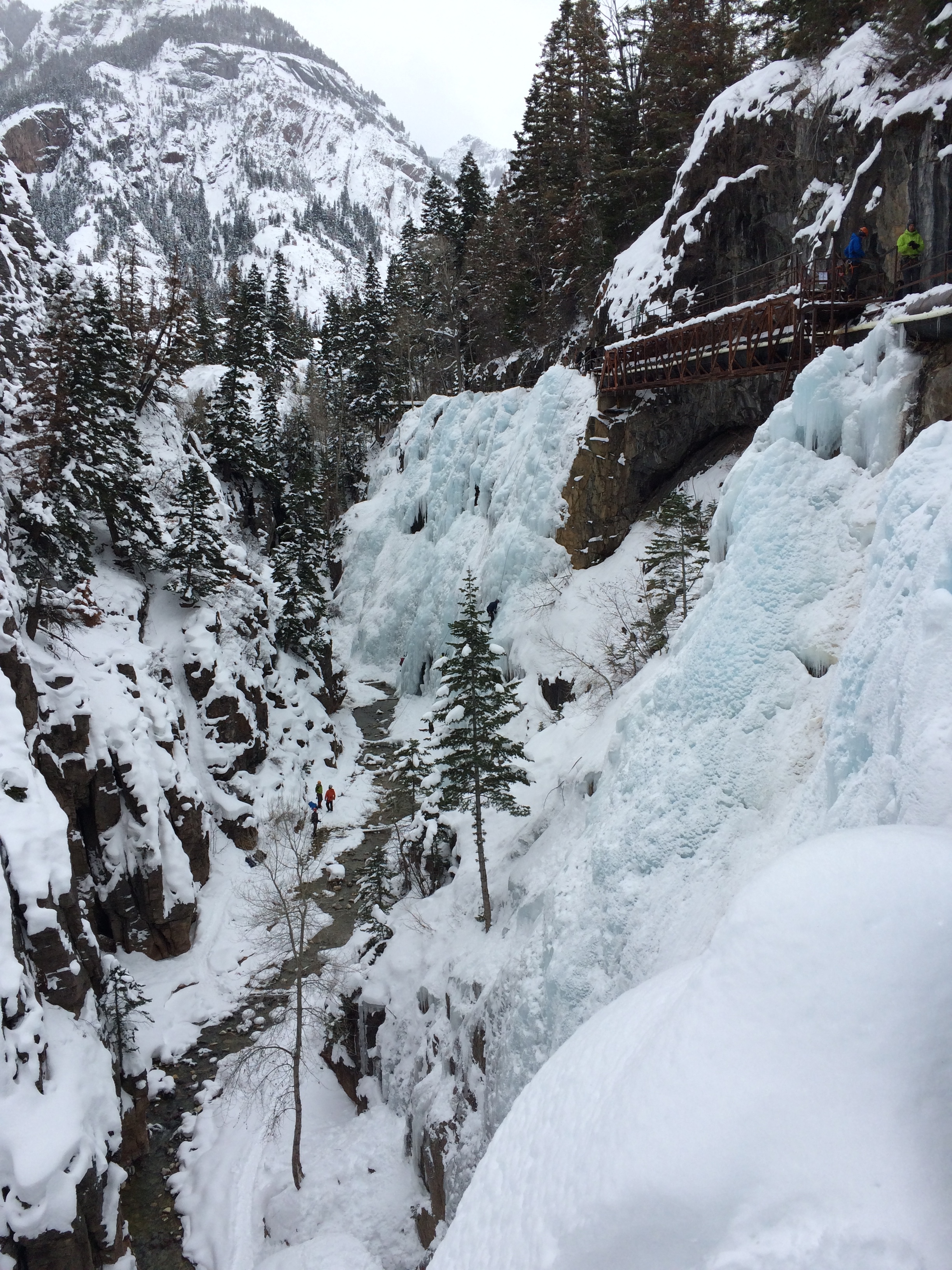
Unfortunately, weather delays meant that Lonnie (the visually impaired fellow I mentioned in Thursday’s post) did not make it to Ouray in time for Danika and myself to climb with him today. So we went climbing at the Ouray Ice Park together. I learned a lot from Danika, who still guides part-time; and we also fit in a lot of fun ice and mixed lines.

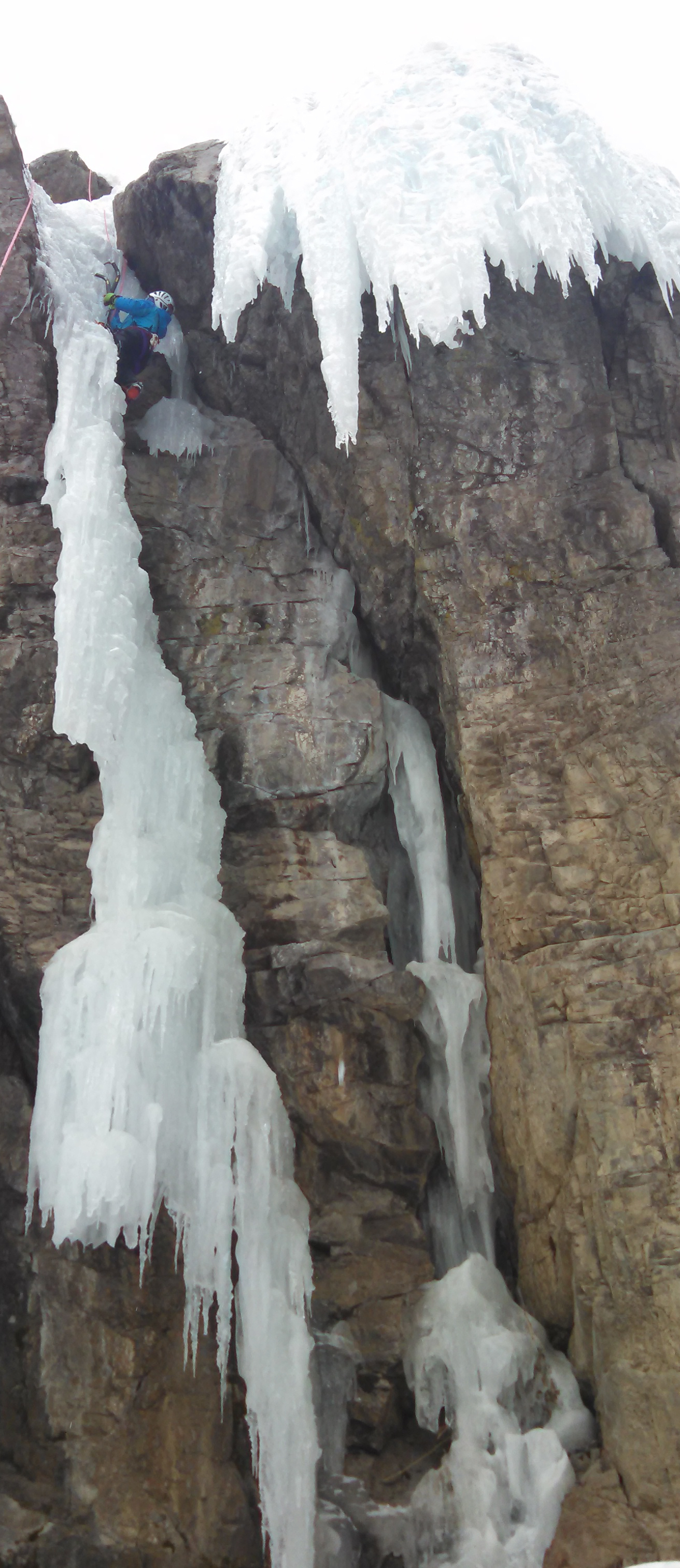
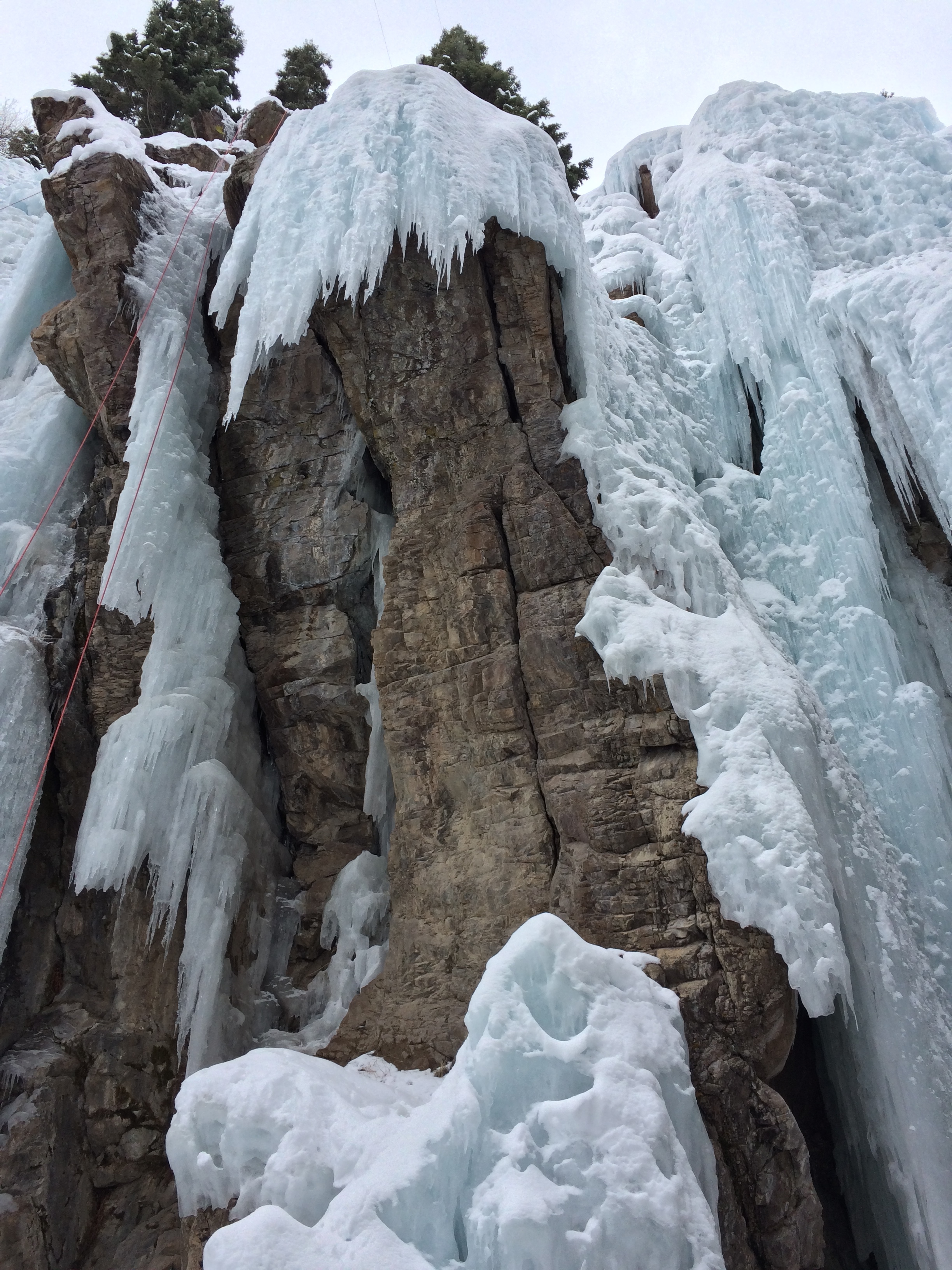
Ouray Ice Park: I love this place

Ouray Ice Park: I love this place

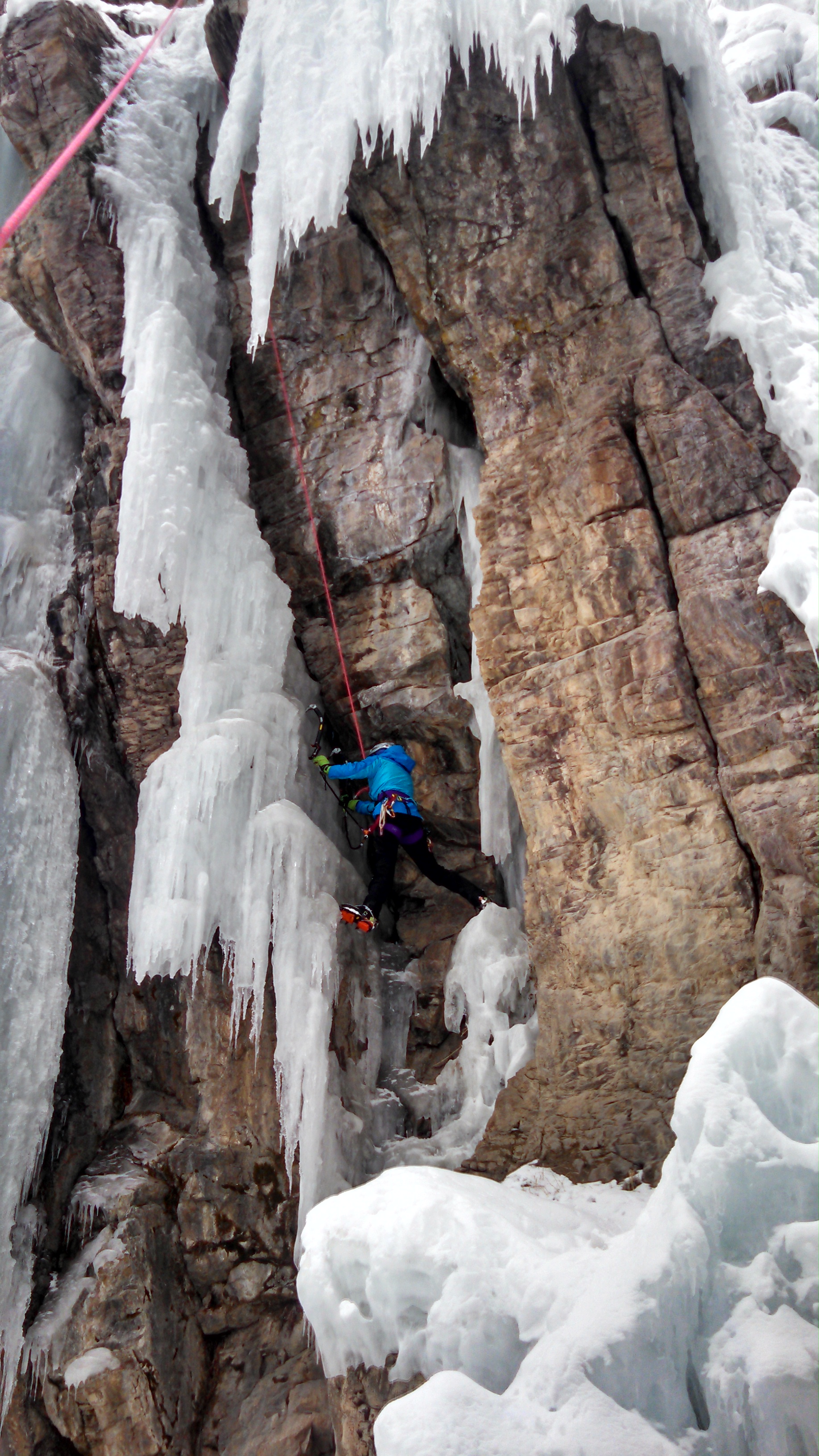
Climbing under/near this dangling formation

Climbing under/near this dangling formation

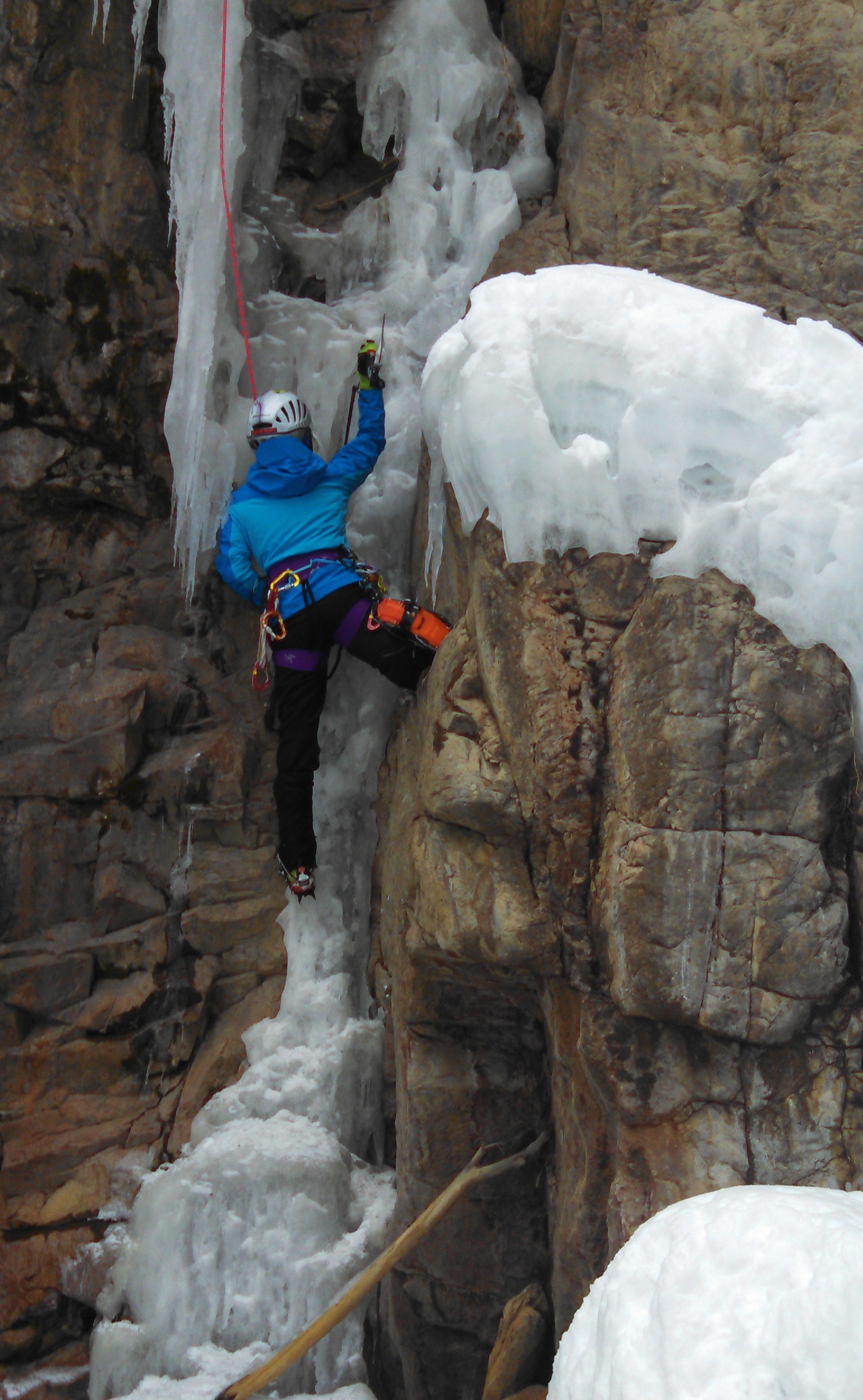
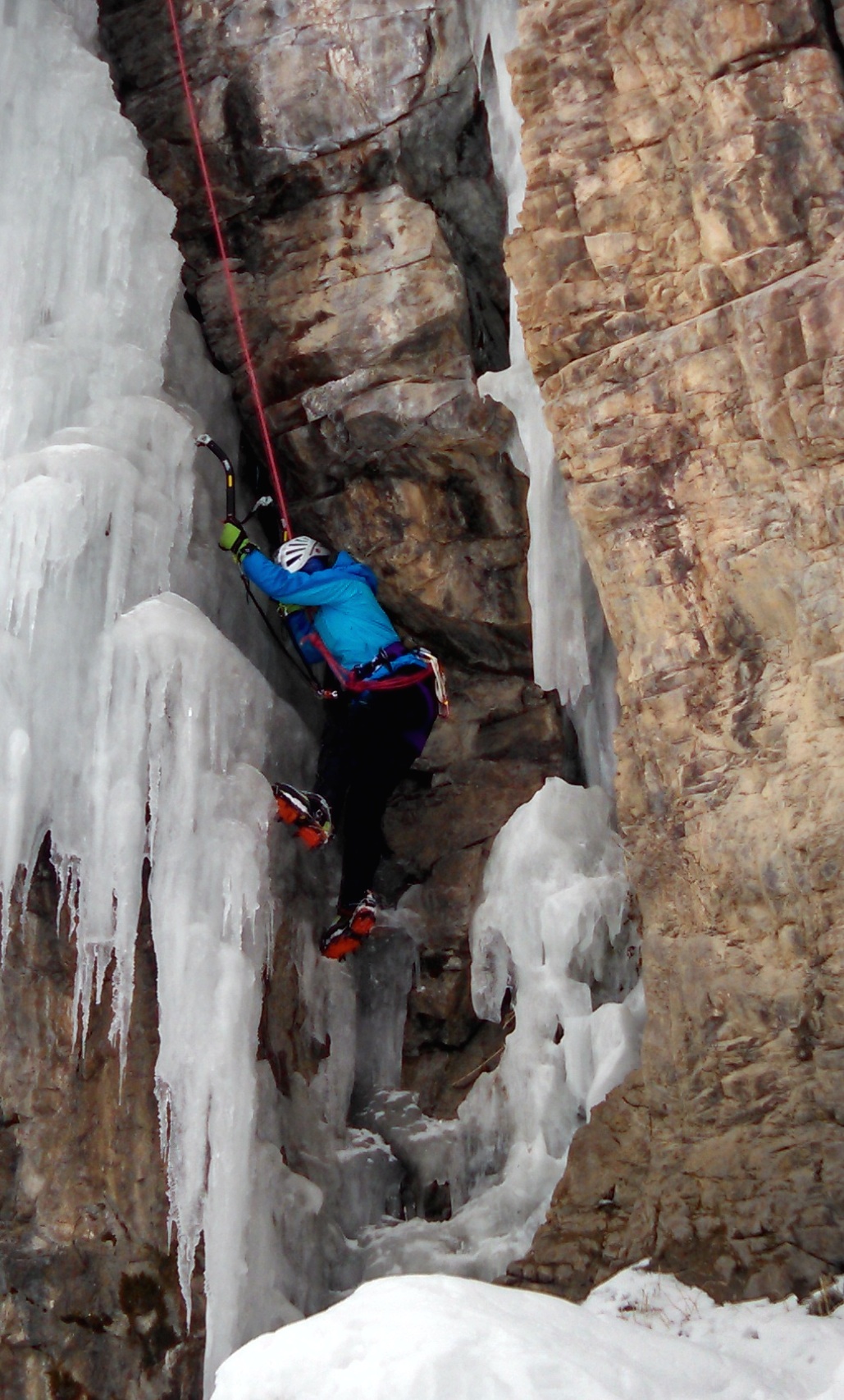
In particular, I learned some new ice-climbing techniques that help me a lot in getting my feet higher up and thus minimizing the number of swings I need to take. In particular, I am matching and crossing tools a lot more when traversing; stemming off ice with my hands; and choking up high on the tool and “daggering” it. I love climbing mixed-routes on top-rope because I can just play around without fear of falling. In the interest of time, we didn’t do any leading. I would like to do more of that this season, but it seems like I am spending my free time skiing.

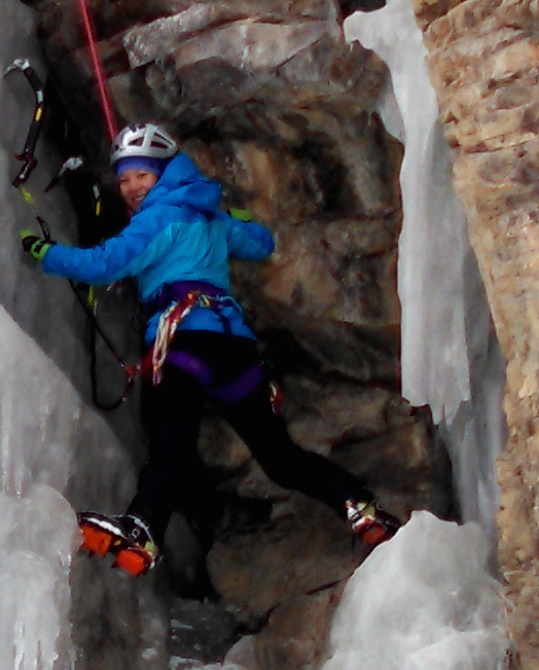
Starting off on a mixed route. You can see I can twist my right leg into many different positions.

Starting off on a mixed route. You can see I can twist my right leg into many different positions.

I often extend my left leg and lock it out.

I often extend my left leg and lock it out.

Stemming and exerting outward force on the left leg is hard for me

Stemming and exerting outward force on the left leg is hard for me


It's like a mother's womb

It’s like a mother’s womb


Topping out

Topping out


The line follows the inside corner, with the ice on the left and the rock on the right side

The line follows the inside corner, with the ice on the left and the rock on the right side

The Paradox Sports crew also arrived on Friday evening so I was able to say Hi to a few familiar faces, as well as meet some new ones.

My experience this year was very different to my previous two years as a participant. Danika kindly let me shadow her and help her with all the work the guides were doing. Each morning, we met early and walked into the Ouray Ice Park to set up all the belay and fixed lines, and all the rigging to lower participants without the mobility to walk or lower themselves into the gorge. It was an incredibly informative experience; learning more about rigging, really solid anchor building. At one point I yelled to a guy whose name I did not know, “Hey! Guy in the purple jacket!” to ask him if he could see whether the fixed line I had set up was touching the ground. The guy turned out to be Steve House! And Kitty Calhoun was also helping out, as well as so many experienced alpinists and ice-climbers. It was so great to be in their company, interact and learn from them. Rigging is very hard work, physically, and my body paid for all the lowering and hauling. As well as lowering people, we were also lowering things like propane tanks/canisters, a large canopy, camping chairs and other things to make things more comfortable for participants, especially for those who may have difficulty sensing temperature.

Down in the gorge, my role was also very different from the previous two years. Rather than being a rather passive participant who just waited to climb some routes, I was busy making myself useful: catching people/loads being lowered down, checking in on participants and offering ice-climbing instruction and tips, packing up, and belaying. On Sunday, I belayed a woman with limited use of her lower body up a route for literally two hours. It was tiring work because I had to keep her on a super tight belay, and she was heavy. It is always interesting to assess my feelings as I observe other handicapped people climb/be active. On the one hand, I was psyched for her, that she made it to the anchors. On the other hand, I thought, well, if you took better care of yourself, worked out, was lighter, stronger etc. you would be able to use your upper body more effectively, like I do. I sound like a bit of a dick, but it is sometimes difficult not to make comparisons between myself and someone with lower-body disabilities.

It is also interesting to note my feelings and interactions with people with disabilities that are very different to mine. For example, I interacted with a blind fellow, who had lost all his vision when an IED blew up near him while he was serving in Baghdad. I also spoke with a fellow who was missing most of his fingers and part of his hand, but also had severe burns on his face. I thought it was super cool that all he put down on his form to describe his physical deficits was, “Missing a few fingers”. I wonder how he views himself? Does he look at himself in the mirror? What does he see? I think he is incredibly brave to face a world where appearances are so important and judgments are made upon. I have also wondered whether my interactions change with people with different kinds of handicaps. Do I react differently to people with physical disfigurements? Or people with cognitive issues? And why? Is it due to unfamiliarity on my part?

At one point on Sunday, a volunteer (and part-time guide) remarked to me as I was belaying the heavier person for a long time, that it was quite inspiring to see these participants get on the ice and climb. I nodded in agreement, and also thought, Wow, he doesn’t know anything is wrong with me. As usual, I kept quiet about my own gimpiness. That tends to be my modus operandi: I only let people know if I feel like they need to know. For example, I will offer it as an explanation for why I am walking slowly on an approach, or if I am climbing, where I usually just say, I have a less than conventional climbing style because of a partly paralyzed leg.

Saturday night’s Fundraiser was also a memorial to Mark Miller, a local guide and big supporter and chief rigger of the Paradox event. I did not know Mark at all, having only run into him twice. Yet, I was quite emotional, crying as it was clear what a big part of the Ouray community he was, and what a loss this was to the town and his family. Many famous alpinists were present, including Steve House and Jim Donini.

I wish Ouray was not such a pain in the ass to get to; but I plan on offering my time and skills next year. I am keen to take a Rigging for Rescue course and learn a whole different skill set that will be useful if I want to guide informally in the coming years.

Telluride – Days 1 to 3 – Getting my three-tracking mojo

I was not anticipating skiing three days in a row, because I had not expected snow conditions to be that great, and I also did not expect to have the endurance or my back to hold up to all the bumps and impact. The journey to Montrose, CO (the closest airport to Ouray and Telluride) was a stressful one. The connection time in Chicago was extremely tight; I am much more aware of such things given that I cannot sprint from gate to gate anymore. Despite the delay in taking off from Boston, my connecting flight was also significantly delayed, so my baggage and myself made it on the plane just fine. Unfortunately, a storm had rolled into Montrose, reducing visibility to distances less than FAA regulations. After circling above Montrose for awhile, our flight was diverted to Grand Junction and after a period of uncertainty, we were finally bused down to Montrose as the snow was really coming down. Fortunately, I did not have to drive very far as I was spending the night with a dear friend who happens to live in Montrose now.

The next day (Monday) was spent shoveling and resting from the day of travel, as air-travel is very uncomfortable for my leg and back.

The storm had made for great conditions at Telluride, so I drove up early on Tuesday to connect with Telluride Adaptive Sports, who had kindly hooked me up with lift-tickets for Tuesday and Thursday. My original plan had been to just ski by myself. Although all my skiing pre-accident had been done out West and I was very familiar with these kinds of conditions, my experience skiing as a three-tracker had been on East Coast ice and hard-pack exclusively. Thus I thought it would behoove me to receive some instruction on what to do with my outriggers and skis in Western bumps and snow conditions.

Being able to not ski with a full-face balaclava, and take off your gloves without getting frost-bite, was a joy for me, given my poor experiences with the bitter cold in New England resorts.

I am really glad I signed up for the half-day lesson and had someone with a tremendous amount of experience offer me advice on how to ski in deeper powder. It turns out that my outriggers, which had been sized when I was still skiing down mostly groomed moderates, were far too long on steeper terrain/bumps. I saw a photo of myself with them and that really highlighted how inappropriate they were for me. For reference, my instructor is 6’3″, 6’5″ in skis and boots, and my outriggers fit him rather well. So that was a very useful piece of information.

Here I am figuring things out in deeper, softer snow (apologies for poor media quality):

You can see just how overly long my outriggers are. In spite of this, I was on bumpy black runs pretty soon after. I will be replacing my current outriggers with a shorter pair.

As I got into deeper snow, my left foot kept getting caught in the snow, causing my hips to rotate out and things quickly going to shit after that. One idea I have is to stick heavy-duty velcro on the inside of my ski pant legs, so that I can lock my legs together but pull them apart with enough force. Guess I’ll be vandalizing a pair of ski pants when I return home.

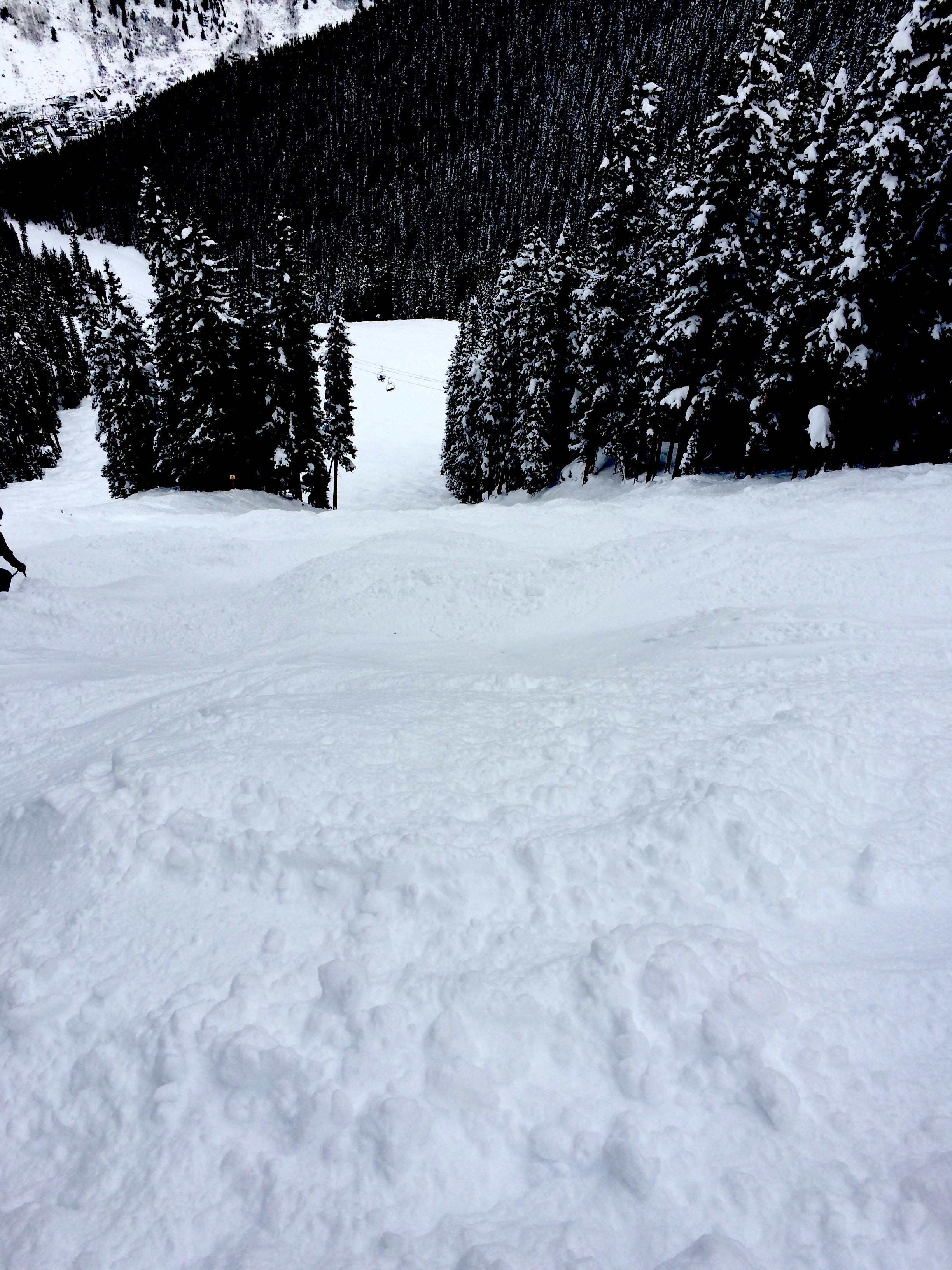
Bumps are getting higher, although in this run they are widely spaced apart

Bumps are getting higher, although in this run they are  fairly widely spaced apart

I learned a lot in a short period of time. In bumps/moguls, being super light on the uphill outrigger is key as is anticipating the turn, looking for where to place your downhill outrigger (not my ski), and facing down the fall line, obviously. As I tire, I tend to lean on the uphill outrigger more, which always ends poorly.

I was pretty gassed by the end of the day, as I had skied a bunch on my own in the morning, and had my three hour lesson in the afternoon. But I had learned so much from Mike, my instructor, that I wanted to take another half-day lesson with him the next day. Tuesday night was spent eating a lot to compensate for my lack of calories during the day, inhaling a lot of Aleve, and just trying to recover for the next day.

Wednesday was a skiing highlight for me. I got down my first legit (legit in that it was long, steep, thigh/hip high bumps) double-black run as a three-tracker, while my legs were still fairly fresh, and bombed down a steep, but groomed, double-black run…all in fairly good style, I think. At one point, a group of German-speakers asked me “What is this??” That was amusing. I received quite a few compliments from them and other folks, which was nice for the ego.

First legitimate double-black run on one leg.

This double-black run will always have a place in my heart

Again, I thought I would not ski the next day given how tired I was. But, when I woke up on Thursday and saw the new snow and clear skies, I thought I could not miss these conditions that are not found on the East Coast.

My legs were not fresh as they were yesterday, but we still got a fair bit of mileage in on steep, bumpy, un-groomed black and double-black runs. The difference in gear requirements is quite apparent between the East and West. While I had gotten a very stiff boot to deal with East Coast hard-pack, and thinking that I had to be totally locked down in my boots because I was only on one ski, I need to soften things up and play around with the flex in my boot for Western conditions. Having a wider and softer ski will help too. There are also attachments you can add to your outriggers to give them more floatation in powder:

IMG_0740IMG_0741

I was fortunate to have the company of Danika, a woman I had not known well before this trip, but had invited me to stay with her, after we had connected at last year’s Paradox Ouray event. My original reason for arriving earlier than the start of this year’s Paradox Ouray weekend, was to help Danika give ice-climbing instruction to a group of veterans from Alaska. The group did not end up coming; thus we had time to ski. It’s funny…I would never say my accident was a blessing, and I wished it had never happened. But, it did open up many wonderful people to me that I would never have met – Danika is one such person.

I am really looking forward to helping Danika guide a blind-climber tomorrow. I am sure I will be saying all sorts of cringe-worthy things to this fellow. For example, it came up that Danika had never met him in person and only chatted over the phone. I asked, Oh, have you guys Skyped? Face-palm. I recall doing something similar with a quadriplegic woman. We met and my first instinct, which I followed, was to extend my hand out in introduction. And then I immediately thought, Oh God Wendy, you’re a fuckin’ idiot.


Different, not inferior

I apologize for not blogging very much lately. Things were pretty hectic between dealing with the joys of too much snow and on-street parking in an urban area, medical appointments and physical therapy, and taking care of work and administrative stuff before a skiing and ice-climbing trip to Colorado.

New England weather is highly unpredictable. Predictions of a few inches of snow on Thursday night, followed by a powder day on Saturday made us decide to take a snow-day and rush up to Jay Peak, VT for skiing on Friday and Saturday morning, before rushing back down to have a Chinese New Year meal with my family Saturday evening. And then rushing to pack for my Sunday morning departure to Colorado. It is ironic how having fun, or at least planning for it, can be rather stressful.

Thursday turned out to be a comically bad day, weather-wise. Winds were blowing so hard that all the chair-lifts and tram at Jay were closed, with the exception of a small beginner lift at the base. The thermometer read -20 degF, making it feel more like -40 degF with the windchill factor. We took our time getting to the mountain, waiting to see if winds would die down and if more lifts were to open. Finally we said, let’s go do something. We hopped on the very slow moving beginner lift (not ideal in such cold temperatures), and did a few beginner runs on my new ski, boot and binding; before having to go inside and warm up. And then doing the same thing over again. It was pretty silly, but Scott and I had an enjoyable time nonetheless, and it gave me the opportunity to dial in my new gear. We dipped into some mini-glades, and I found these challenging – negotiating the bumps on one leg and keeping my outriggers out of the way of trees. It was a good data point to acquire: outriggers take up a lot more space than using ski poles.

It was pretty comical (and painful) to see just how stiff my ski boot is, given how much I weigh. The combination of stiffness and very cold temperatures made for a ski boot that took a lot of effort to get into. It made me think of how foot-binding would feel. I need to make sure to have someone with a defibrillator next to me in case I keel over from that exertion.

Friday was significantly better. While we did not get the overnight dump that was predicted, almost all the lifts were open. Temperatures were warmer than Thursday, although still very cold in the single digits before wind-chill. We got on first tram, my first tram-ride post-accident. Disembarking from a swinging tram was not trivial for me. I decided to time my exit as the tram was swinging to the left.

Given how wind-swept and icy things were, we decided to start off on blue cruisers. These were a blast. I found myself overtaking a lot of folks, even on the flatter sections, which I find hard to believe since I am on one less ski than them. As we rode up a lift, we talked about doing a very icy black run off of the lift. It was not so much the pitch that was intimidating, but how windswept and icy conditions were. Scott told me how one guy had died on that run not long ago. He fell, lost all his gear, seemed to knock his head back and continued to slide uncontrollably, picking up a tremendous amount of speed; until he came to a dead (yes, deliberate choice of word) stop at a tree. That was a bit sobering, but I wanted to give the run a go nonetheless.

High winds buffeted me as I tried to pole my way to the top of the headwall. This was looking like an increasingly poor idea, but there wasn’t really anyway out of this, so down I went. I now know that I have to link at least two turns together on icy slopes like this, so that my left (free) foot is on the uphill side. The top third of the slope was pretty crappy; I was a bit nervous about just going for it, worried that I might lose control and slide a really long way. Then, for the last steep portion, I just bombed it and got through it fine. Again, another data point: really icy slopes are a lot harder on one edge, but I just need to power through ice and not stop.

We had to call it a day before noon so that we could drive back in time to have a Chinese New Year dinner with my family. Although things had not gone as planned i.e. all but one kiddy lift was open on Friday and we did not get the powder day forecasted on Saturday, it was a really wonderful couple of days for a few very concrete reasons:

  1. I have found that I am getting better at letting go of being “disabled”, and was able to take total pleasure in doing the same activity that I did before my accident, in a totally different way; as opposed to being resentful that circumstances have forced me to do things differently. Different, not inferior. I have to admit, it feels pretty good to begin to rip on one ski, and attract attention for doing something well, despite physical limitations.
  1. On Friday, while we were warming up by the fire in the lodge, preparing to head out into the freezing cold again, a man remarked “Are you skiing like that for the thrill of it?” as he pointed to my one ski boot and one Sorel on my other foot. I was somewhat pleased that he had noticed, and had the chutzpah to inquire, rather than wonder silently. I was able to tell him that I had been in a bad climbing accident that left me with paralysis in my left leg, and that I ski like this because I have to. And I did this all with a smile, laughing a little. It was quite liberating, actually…not feeling so self-conscious as I carry my outriggers and one ski, or take steps up to a tram one at a time. That isn’t too say all self-consciousness has disappeared. There are still times I am standing under a lift, on an advanced run I would have just cruised down like a green, thinking, man, all these people on the lift must be wondering, Why on earth is she going down slowly, or Has she lost a ski? But, then again, Scott reminds me, you always apologize for being slow and slowing others down, yet you’re just bombing by the majority of folks.

I am sure my self-consciousness stems from a background where sporting and academic accomplishments came very easily, and in many ways, praise was offered for picking something up very quickly, as opposed to working assiduously towards a goal. It is only in recent years that I have come to learn and appreciate that there is no end-state called perfection, only the process under current constraints.

I wonder whether it took my accident to inculcate this into me, or whether the arrow of time would have led me to this realization in due course. There is no doubt, however, that my accident made me “grow old”, fast. While the toll was very high indeed, I think taking the viewpoint that I can only do my best, and work as hard as my physical and mental constraints allow (the farthest boundaries of which are still undetermined), allows me to be content, even proud, of what I have done and am doing, rather than comparing myself against the highest levels of excellence of folks with, say, completely functional body parts. I know people have different interests, and not every one is into athletic pursuits. But I can’t help but feel sad, even angry, when people who are totally able-bodied, do not celebrate their full physicality, or those who actively do a disservice to their bodies and not take care of it.

Mini skiing milestone(s)

Scott and I had made plans to go skiing this past Saturday as we had received a fair bit of snow during the week, and it was the least cold (high single digits Fahrenheit as opposed to low single digit temperatures) of the two weekend days. I was psyched to get more practice in and share it with a partner who is just so psyched about my progress. Scott was not feeling well on Friday night and warned me that he might not be up for skiing with me on Saturday. I spent Friday night mulling over whether to head up on my own or not. Now, in my youth, I did the majority of my skiing alone. I was much more of a loner than I am now (most people find that hard to believe, given how insular I can be) and thought nothing of driving 4+ hours each way to either a ski resort for some lift accessible boot-packing or some backcountry area (although I tried not to ski by myself too often in the backcountry, especially when avy danger was not low). But I had some hesitations this time round, because it would be my first time skiing without New England Disabled Sport (NEDS) or Scott, having to get on/off chairlifts by myself with a full chair load of people who probably aren’t used to seeing my one ski/outriggers setup, and managing to carry all my gear by myself up and down steps etc. Scott confirmed that he was not in shape to go up with me on Saturday morning and since me staying around wasn’t going to accelerate his recovery and I wanted to ski, I thought, fuck it, I should do this.

The drive up in the dark, quiet and cold reminded me of the countless early morning solitary drives up to Tahoe that I would do. It felt good in a way, perhaps because I felt a continued return to my “normal”. Because I was not renting via NEDS, I needed to rent my own gear. I arrived at a well-regarded ski shop in Lincoln, NH and told them what I was looking for: demo/high-performance ski and boot, boot size mondo-point 23.5, ski about 154cm long, 88mm underfoot, stiff and tip-rocker. With the ski, they delivered. When they walked out with the ski boots, I basically said, Are you shitting me? I had been presented with a two buckle ski boot with a flex index of 60 (for reference, a flex index of around 85-100 is considered “expert” and the new ski boots I ordered are of flex 90). I may be on the smaller side, but my feet are not kid sized and, WTF, small women rip it up too! I was not impressed with the initial attitude of, well, that’s all we’ve got so deal with it. Another employee stepped in and worked with me to find a solution with a size 24.5 boot (which they did have a stiff, four buckle versions of), by putting in a foot bed inside the boot liner and another foot bed between the liner and shell. He understood that because I was only skiing on one boot that it was important I wear a stiff boot. Also, at my request, the DIN setting on the bindings was cranked up from the recommended 6 (for a person of my weight, height and skier level (advanced)) to 9, because retrieving a popped off ski isn’t all that easy for me these days.

I thought that I should try out my “new” ski on a green run – big mistake. It was sluggish and I thought, oh my goodness, what is wrong with me, why am I not able to ski today? It was only when I moved to steeper blues and blacks that the much longer and beefier ski really shone. I managed to get on/off lifts without any incident. And I got pretty comfortable on icy black runs. I was surprised that not a single person asked me about my less than conventional setup while we were riding lifts. I wonder if it was out of fear of prying. I did receive a few compliments from folks as I was skiing down runs and pausing (to rest); two people asked if I was skiing on one ski because I had to or for fun. All in all, it was a successful day of skiing and I felt good that I was building up mileage on more advance terrain. I might need to start doing one-legged pistol squats to build up the strength and stamina in my right leg even more, but not neglecting my left leg because I still need to be able to keep it off the snow.

I’m not sure what I hate more: not being able to do certain physical things anymore, or the high cost of being physical and active. I found that after not even a full day of skiing on hard-pack and some bumps, I was in a lot of pain for the rest of the day and entire night (low back and neuropathy/spasms in my left leg), which prevented sleep. But what is the alternative, sitting on my arse all day? That would hurt too.

I just had a conversation with an old skiing partner, and it was the first time in, oh, half a decade, where we could shoot the shit and talk about gear again without me feeling sad. Same deal with the stack of SKI magazines Scott brought home. It took me a few years before I could read anything climbing related, and even longer to read anything related to skiing. A sign of continued healing, I guess.

Smuggs Ice Fest and Thermal Management

Despite my usual anxieties about these group events, I drove up to Jeffersonville, VT (a bit outside Burlington, VT) for the annual Smuggs Ice Fest, held at Smugglers Notch. I wanted to check out a different ice climbing area, conditions for ice climbing seemed good (it had been very cold in the run up to the Fest), the conditions for skiing were not good this weekend, and I just wanted to get more ice-climbing practice in. As usual, I was very anxious about holding other people in the group back on the non-trivial uphill approaches on un-maintained roads. I contacted the organizers to tell them about my physical circumstances and after deciding that I would be able to manage the approach to the climbs (if it didn’t snow a ton), I decided to go for it. I signed up for a mixed-climbing clinic on Saturday and a personal guide on Sunday because all the clinics I was interested in were filled up.

The approach to Saturday’s climbing area was challenging for me. Even though the incline was not steep, it was sustained and long enough to tire my leg(s) and back when carrying a pack. I was at the rear end of the group, as I expected. I still have a really hard time accepting/dealing with being the slowest one on approaches/descents, since I had always been one of the people at the head of these group hikes/backpacking trips. But, I found that my fears about holding the group back evaporated once I got on vertical terrain. I think I was one of the strongest climbers on the wall. I really enjoyed learning more about mixed climbing and the menu of options/moves that I am just not familiar with. I found that my  core and lock-off strength was very useful. It is a bit more like rock climbing in that the core and precise foot placements are important. Having mono-points on my crampons helped there. It also helped that Saturday’s temperatures were very temperate, ranging from the 20’s to low 30’s (Farenheit).

Sunday was a totally different story. Temperatures were in the low single digits (Farenheit), with wind-chills bringing perceived temperature into the negative range, and the temperatures only dropped (and wind picked up) as the day progressed. The climbing area for Sunday was also farther than Saturday’s, and I was very very slow plodding uphill. My gait degrades significantly when I am wearing heavy boots, so the combination of those, fresh snow, carrying a heavier pack with more clothing and gear (pro) made it a pretty miserable experience for me. I got on some steep W5 pillars, but soon lost feeling of my hands and just couldn’t place my tools properly. I completely shut down when I am freezing cold, and I was miserable to the point of tears. One challenge with staying warm is that because I am worried about having a bowel/bladder accident, I do not drink or eat much when I am climbing outside to try and boost my metabolism. This is especially important when ice-climbing; continually sipping a hot drink is so effective, yet I am/was so worried about peeing in my pants that I only took little sips of the hot chocolate in my thermos, and that was not enough to keep me from becoming cold enough to the point of being non-functional. It bums me out that I might only be a fair-weathered ice-climber, and that some options may be eliminated for me because of my plumbing defects. But I am trying not to be too discouraged and find encouragement in knowing that being pushed out of your comfort zone is, generally, a good thing (I think).

Wabi-sabi

I recently came across the Japanese concept of Wabi-sabi: “Wabi-sabi is the Japanese idea of embracing the imperfect, of celebrating the worn, the cracked, the patinaed, both as a decorative concept and a spiritual one — it’s an acceptance of the toll that life takes on us all.” (Source here). I like it.

For a long time, I saw myself as this completely damaged person. I thought, who would want to be with someone as broken, physically and, to some extent, mentally, as I am?? It is only in the last year or so, that I’ve finally come to appreciate the burnishing I have, and how this makes me beautiful, rather than disfigures me. I used to be very self-conscious about the long, big scars on my back and hips, especially when I was wearing a swim-suit. Now, I almost take pride in my battle-scars – I have certainly earned them. It is funny when someone will describe a scar of theirs they think is super-gnarly. I just nod and silently think, I’ve got you beat on that one.

My partner used the word “patina” very early on in our relationship; and patina is, well, beautiful. He said, before your accident you were just another pretty, smart, athletic climber chick; but having come through your accident the way you have, makes you remarkable. He says he wishes I could see myself the way he and others see me. Self-perception versus truth has always been something I’ve struggled with, and I know many people do too. I am working on getting better at seeing myself in a more objective light.

Old photos post-accident

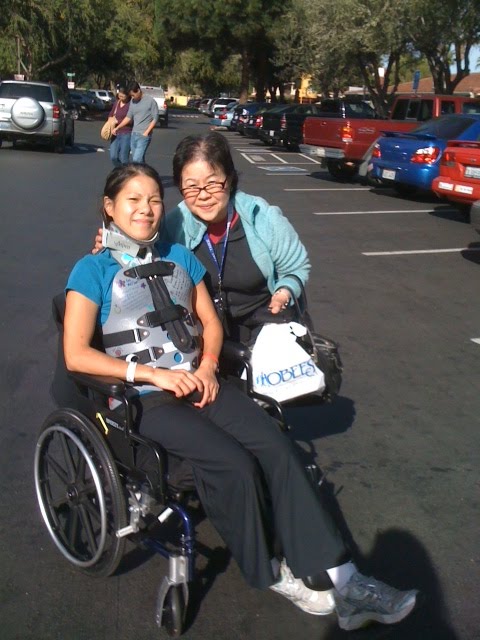
I made the conscious decision not to document myself right after my accident, because I felt like this was a part of my life I would never want to look back on and recall. I regret this decision because it would have been documentation of just how far I have come. So, I only have a few pictures. I found these two, which was my first excursion out of the hospital (acute in-patient rehab), just for lunch. It is funny how looking back, it is still very fresh how this was a really big fuckin’ deal. It took a lot of OT and PT to prepare myself to even handle leaving the confines of a hospital, and all the worries about having and handling a bowel/bladder accident. But the challenge was also largely emotional and mental, where I had to face my deep worries of anticipated self-consciousness and being in a public place where people could see me in this state. I am thankful to have my dear friend, Jen Sager, be there with me, and my mother.

You can see that I got friends to sign my turtle-suit. Eating with the full cervical neck brace was not easy either. I remember being so happy when that thing came off. It was like, wow, I have a neck!

I wore baggy sweatpants exclusively for many months because, with my paralyzed leg, I could not dress myself with any pants that were in the slightest bit form-fitting. Putting on my first pair of jeans quite a few months afterwards felt like such a triumph.


wheelchair

Smiling in this photo, but crying inside.

wheelchair2

Looking noticeably more pissed off with my Mum. She drove me bonkers (and still does) but I still love her.

First Post

(This is a repeat of what is posted under “My Story”, but it gives you some context to my blog).

In October 2010, while sport-climbing at Owens River Gorge near Bishop, CA, I was dropped and fell 140 ft, smashing to the ground. The result was a T-10 incomplete Spinal Cord Injury, shattered pelvis, sacrum, exploded L-vertebrae, a paralyzed left-leg and a lifetime of chronic pain and impaired bowel/bladder function.

Details about my accident can be found here.

Aside from the vertebral fractures and Spinal Cord damage, my L2 vertebra exploded upon impact, my pelvis broke in multiple places and my sacrum was reduced to a collection of pebbles. The process of piecing back together humpty-dumpty was a long, arduous and very painful one.

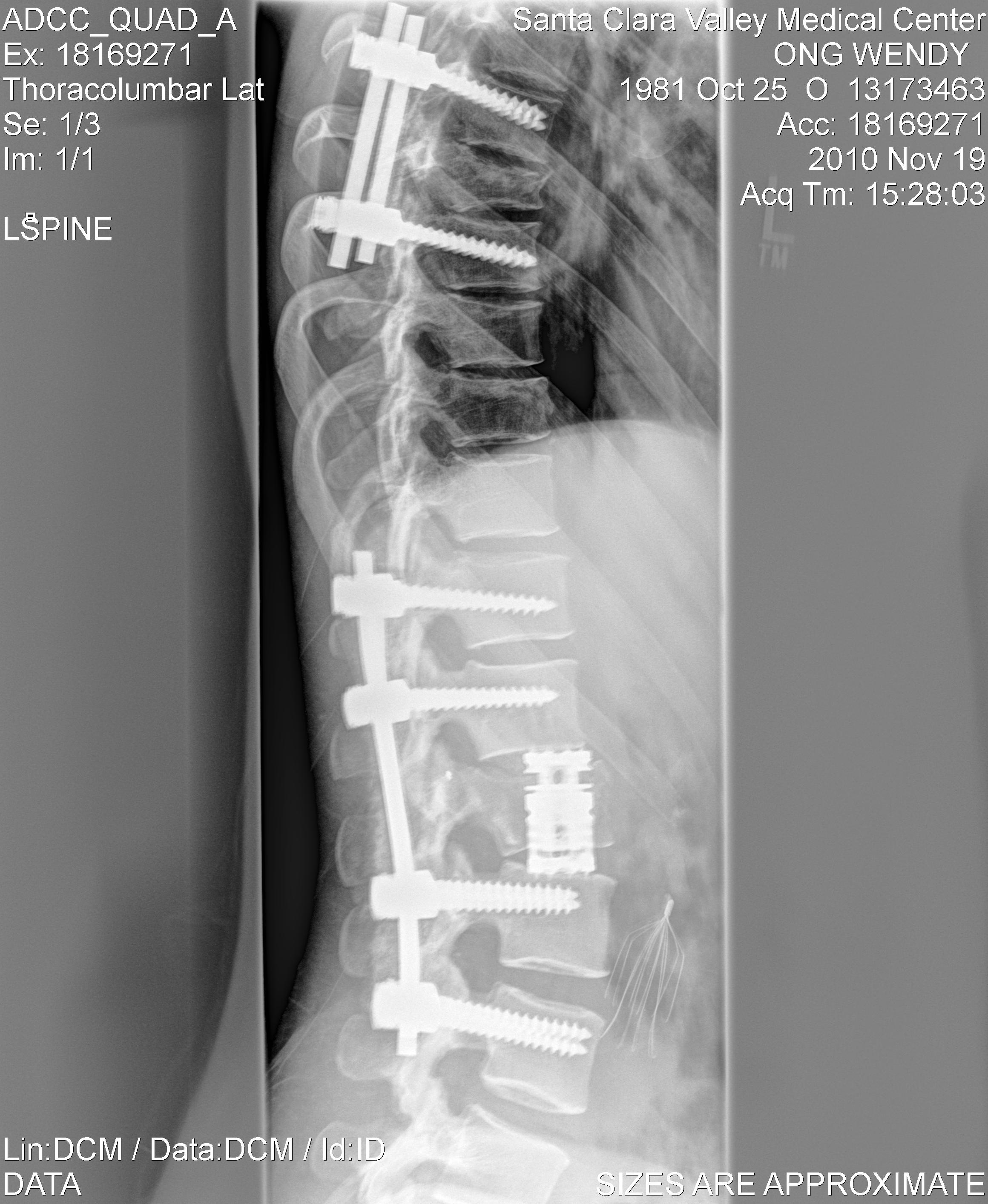
thoracolumbar LAT

You can see I am fused between T12 and L4, with a cage in place of my L2 verebra. I am also fused between T6-T8.

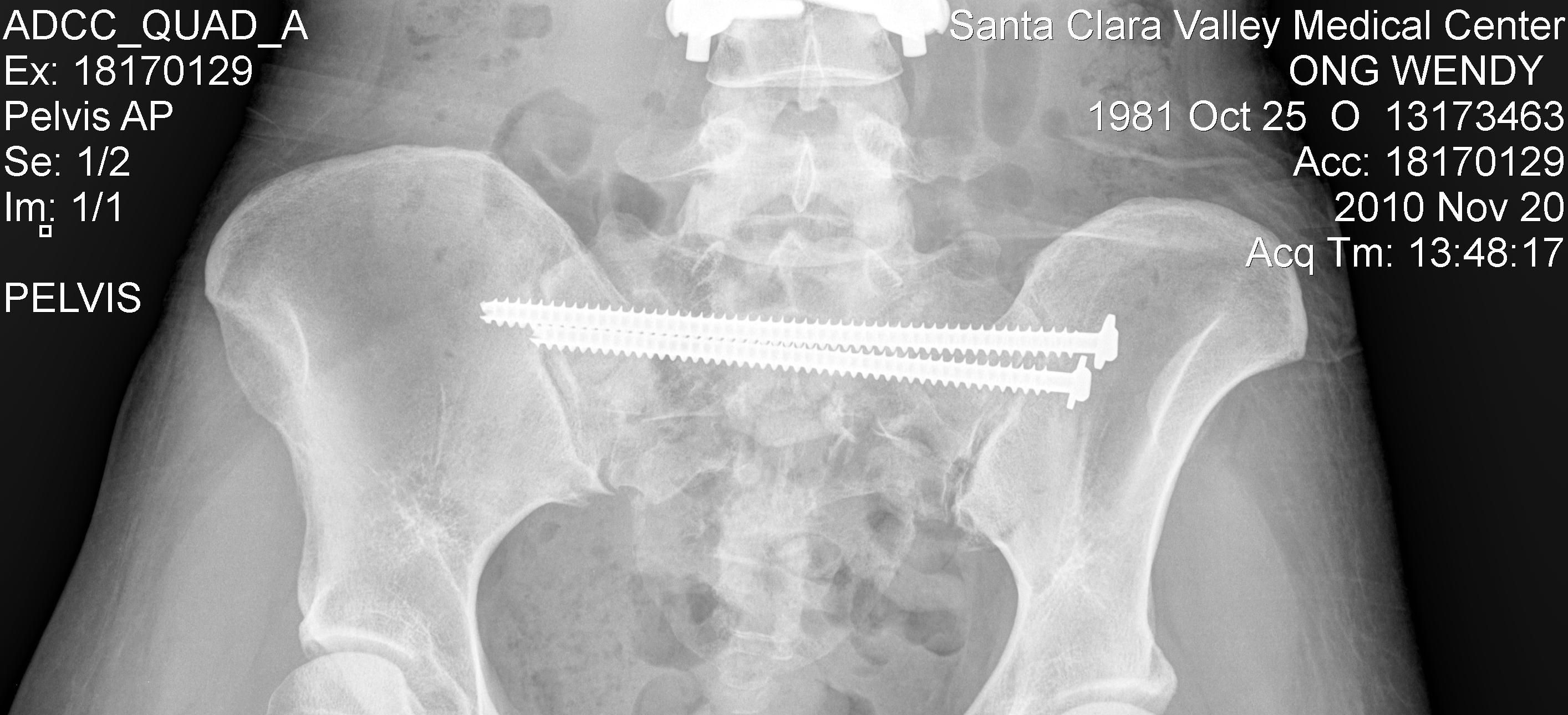
pelvis-AP-cropped

Two fat 15cm surgical steel rods are holding my pelvis together. Pretty hot, eh.

This accident changed my life completely. My identity as a physically strong climber, skier, tennis player, triathlete, cyclist, all-round athlete and mountain woman was ripped away from me. I had been blessed with athletic and other talents, and was used to many things (especially athletic endeavours) coming easily to me. Being strong, capable and independent had always been important things to me from a very young age; and now, I relied on others to help dress me, feed me, bathe me, help me go to the bathroom, and so forth. Being “weak” and dependent was not a position I was used to being in. Even when I did get out of the hospital, and then acute in-patient rehab, and started to learn to be more self-sufficient, I saw no possibility of future happiness. I saw no future where I could not be active. I thought I would never have a romantic relationship or sex because I thought, who would want to be with someone who couldn’t go running with them? Who would want to be with someone so fuckin’ broken. My outlook seemed to bleak that I was driven to trying to kill myself in January 2011, resulting in my one (and only) experience sitting in the back of a police car and an involuntary psychiatric hold over the weekend.

Somehow, I pulled myself up from rock bottom. I put as much effort into maximizing my physical recovery, or at least, the extent that my irreversible injuries would allow. I engaged in multiple rounds of physical therapy, treating it like a full-time job. I returned to work; but soon after, decided that I wanted something good to come out of what was otherwise a horrible thing. I thought I would not be very mobile again, that I would not be able to derive fulfillment from my recreational and athletic pursuits, so my work had to be all-consuming and my life’s work. Naturally, medicine fit the bill rather nicely, especially given my first-hand experiences in the hospital and with rehabilitation. I quit my job, volunteered in Guatemala (I documented my experiences here), moved to Cambridge, Massachusetts to embark on a pre-medical post-bac program, with my eyes firmly set on becoming a doctor.

Sometime in early 2013, I started to climb again, first on ice (because I thought that since I had not climbed on ice even before my accident, it would be easier, mentally and emotionally, for me to not hold myself to a certain standard), in North Conway, NH, then Ouray, CO; then I decided I needed to just go fling myself against rock to see if I could even climb at all; joining a climbing gym came last :) The last part actually has a lot to do with me taking a long time to overcome the self-consciousness I expected to feel, not being able to climb as well as I did before, and feeling self-conscious about climbing in a totally different manner to able-bodied folks.

As I climbed more and got stronger, I realized that I could still derive and enormous amount of satisfaction from my athletic pursuits, and the opportunity cost of studying to be a doctor – time-wise, financially, and vis-a-vis relationships, was just too high. I completed the post-bac program but then devoted the rest of the Spring and Summer to training for Paraclimbing competitions.

My older blogs capture my thoughts at particular stages of my life, all highly relevant and worth remembering. I started this blog because I felt that I had moved to a new epoch in my life, one where I felt strong, capable and comfortable in my own skin. Of course there is still much self-doubt and uncertainty – my accident didn’t change some things about me – but self-doubt and confidence are not mutually exclusive things. I hope to share my upcoming musings, stories, and adventures with you all.