Early August update

Apologies for the lack of writing. Right after Paraclimbing Nationals in Atlanta, I had to fly right back out to Denver, Colorado for a work-related trip to the National Renewable Energy Laboratory in Golden, Colorado. I was not pleased with all the flying, as sitting down for extended periods of time is painful for my back and exacerbates the neuropathy in my left-leg. Between my partner and myself, we had shuttled ourselves back and forth from the airport far too many times, and I quipped that this was like Groundhog Day, except far less entertaining.

While the training at NREL was long and tiring, I managed to fit in one day of climbing outside in Vedauwoo, WY! The place reminds me a lot of Joshua Tree, in terms of the jumbles of rocks, the abrasiveness of the rock, and the length of climbs. I came back as one big scab. While I may never regain my title of the off-width wizard, I am looking forward to getting more into the wide again. I do not think I will be able to do off-widths that are left side in though :-/

The formation Nautilus.

The formation Nautilus.

Forgot to wear my thrutching pants :(

Forgot to wear my thrutching pants :(

Trashed hand #1

Trashed hand #1

Trashed hand #2

Trashed hand #2

This past Saturday, I took a friend to North Conway to show her the ways of the crack-climbing warrior. She is not an experienced crack (or even outdoor) climber at all, so I did all the leading. It was actually a very good learning experience for me and gave me experience as to what guiding might be like. In fact, as I was belaying her up from the top of the first pitch of the day, a guide who was on that same ledge asked me “Are you guiding?” I was very pleased that 1) I didn’t look so gimpy as to preclude the possibility of me being a guide; and 2) My anchors and belay setup were guide-worthy :) It was hard work though, physically. There was a fair bit of hoisting my friend up and even though she is about the same weight as me, it was still very tiring.

The weekend was capped with a fantastically simple and delicious meal of pasta fagioli, using the sweetest tomatoes I have ever had and fresh cranberry beans. All the ingredients were grown at a nearby place called Wilson Farms.  Talk about eating/buying local!

Summer's bounty!

Summer’s bounty!

Transformed into pasta fagioli, accompanied with mozz, confit tomatoes, and a barbaresco.
Transformed into pasta fagioli, accompanied with mozz, confit tomatoes, and a barbaresco.

Why comp climb?

My win at the 2015 Paraclimbing Nationals was surprisingly anticlimactic. Not winning would have felt worse, but I was still surprised by how much of a post-win comedown I felt. My partner says this is natural and that his approach is to move onto the next milestone. I argued this makes life seem like one endless stretch of toil; he replied that his strategy was not necessarily the healthiest one.

I have expressed my ambivalence before about these competitions; I definitely struggle with why I choose to compete in the comps. Is it because I am “good enough” to place well and therefore feel like I should do it? Does competing bring my story to more people’s attention and therefore increase the potential impact my story/journey might have on other people? I struggle with the term “adaptive” and the negative connotations it holds for me, because I while I climb differently to “normal” folks, I don’t climb in an inferior way. I don’t climb well for a disabled person; I climb well period.

Part of it stems from my slightly negative opinion of competition climbing in general, but these are my personal biases. While I feel like sport climbing indoors is a great way to train and get strong, I think there is/can be narcissism involved when one decides to be a competitor. But there is ego involved in both sides, even choosing not to compete. Of course, some people use these competitions as a reason to train. I think I am “guilty” of both reasons. The relatively small field of competitors means that the number of categories and discretization of disability/ability is very coarse. At last year’s World Championships, the “Physical Disability” category I was in was split into two groups, and even then, the line was very blurry between the two. I was right on the border and ended up in the more “able” category, even though arguably, there were competitors in the second category that had more (climbing) function than me. At Nationals, it was just one category.

Climbing is also a deeply personal thing for me. I love sharing the company of a close friend/climbing partner but also being high up on a route, alone and being the master of my thoughts and experience. I don’t like cragging and large groups of people so much  because I think that being all social can lead to unsafe situations and inattention, and also because I am quite introverted. Competition climbing is the exact opposite of long-route climbing outside. You are suddenly thrust into the spotlight, all eyes on you as you “perform”.

Some people do these competitions because they feel a camaraderie and kinship with the community. While I have met a few people I respect and like a lot, I do not have that kind of relationship with most folks. I think it is because my heart lies outside and spend more time there, whereas the vast majority of folks in the adaptive climbing community do not lead and climb indoors exclusively, out of necessity, accessibility issues or because they just don’t want to – which is totally fine! But yet another reason why I don’t connect with many people there.

I have a good while to decide whether to take part in 2016 Paraclimbing Nationals, which will serve as a qualifier for the 2016 World Championship which will be held in Paris – a rather nice place to visit in the Fall. I think it will come down to how much I feel competition climbing deviates from my true self and my reasons for climbing. And maybe competing might allow me to develop new skills, such as performing under pressure with all eyes on me.

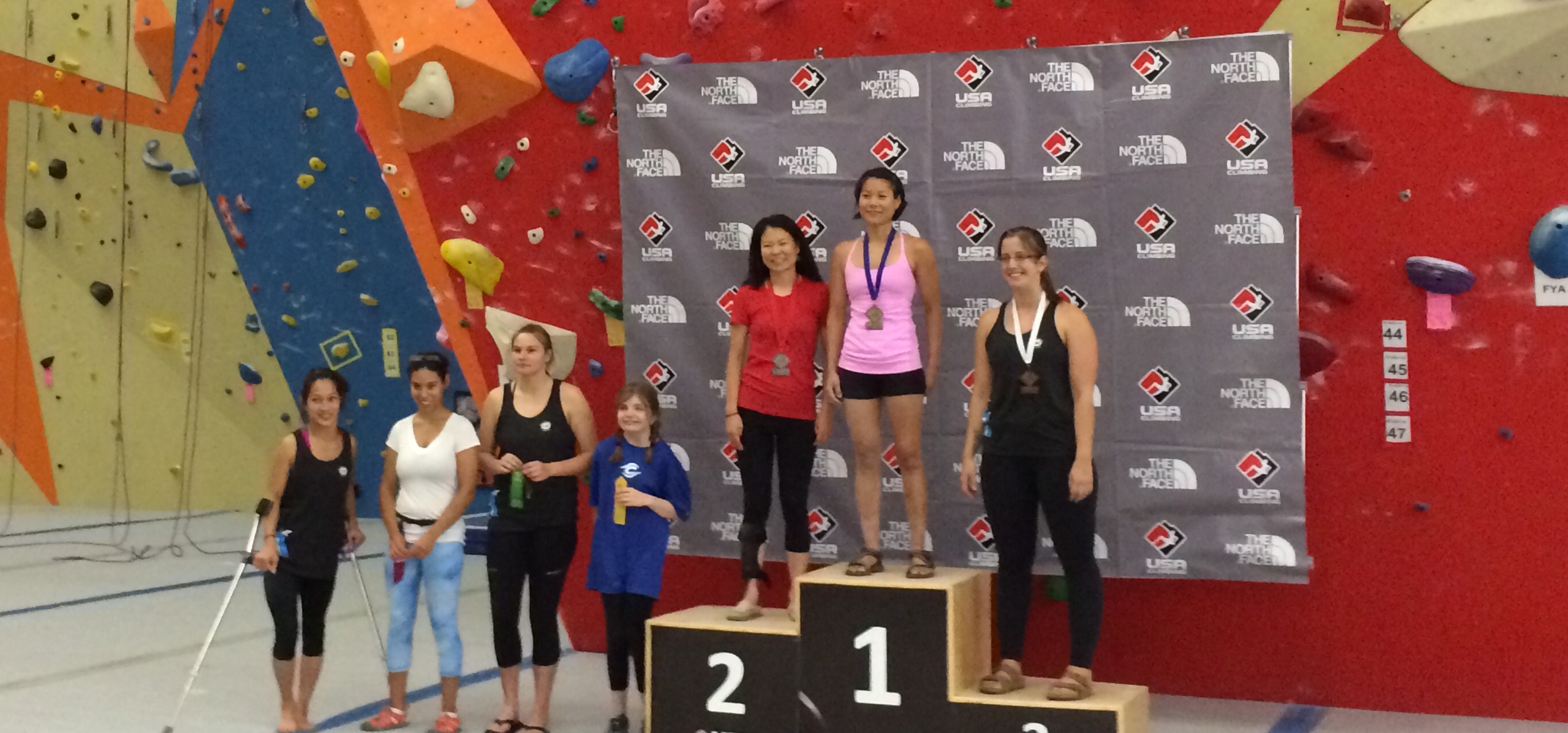
Achievement unlocked: 2015 US Paraclimbing Nationals

Well, I am pleased to have defended my title of top US Paraclimbing female, by winning my category, being the highest scoring female, and in the top-3 among Men and Women across all categories.

Apologies for crappy resolution.

Apologies for crappy resolution.

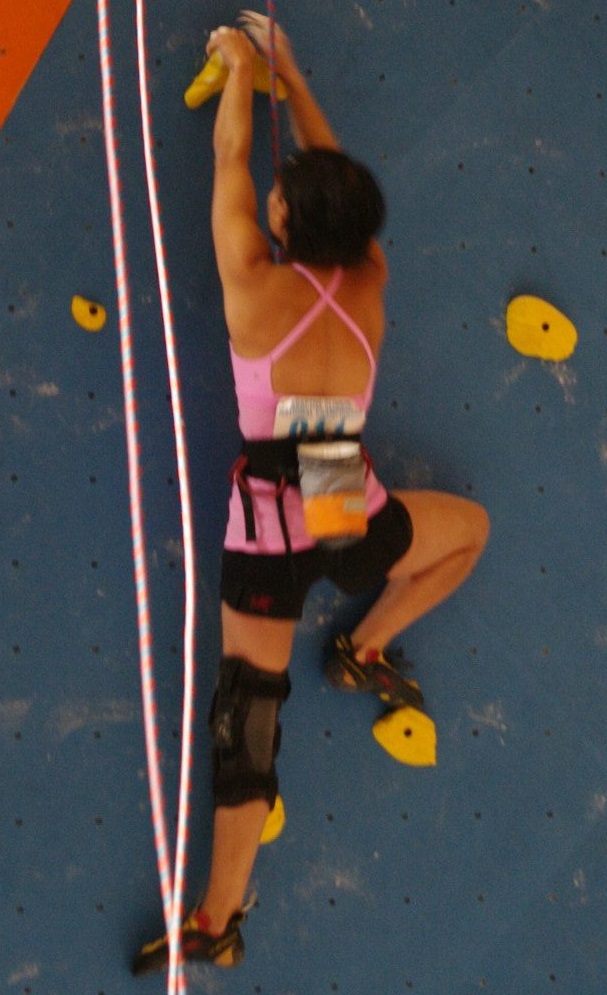
Warmup.

Warmup.

I like this pic very much, as it shows me and the top-placing Male, gimpy left leg and all.

I like this pic very much. It shows me and the top-placing Male, similar left leg and chalking technique, it seems.

Now, back to outdoor season!

Countdown to Paraclimbing Nationals

Well, I have gotten as strong as I can possibly get before the 2015 Paraclimbing Route Climbing Nationals this Friday in Kennesaw, GA. I did my last moderate workout on Monday and will be resting for the remainder of the week. The trick is to somehow maintain my form and weight (which I find hard to do when I am in slug mode), stay limber this week, and avoid any further injury. Sleep has been tough the last few weeks, due to neuropathy and pain issues. Nothing new there, I suppose, but it is still hard to function sometimes when I am feeling so tired so often.

I am a bit disappointed that the walls at Stone Summit Kennesaw are not as steep as the ones in Stone Summit Atlanta. I had been climbing almost exclusively on steep overhanging terrain inside on lead, and feel like I have gotten much better at my power game. I heard someone describe this style of climbing as “thuggy”, which I think is rather perfect :) Endurance is a strong suit of mine, so I feel like long routes will be to my advantage. More footwork-intensive, vertical/slabby terrain will not help me much against the competition, as my fellow competitors have more function than me in their lower bodies. I am still aiming to win my category, and be the highest scoring female. I would also like to place in the top-3, men and women. We shall see. I am a bit nervous, as I tend to be in indoor comps with all eyes on me. As someone said, I just need to climb with swag. Ha. I am pleased that I my fingers are not hurting as much as last year, so I hope to significantly improve on last year’s grades/scores, but I know the competition will be tougher

It looks like this year’s competition is attracting many more competitors, so I am looking forward to meeting a bunch of new folks. At least training for this competition is another useful data point for me to build upon and determine what my training will look like for next year’s Nationals, which will also be the qualifier to be on Team USA at the 2016 IFSC World Championships.

The next few weeks will be a bit jammed, between travelling to Atlanta (or, rather, Hot-lanta – temperatures reaching 100 degF, before humidity is taken into account!) and then to NREL in Golden, CO for work afterwards. I am hoping to fit in a day of climbing outside while I am in Colorado. Then, hopefully, focusing on the short outdoor season in New England when I return.

A pretty un-American America weekend

My friend Dave and I did a quick day-trip to North Conway, NH on July 4, before the rain was supposed to come in the mid-afternoon. Although our original objective needed to be set aside due to a slow party ahead of us and a very wet route, we managed to find a lot of good stuff to do, even if they were only 1-3 pitches long. I can’t say I truly love New England, but I suppose the place grows on you a little bit. The slick, moist rock, often seeping and sections of unprotected, mossy slab (three words I do not like to hear together), interrupted by some cool cracks in North Conway, is certainly very different to the bone-dry, friction-y rock of the Sierras. Feels harder.

It was great to feel comfortable on 10’s cracks again although, for me, it is highly dependent on how good the pro is. We knocked off a couple of really cool finger cracks, which used to be one of my fortes. I have to hang off my fingers/hands a lot, which makes things a bit spicy at times, but it was awesome to feel more confident on stuff like that again.

Conway with Dave_20150704

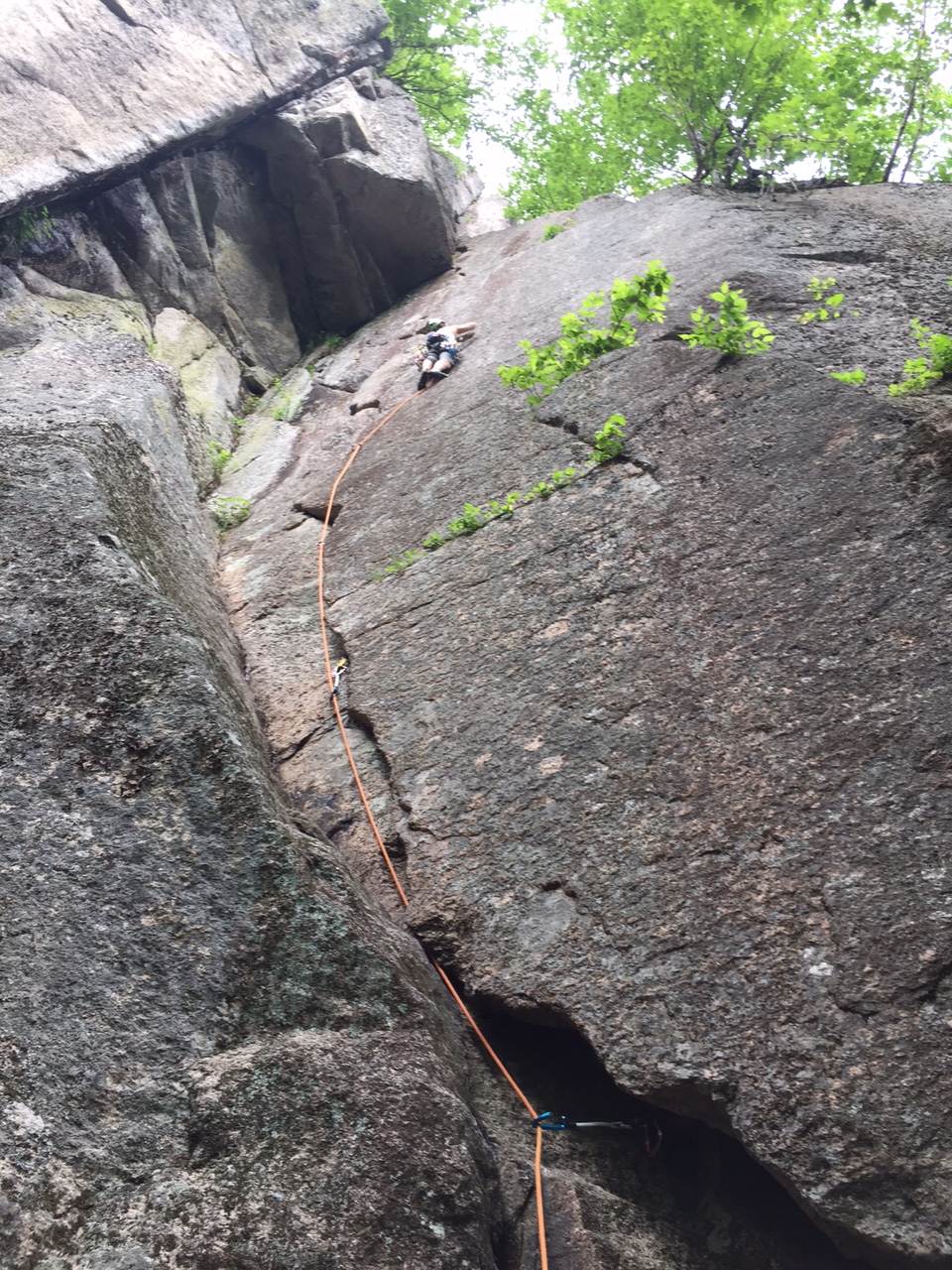
Warm-up lead on Raising the Roof, a surprisingly fun 5.9. The gentle arc of the rope is a metaphor for the gentle beauty of New England.

I had to be a bit careful because of my broken PIP joints in both fingers, but the finger cracks were too seductive to resist.

Currently I am on the home-stretch for training for the upcoming US Paraclimbing Nationals on July 17. I was knocked out a bit last week due to a low-grade illness, and am walking the fine line between training hard and feeling my body break-down/on the cusp of injury. In the past, I have just very quickly transgressed into injury territory and then it is pretty much game-over misery; so this state I am in feels quite strange. I don’t feel very strong, again because I am bordering on body breaking down; but I think after resting for a few days, I might be roaring again. My goal is to not only win my category (Neurological and Physical Disability/SCI), but to be the top female, again, across all categories by points. I am trying not to set myself up for disappointment; and I do feel somewhat ambivalent about these comps because they are also a function of how much function a person has versus how good a climber they are; but, I think it is a goal I will stick to. I am pretty sure I am the strongest female, in terms of upper-body strength. It seems like there are a lot of new people, so it will be interesting to meet a bunch of these folks.

The Tongue revisited

My partner always tells me that the perception I have of myself climbing – namely, that I am slow and weak – is vastly different to reality. In the early days of our courtship in April 2014, I showed him a video a friend had taken of me climbing a feature in one of the local climbing gyms called The Tongue, which basically starts of very slightly over-hung, kicks back and eventually ends up almost 90 degrees to the vertical. The video was from late October 2013 (I guess the order in which I did things was a bit off: first ice-climbing (February 2013), then rock-climbing (May and August 2013), then pulling on plastic in a climbing gym (October 2013) :))When he watched this video, he said, Wow, you climb so much better now, and I thought, “Really??” He said, yeah, you actually use your left leg now, as an active counter-weight and not just this passive dangling thing.

As usual, New England’s fickle weather thwarted my plans (it turned out to be a really nice day despite the forecasts for wet weather today – drat!), and I had made indoor climbing plans with a friend. Scott just so happened to come by as I was about a third of the way up The Tongue, and he thought it would be good to catch me on video so that I could see for myself how my climbing has evolved.

For reference, here is that first video of me climbing the feature (Nov 2013), on some 5.9+, just wearing a tennis shoe on my left foot.

The route I was on today was a 10c, which isn’t particularly difficult, but the steepness of The Tongue makes up for that. You will see that when things start to get very over-hung, without the use of my left leg, my feet really kick out, and I just have to use my core to suck my right leg back in. I cut out parts where I am hanging on holds shaking out a lot; this route was done close to the end of a long session, so I was pretty tired and climbing slowly, but hopefully not too sloppily. It is hard to tell just how overhanging The Tongue is in this video because my partner was lying down when he was recording; but you might get an idea from how frequently my feet cut out and I am just hanging with my arms – it’s like I am at a bloody jungle gym.

FYI, I did finish the route but did take at the second to last move, which was unfortunate, but I was pretty gassed at that point. Having a functional left leg would have been super useful for that part.

I still have the tendency to critique myself extensively when watching such videos; but, I will admit there has been improvement. The main things I observe as I compare these two videos is that:

  1. I do a lot less tugging and “adjusting” at holds to test if they are “good” (which is silly since it is plastic indoors, not some loose flake outside); I think that was just because I was so unconfident about my feet.

  2. I am actually placing my left foot (with a climbing shoe on it!) on holds. At around 0:15 in the new video you will see me using my left heel on a hold, because I was trying to recruit some of the hamstring function I do have at that spot. There is a lot more “hopping” with my right leg (and I still do that a lot) in the first video.

  3. My partner thinks I move more confidently and smoothly; I would argue that I am still plodding along here, but that could be because of just being tired. He also didn’t start filming until I was about a third of the way up the feature, and the first third was not trivial for me.

  4. Oh, and I am comfortable enough in my own skin to just be wearing a sports bra, showing big fat scars and all.

AMGA SPI Course weekend

I spent Thursday to Sunday at The Gunks, NY taking the American Mountain Guides Association (AMGA) Single-Pitch Instructor (SPI) course. The course is a 27 hour long program spread over three days, with the aim of preparing an individual to be certified to guide clients in a single-pitch setting. The SPI exam is a separate 16-hour affair. Even though this kind of climbing does not interest me terribly, I had wanted to take this course because it is the prerequisite for any other kind of guiding certification (e.g. the Rock Guide program and certification). As I have mentioned in earlier posts, climbing 5.hard can be fun (feeling strong certainly is), but I think I derive much more satisfaction in acquiring the full body of skills/knowledge that, to me, make one a competent and safe climber. I had familiarity with a lot of the material covered in the course, but I learned a lot as well. I contacted the instructor ahead of time to make sure he was fully aware of my disability and talk to him about whether I would be holding the group back at all – something I always try to avoid. We discussed my climbing experience, what level I climb at now, how heavy a pack I can carry and on what kind of terrain. The scope of the SPI course covers pretty benign terrain, with approaches and descents not requiring advanced route-finding skills or even long approaches. I had some anxieties about carrying a fully loaded pack (double rack, usual pro and softgoods), 60m rope, 30m static line on my own; it was tiring but I think I managed all right. I think I can definitely slim down my rack since the kind of terrain I would be leading in is easy; and, a lot of the times, I will be dropping down a rope for the client to top-rope and/or rappel on. To my surprise, I found myself to be the most experienced/competent participant of the course, and really did not hold anyone in the group back. One thing that was both a challenge and illuminating thing about the whole experience is making the switch back and forth between being a “recreational” climber (i.e. climbing with buddies) versus being a guide and instructing and being responsible for clients. While I always feel a degree of responsibility for my climbing partner(s), being a guide takes things to another level. The single-pitch setting is also different for me. For example, I would not be carrying around a 30m static line to build anchors with if I am just climbing with a buddy, and certainly not on a multi-pitch climb. I am much faster at my bowlines and munter-mules now too :) Another thing that was new to me was the frequent and encouraged use of the Gri-gri (or any other auto-locking device). Before this past weekend, I think I leaned towards the Oh, using a gri-gri is a sport-climber thing, encourages complacency, blah blah blah attitude. I have since changed by mind. In a rock setting (as opposed to ice), it is a great tool for backing myself up when I am setting up an anchor over an edge and for belaying a climber who might need to be lowered; again, a more likely scenario as a guide instructing less experienced climbers than my climbing buddies. But, I still think I will incorporate using a Gri-gri more even in my own multi-pitch climbing. The end of the course had us doing a group and individual de-briefs. My instructors offered kind words, saying that I may have some of my own perceptions of my disability, but it really did not show at all in the course, and that my participation in the course really added to the experience of the other participants. One of the instructors said he would have no problem offering me a job, which was nice to hear. I know enough people who guide to not have an overly-romantic view of the profession. The instructors were also very candid in sharing the realities of guiding. There are all the injuries, the lack of health insurance, the risks, the limited income; I mean, there are only so many days in the climbing season, most of your clients will be on weekends…that isn’t very many days of actual work a year. One of the instructors is actually starting nursing school this summer for the aforementioned reasons, and also because he wants to interact with more people than just the 1%. There are also the very real physical limitations and realities that I face, and the fact that I probably will never be able to make guiding a full or even part-time career; the lack of good health insurance is particularly problematic as getting private health insurance with a pre-existing condition(s) such as mine, would be painfully expensive. This left me feeling quite depressed on Monday, as having options removed from me always does. It was nice to hear from my SPI instructors that they felt like I was pretty ready to take the SPI exam. One guy did say, yeah, the Rock Guide exam could be tough for you physically, but I think you can do it. I was a bit surprised by how little is required to be a Single-Pitch climbing guide. But it also makes me realize how much more there is to learn and how eager I am to take the full Rock Guide course (that is a 10 day course, followed by a 6 day Advanced Rock Guide Course). The Rock Guide exam is 6 days long. I am facing a bit of a dilemma in deciding whether I care about being certified and taking all the AMGA exams, or am I just happy to be exposed to and practice the content of these courses. The courses and the exams are expensive; and, I would need to invest a fair chunk of change and time into a Wilderness First Responder (WFR) course as well, if I am to be a certified Rock Guide. I’m trying not to fixate on all these somewhat amorphous, longer-term options. My next steps for the next few months are to focus on winning the 2015 Paraclimbing Nationals, train for NIAD in the Fall, and perhaps look into WFR courses if I am to keep the Rock Guide course an option. I am totally pulling this out of my ass, but I suspect there are not many SCI’s who are certified as full AMGA Rock Guides (there are quite a few who are AMGA Climbing Wall Instructors); it would be pretty neat to be the first.

Fatality at Owens River Gorge

There was a climbing fatality at Owens River Gorge earlier this month. For obvious reasons (or maybe not so obvious for those who do not know me – my accident in 2010 was at Owens River Gorge), I read about this with some interest, and sadness, of course. It also led me to a very long thread regarding bolts.

One poster said this: “Grief never ends….but it changes. It’s a passage, not a place to stay. Grief is not a sign of weakness, nor a lack of faith. It is the price of love.”

Yes.

Trajectory vs. local minima

My last post started off somewhat upbeat and optimistic. As I neared the end of it, it became considerably less so. I know I have a tendency to let local minima influence my mood. I know that I cannot turn back the clock, undo what happened to me – my accident – and therefore, all I can do, is be cognizant of the upward trajectory my life has, overall, taken since then, and the potential to get stronger, not weaker, with each passing year. But, as I was thinking about Moby Grape, about how I could find myself so exhausted from the approach that I would not be able to do “my” part on the climb itself i.e. do my share of the leading, not fizzle out part way through the climb…I started to cry, reminded of the sense of loss, the delta. My partner says I need to let go of the grief and forgive myself. Forgive what, exactly? I asked. He responded, that I needed to forgive myself for once having been here and now at a different absolute level (by some criteria).

I am not a boundlessly optimistic person by nature. Never have been. Which is maybe why this tendency for me to be mired in the grief, is so hard for me to shake sometimes. It is practice, I know. But, it is going to be a very long time, and probably quite a few more years of practice, before it feels second nature.

Back to “normal”. Kinda.

Due to time-constraints, a friend and I made a day trip to North Conway to climb some classics at Cathedral. I had climbed on one occasion with Lian (sport climbing at Rumney), but this was the first time we had climbed trad together. Due to my perpetually broken PIP joints, we chose to stay away from any finger cracks, and warmed up for the season on routes like The Roof, Funhouse and Bombardment. The last two are well-known moderate classics; but the first climb, a 5.8+/5.9 climb was actually super fun. Even though these are very easy climbs, it was nice to just get moves in on a nice (this translates to “not rainy” in the Northeast) day. I think Northeast ratings are also pretty stout! The combination of the wetness and foliage definitely makes things a bit challenging, especially when you do not trust both feet.

It is easy for me to look at climbs like this and think, man, these barely would have been warm-ups in my “prior” life. And not beat myself up too much about feeling a bit sketched out on some sections I led which felt incredibly run out, when I know, objectively, they were not. My pro was solid, the fall would have been clean…yet, it would make me slightly nervous. Lian said, you always look so calm! I replied, clearly you didn’t hear me swearing…

I don’t think Lian was aware of the trauma and lasting physical effects of my accident. I was curious to hear from him if there was anything about the way I climbed that surprised him. He said, no, not really, you looked really comfortable. We agreed that I spend a lot of time in sections, where I am figuring out the sequence of moves I am going to make with my right foot and where I would lock my left leg out. He said that I clearly was very comfortable hand-jamming. Well, yeah. It was nice of Lian to say that I climbed harder trad than most of his friends; but a) it’s New England – not that many people climb trad/cracks, and b) he doesn’t have that many friends who climb trad (related to (a)).

I guess on the one hand, this should all be interpreted as a compliment; that the strength I have developed in other parts of my body, and the way I use my body around my gimpy leg, hides theses deficits. On the other hand, I still feel a sense of frustration, that I can’t just stick my left leg in a crack, torque it, walk up a crack like a staircase and feel totally secure.

I think one thing that came out of this brief outing, was how these climbing trips seem rather normal now. How I am out with a partner, not as a handicapped person to him/her, not as someone to babysit (although I did ask Lian if he could carry the rope and a lot of the pro), but as an equal who swings leads with them, and who can just hang out with them, climber-to-climber. All good things I guess.

But in some ways, things are not entirely normal. I now do much more research about the approach/descent to climbs now, and I have to eliminate a lot of climbing options because of the length/steepness of the approach and difficulty of the climb. I know this is the case for most people, but it seems like the field of options is smaller for me now, and I hate feeling limited like that. Right now, I am on the fence about doing a total New Hampshire classic, Moby Grape, on Cannon Cliff this weekend, solely because of the approach and descent. It would suck to have to turn my back on some of the best cracks around here for this reason. We will see.