Yosemite 2015 – Part 1

Well, there is quite a bit of catching up to do. I am back facing the daily grind of life, but will be posting about my time in the Valley. I was not sure what to expect, given all the uncertainty around my original objectives. There was disappointment and surprises (good and bad); but, overall, the trip was a wonderful and healing experience. Apologies in advance if the tenses are bit weird here and in the next few posts.

IMG_1963

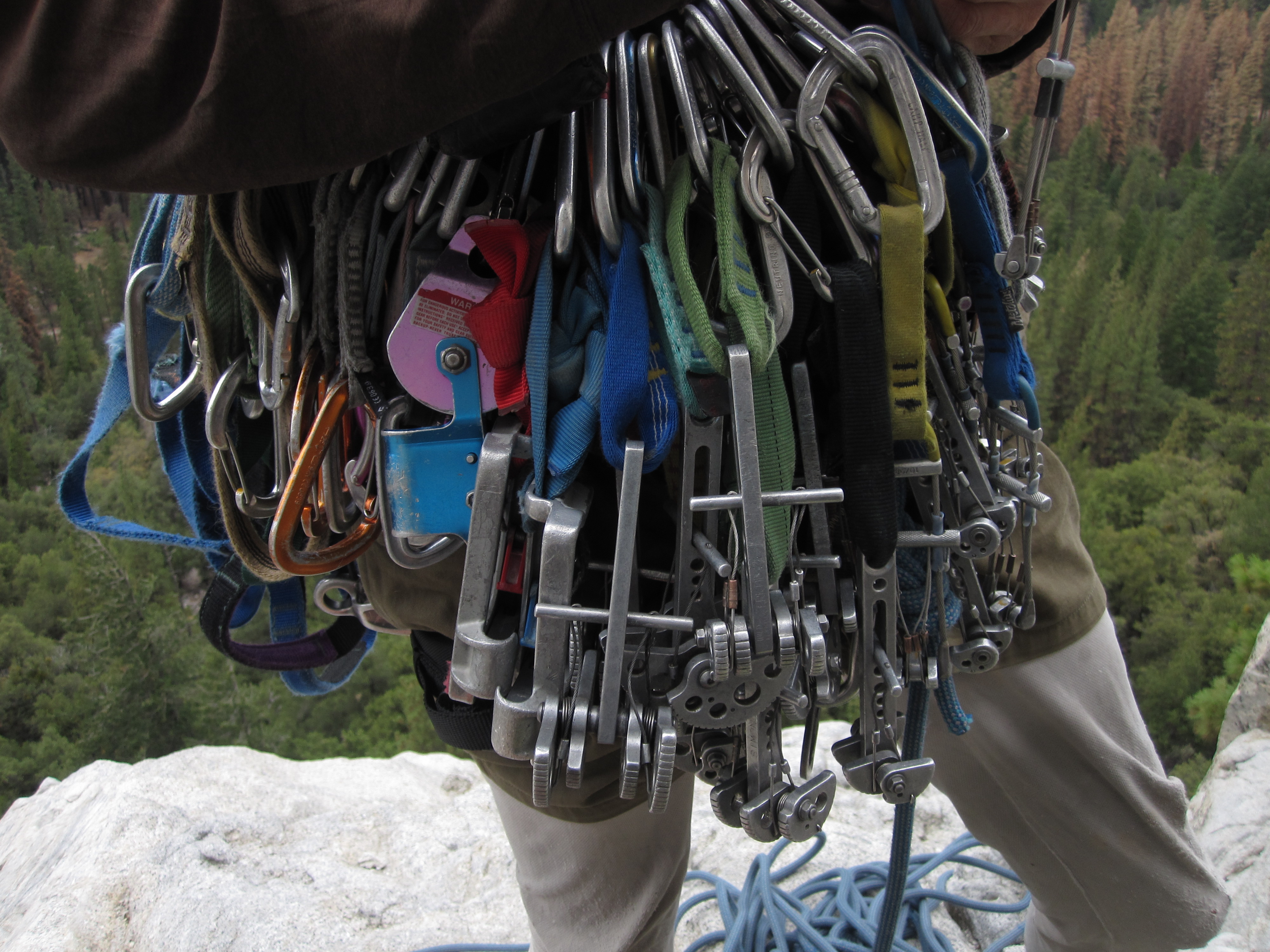
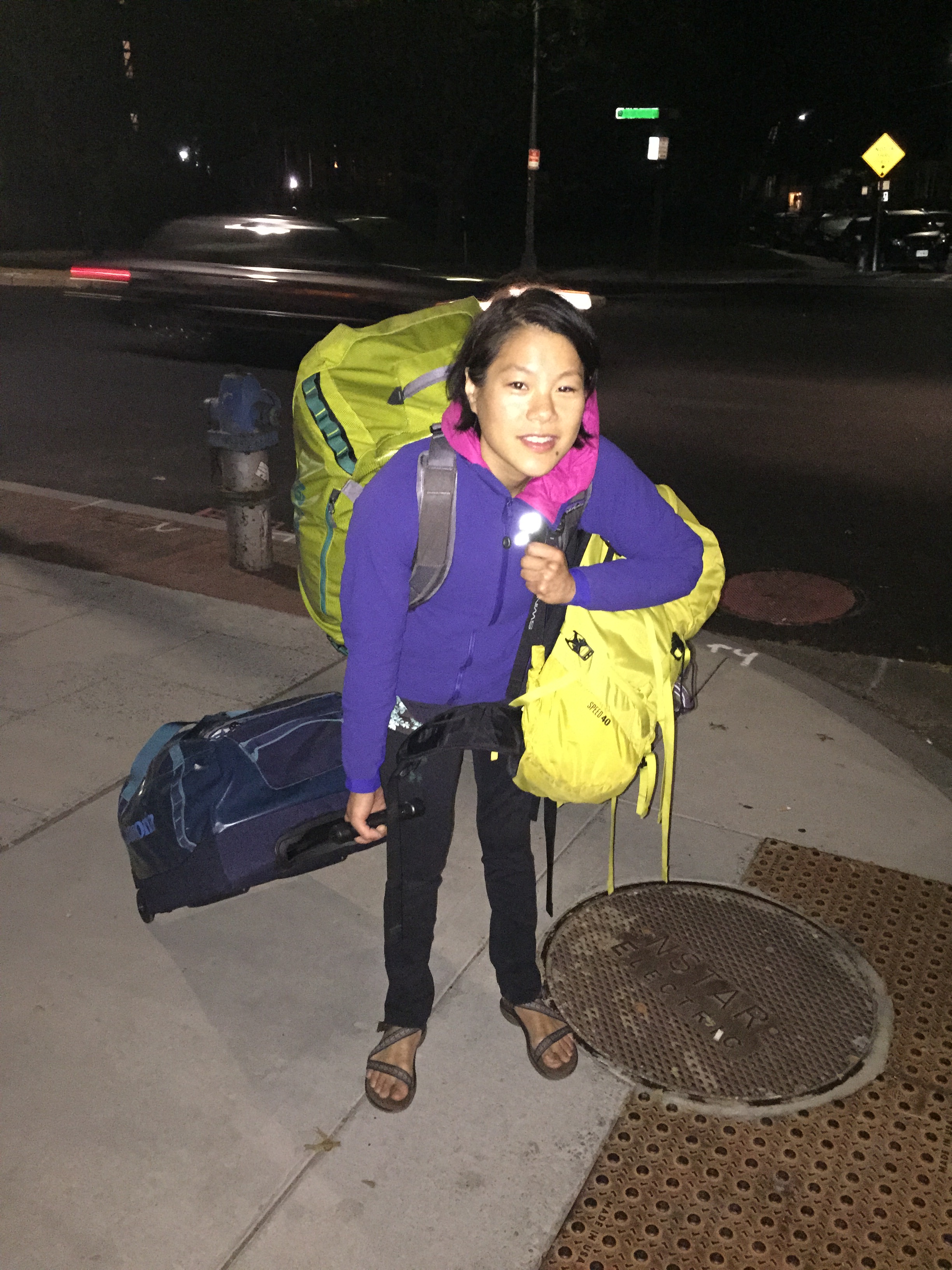
Since my plans were unclear, I ended up bringing a lot of my free and aid-climbing gear. It is hard to tell, but the rolling bag is twice the capacity of the gear bag on my back.
IMG_1962

I am carrying ~125 lbs worth of gear (and I weigh 105 lbs on a good day). So, yes, it was a bit of a circus lugging these bags around airports and rental car terminals.

So, what do you do when your original NIAD partner backs out one week before your scheduled departure? You get back on the big stone anyway, the leisurely, older than old-school way. My friend, Clint, threw out Lurking Fear and Zodiac as alternatives to The Nose, in case it was too busy. The less slabby hauling on Zodiac sounded much more appealing; but the short approach to The Nose won out, and we at least went out to see if there was a line and see if we could fix lines to Sickle Ledge.

IMG_1251

An old friend.

Older than old school.

IMG_1248

Clint starting up. The weather was unseasonably cool and the sky became less blue as the day went on.

DSCF1149

Lots of lower-outs on the route.

I find that even on slabby terrain, keeping just my right (good) foot in an aider works the best for me. My left foot/leg can be utilized more when it is allowed to stick out straight, and it is hard to keep that foot in step-aiders anyway. I do keep a ladder aider attached to me though, just in case

DSCF1146

(Photo: Clint Cummins)


DSCF1164_adj

We got to Sickle just as the sun was setting (Photo: Clint Cummins)

We decided not to pack the haul bag and haul to Sickle that evening, deciding to just crash and sleep on the ground instead and deal with things in the morning. This was a decision I would later regret.

The next morning started off, as usual, very leisurely. We took our time waking up and then dealing with packing the haul bag. Then we began the jug up the fixed lines to Sickle. I was curious to see how my stamina would be for non-stop jugging for quite a ways, as this would give me a better idea of how I might do jugging as fast as possible, continuously, in a NIAD attempt. To my pleasant surprise, I was not moving slowly or getting too tired too quickly.
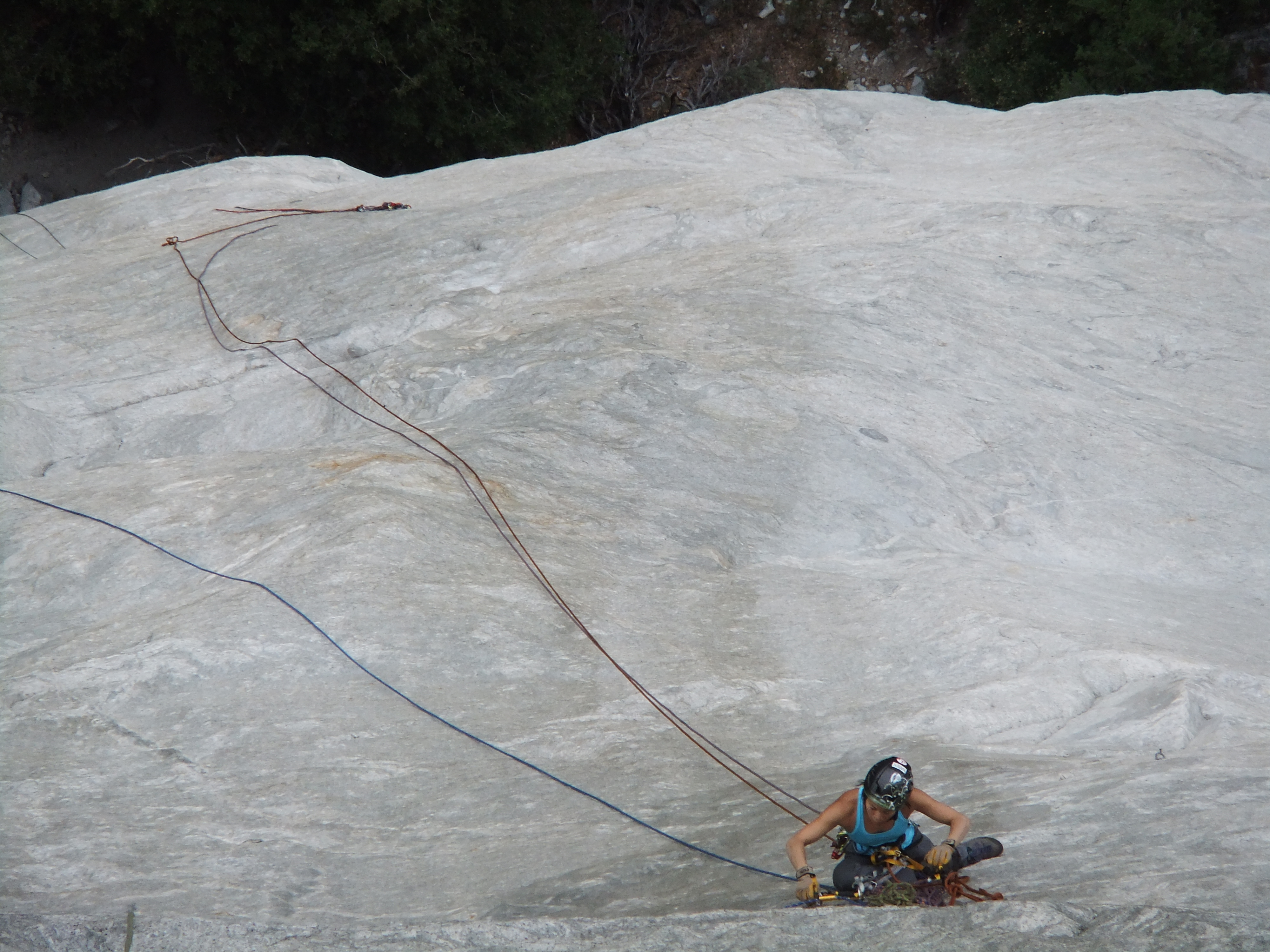
DSCF1167

Moving from one fixed line to another (Photo: Clint)


And what does one do when they are done with their extra fixed line, which is not required for the rest of the route? Why, this of course.
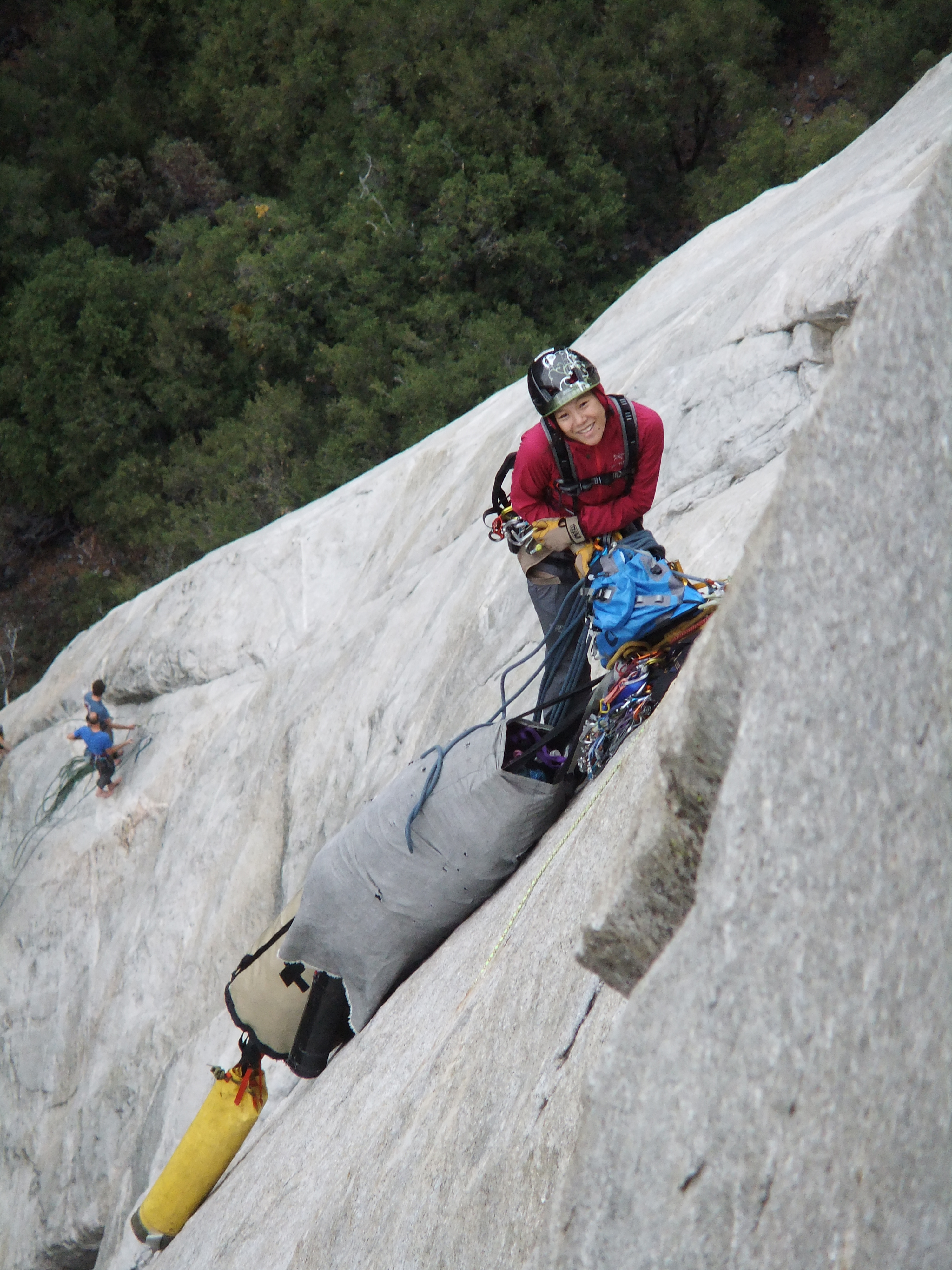
DSCF1173

Guess which one is Clint’s (our) haul bag? This was the first time I was introduced to the concept of a haul bag condom (Photo: Clint)

DSCF1175

More lower outs (Photo: Clint)

DSCF1177

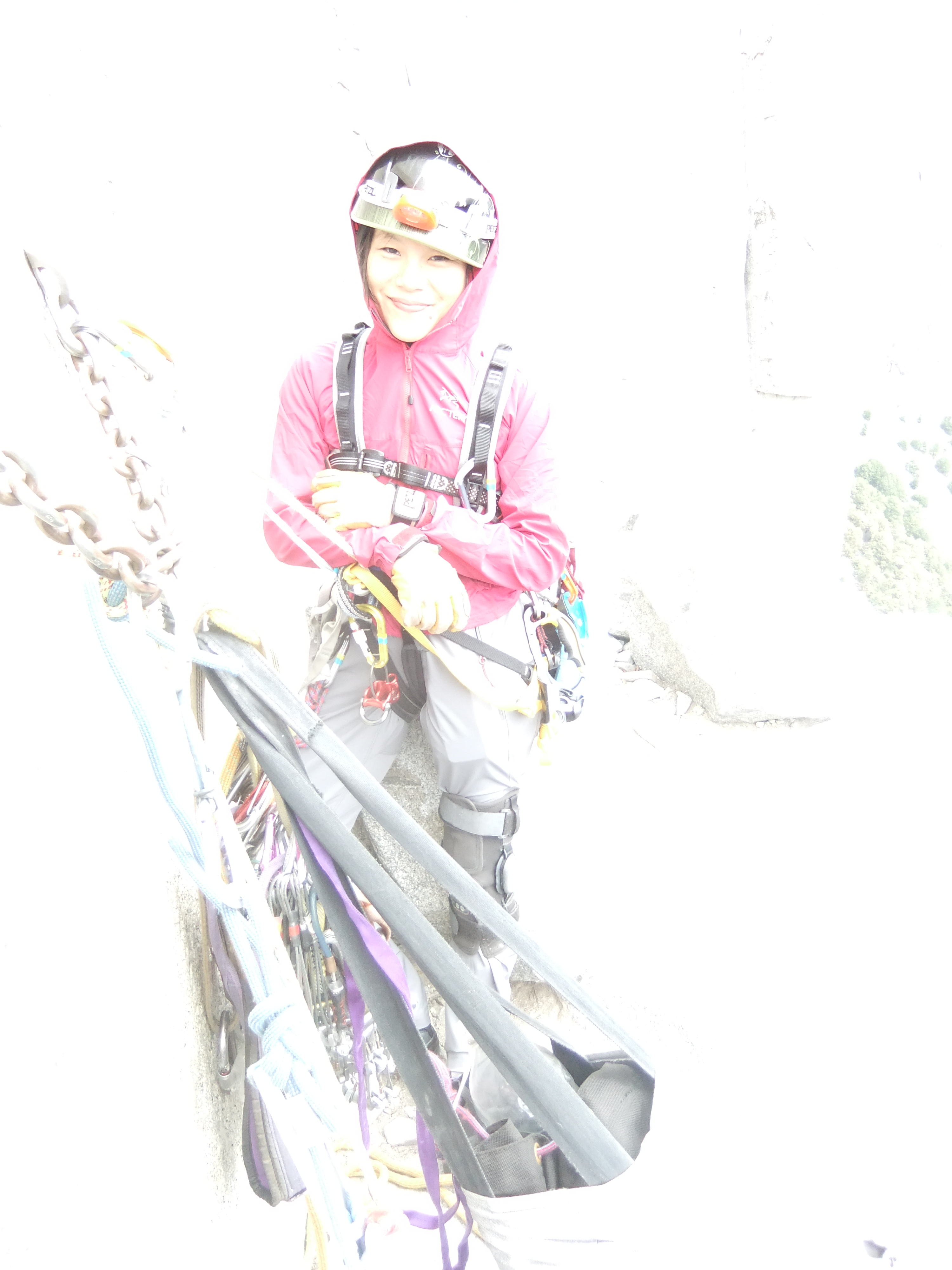
The lighting in the photo is deceptive. The fact that my headlamp is poised on my helmet, is not. (Photo: Clint)


The combination of our very leisurely start and some hauling misadventures (it took a very very long time to get our haul bag up to Sickle and beyond) led to an all night epic. Clearly, I am built for fast and light, not frigid multiple-hour, uncomfortable belays. I was struggling to keep it together in the dark and cold. Turning off my headlamp to conserve battery life just made me feel even more alone and cold. I was shivering uncontrollably at points and at one point teared up, as I do when I am very very cold. I knew I had to keep composed though and get myself, our bag and our gear to Dolt. Clint was a total chief, doing some long pitches in the dark and hauling.

As I was waiting at the hanging belays, I heard from faster parties that there was rain/thunderstorms in the forecast, which was why so many parties were trying to do their NIAD run that night/day. After napping on Dolt for a few hours, we made the decision to go down. It was not a difficult decision to make, given we had little in the way of rain gear, and climbing the route in wet, cold conditions, with lightning and thunder would have been ridiculous. The forecast did materialize and we did well to get off the route. Of course there was quite a bit of disappointment not being able to finish the route due to factors out of our control. But what can you do about weather? What would have been worse would have been to bail and then see sunny skies the rest of the time. Most importantly, we both got back to the ground safely.

Clint put the following two images together to show where along the route we reached and descended from.

POV_2743R

Nose_to_Dolt_ov

I guess there were a lot of positives to this experience. It felt good to know that I am back in the big-wall game; that my modified jumaring technique works even on vertical non-overhanging terrain; my jumaring stamina and speed are good; confident/comfortable on lower outs (found that the Deucy worked fine); and I was not the limiting factor (well, I was pretty useless for the hauling – which was a bitch. Clint and I need to find a fat person as our counterweight or at least find someone a lot heavier than the two of us to do the hauling).

I extended by trip by two days in the hopes of a possible NIAD attempt the next weekend – partner and weather-dependent. I couldn’t believe there was so much wet and cold weather in the forecast. What the hell!

Getting back on El Cap has rekindled the flame and given me perspective for future trips; if NIAD does not work out this trip, I will try to come back in the Spring when there is more daylight. I would love to solo a big wall route, but think the hauling thing will be a deal-breaker for me.

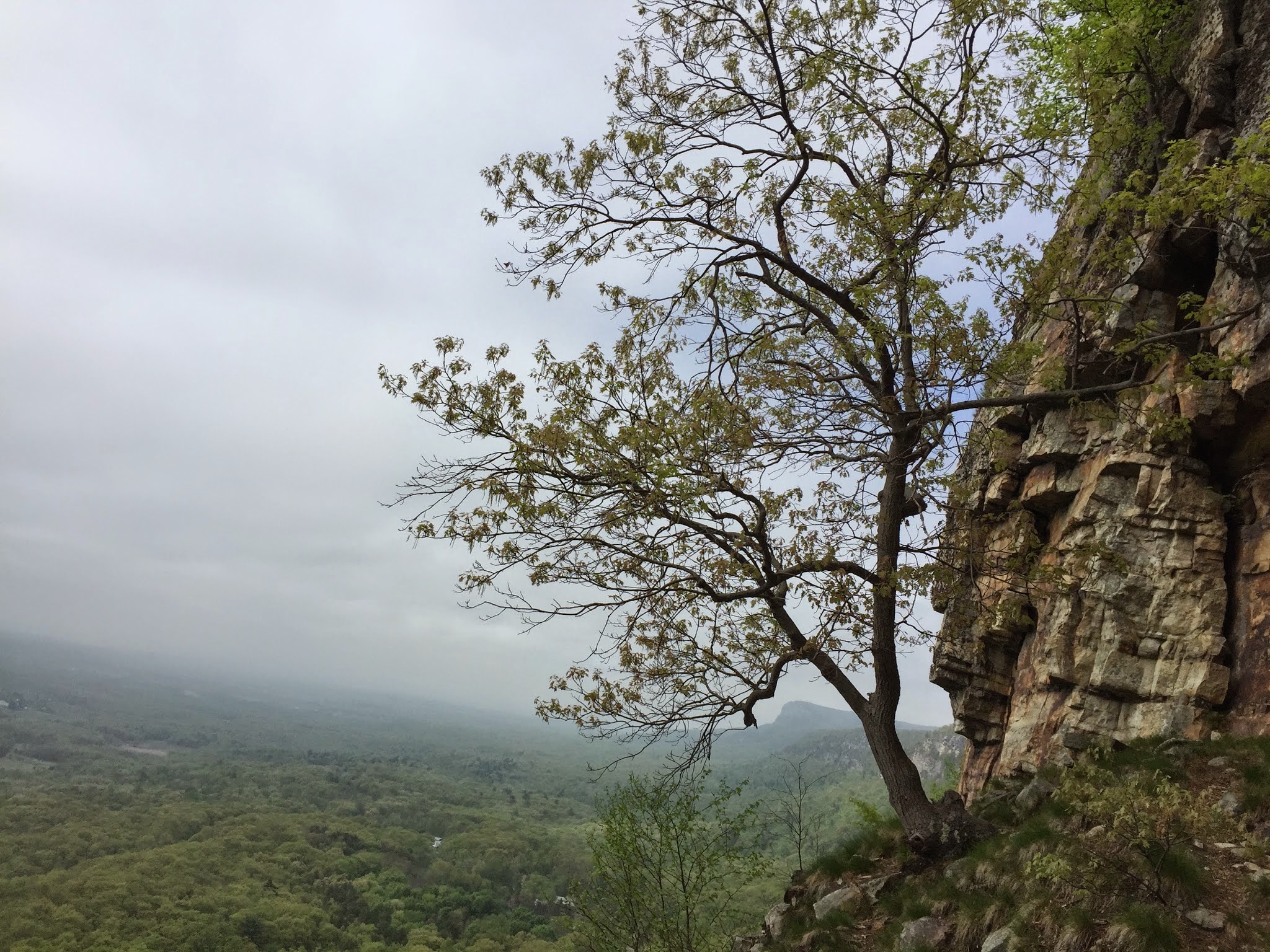
AMGA SPI Course weekend

I spent Thursday to Sunday at The Gunks, NY taking the American Mountain Guides Association (AMGA) Single-Pitch Instructor (SPI) course. The course is a 27 hour long program spread over three days, with the aim of preparing an individual to be certified to guide clients in a single-pitch setting. The SPI exam is a separate 16-hour affair. Even though this kind of climbing does not interest me terribly, I had wanted to take this course because it is the prerequisite for any other kind of guiding certification (e.g. the Rock Guide program and certification). As I have mentioned in earlier posts, climbing 5.hard can be fun (feeling strong certainly is), but I think I derive much more satisfaction in acquiring the full body of skills/knowledge that, to me, make one a competent and safe climber. I had familiarity with a lot of the material covered in the course, but I learned a lot as well. I contacted the instructor ahead of time to make sure he was fully aware of my disability and talk to him about whether I would be holding the group back at all – something I always try to avoid. We discussed my climbing experience, what level I climb at now, how heavy a pack I can carry and on what kind of terrain. The scope of the SPI course covers pretty benign terrain, with approaches and descents not requiring advanced route-finding skills or even long approaches. I had some anxieties about carrying a fully loaded pack (double rack, usual pro and softgoods), 60m rope, 30m static line on my own; it was tiring but I think I managed all right. I think I can definitely slim down my rack since the kind of terrain I would be leading in is easy; and, a lot of the times, I will be dropping down a rope for the client to top-rope and/or rappel on. To my surprise, I found myself to be the most experienced/competent participant of the course, and really did not hold anyone in the group back. One thing that was both a challenge and illuminating thing about the whole experience is making the switch back and forth between being a “recreational” climber (i.e. climbing with buddies) versus being a guide and instructing and being responsible for clients. While I always feel a degree of responsibility for my climbing partner(s), being a guide takes things to another level. The single-pitch setting is also different for me. For example, I would not be carrying around a 30m static line to build anchors with if I am just climbing with a buddy, and certainly not on a multi-pitch climb. I am much faster at my bowlines and munter-mules now too :) Another thing that was new to me was the frequent and encouraged use of the Gri-gri (or any other auto-locking device). Before this past weekend, I think I leaned towards the Oh, using a gri-gri is a sport-climber thing, encourages complacency, blah blah blah attitude. I have since changed by mind. In a rock setting (as opposed to ice), it is a great tool for backing myself up when I am setting up an anchor over an edge and for belaying a climber who might need to be lowered; again, a more likely scenario as a guide instructing less experienced climbers than my climbing buddies. But, I still think I will incorporate using a Gri-gri more even in my own multi-pitch climbing. The end of the course had us doing a group and individual de-briefs. My instructors offered kind words, saying that I may have some of my own perceptions of my disability, but it really did not show at all in the course, and that my participation in the course really added to the experience of the other participants. One of the instructors said he would have no problem offering me a job, which was nice to hear. I know enough people who guide to not have an overly-romantic view of the profession. The instructors were also very candid in sharing the realities of guiding. There are all the injuries, the lack of health insurance, the risks, the limited income; I mean, there are only so many days in the climbing season, most of your clients will be on weekends…that isn’t very many days of actual work a year. One of the instructors is actually starting nursing school this summer for the aforementioned reasons, and also because he wants to interact with more people than just the 1%. There are also the very real physical limitations and realities that I face, and the fact that I probably will never be able to make guiding a full or even part-time career; the lack of good health insurance is particularly problematic as getting private health insurance with a pre-existing condition(s) such as mine, would be painfully expensive. This left me feeling quite depressed on Monday, as having options removed from me always does. It was nice to hear from my SPI instructors that they felt like I was pretty ready to take the SPI exam. One guy did say, yeah, the Rock Guide exam could be tough for you physically, but I think you can do it. I was a bit surprised by how little is required to be a Single-Pitch climbing guide. But it also makes me realize how much more there is to learn and how eager I am to take the full Rock Guide course (that is a 10 day course, followed by a 6 day Advanced Rock Guide Course). The Rock Guide exam is 6 days long. I am facing a bit of a dilemma in deciding whether I care about being certified and taking all the AMGA exams, or am I just happy to be exposed to and practice the content of these courses. The courses and the exams are expensive; and, I would need to invest a fair chunk of change and time into a Wilderness First Responder (WFR) course as well, if I am to be a certified Rock Guide. I’m trying not to fixate on all these somewhat amorphous, longer-term options. My next steps for the next few months are to focus on winning the 2015 Paraclimbing Nationals, train for NIAD in the Fall, and perhaps look into WFR courses if I am to keep the Rock Guide course an option. I am totally pulling this out of my ass, but I suspect there are not many SCI’s who are certified as full AMGA Rock Guides (there are quite a few who are AMGA Climbing Wall Instructors); it would be pretty neat to be the first.

Fatality at Owens River Gorge

There was a climbing fatality at Owens River Gorge earlier this month. For obvious reasons (or maybe not so obvious for those who do not know me – my accident in 2010 was at Owens River Gorge), I read about this with some interest, and sadness, of course. It also led me to a very long thread regarding bolts.

One poster said this: “Grief never ends….but it changes. It’s a passage, not a place to stay. Grief is not a sign of weakness, nor a lack of faith. It is the price of love.”

Yes.

Trajectory vs. local minima

My last post started off somewhat upbeat and optimistic. As I neared the end of it, it became considerably less so. I know I have a tendency to let local minima influence my mood. I know that I cannot turn back the clock, undo what happened to me – my accident – and therefore, all I can do, is be cognizant of the upward trajectory my life has, overall, taken since then, and the potential to get stronger, not weaker, with each passing year. But, as I was thinking about Moby Grape, about how I could find myself so exhausted from the approach that I would not be able to do “my” part on the climb itself i.e. do my share of the leading, not fizzle out part way through the climb…I started to cry, reminded of the sense of loss, the delta. My partner says I need to let go of the grief and forgive myself. Forgive what, exactly? I asked. He responded, that I needed to forgive myself for once having been here and now at a different absolute level (by some criteria).

I am not a boundlessly optimistic person by nature. Never have been. Which is maybe why this tendency for me to be mired in the grief, is so hard for me to shake sometimes. It is practice, I know. But, it is going to be a very long time, and probably quite a few more years of practice, before it feels second nature.

Back to “normal”. Kinda.

Due to time-constraints, a friend and I made a day trip to North Conway to climb some classics at Cathedral. I had climbed on one occasion with Lian (sport climbing at Rumney), but this was the first time we had climbed trad together. Due to my perpetually broken PIP joints, we chose to stay away from any finger cracks, and warmed up for the season on routes like The Roof, Funhouse and Bombardment. The last two are well-known moderate classics; but the first climb, a 5.8+/5.9 climb was actually super fun. Even though these are very easy climbs, it was nice to just get moves in on a nice (this translates to “not rainy” in the Northeast) day. I think Northeast ratings are also pretty stout! The combination of the wetness and foliage definitely makes things a bit challenging, especially when you do not trust both feet.

It is easy for me to look at climbs like this and think, man, these barely would have been warm-ups in my “prior” life. And not beat myself up too much about feeling a bit sketched out on some sections I led which felt incredibly run out, when I know, objectively, they were not. My pro was solid, the fall would have been clean…yet, it would make me slightly nervous. Lian said, you always look so calm! I replied, clearly you didn’t hear me swearing…

I don’t think Lian was aware of the trauma and lasting physical effects of my accident. I was curious to hear from him if there was anything about the way I climbed that surprised him. He said, no, not really, you looked really comfortable. We agreed that I spend a lot of time in sections, where I am figuring out the sequence of moves I am going to make with my right foot and where I would lock my left leg out. He said that I clearly was very comfortable hand-jamming. Well, yeah. It was nice of Lian to say that I climbed harder trad than most of his friends; but a) it’s New England – not that many people climb trad/cracks, and b) he doesn’t have that many friends who climb trad (related to (a)).

I guess on the one hand, this should all be interpreted as a compliment; that the strength I have developed in other parts of my body, and the way I use my body around my gimpy leg, hides theses deficits. On the other hand, I still feel a sense of frustration, that I can’t just stick my left leg in a crack, torque it, walk up a crack like a staircase and feel totally secure.

I think one thing that came out of this brief outing, was how these climbing trips seem rather normal now. How I am out with a partner, not as a handicapped person to him/her, not as someone to babysit (although I did ask Lian if he could carry the rope and a lot of the pro), but as an equal who swings leads with them, and who can just hang out with them, climber-to-climber. All good things I guess.

But in some ways, things are not entirely normal. I now do much more research about the approach/descent to climbs now, and I have to eliminate a lot of climbing options because of the length/steepness of the approach and difficulty of the climb. I know this is the case for most people, but it seems like the field of options is smaller for me now, and I hate feeling limited like that. Right now, I am on the fence about doing a total New Hampshire classic, Moby Grape, on Cannon Cliff this weekend, solely because of the approach and descent. It would suck to have to turn my back on some of the best cracks around here for this reason. We will see.

Gunks-tastic weekend

I finally made it to the Gunks this past weekend, after bumping into a friend from our Stanford/Palo Alto days at one of the local climbing gyms. It is always funny to re-encounter old acquaintances a rather long distance from where you first met/knew each other, but I suppose the academic and tech scene around Stanford, CA and Cambridge, MA make the two spheres overlap with each other considerably. Dave was the house-mate of an ex-boyfriend (who taught me a lot about climbing and really nurtured my development as a climber); a really strong telemarker, and all-round mountain man. I think there is both comfort and slight discomfort in doing activities, like skiing and climbing, with people who did these things with me, and knew me, before my accident, like Dave. Comfort in that there is a shared knowledge of how I “used” to be (I hesitate to use the word “perform” as well, although that was my first instinct), what happened with my accident and its effects, and therefore an appreciation for how I am back at it and getting out. But also a slight discomfort on my part because I worry about holding old friends back, compared to how hard I used to be able to [insert activity]. I did not feel quite so bad with Dave though, because he is a full foot and almost 100 lbs heavier than I am; so he has always been much stronger and faster than me. It also made me feel less bad about asking him to carry a lot of our gear (ropes and pro) to the base of climbs. It looked like a very warm, dry weekend at the Gunks; Dave had never been, so off we went.

We had never roped up together. Most of the time, I will not climb with folks outside unless we have lead-climbed indoors together or they are a guide/pro-climber etc. But, I know Dave is an experienced trad-climber, having climbed with mutual friends before, so I was not worried. The weight difference did make for some very attentive belaying on my part though! Since it was Dave’s first time at the Gunks, we worked on knocking off the various moderate classics e.g. CCK, High E, Son of Easy O, and so on. If you are not familiar with Gunks ratings, they are pretty stiff. The fact that the grades are “old-school” (e.g. 5.9 was the highest grade at the time, so any climb 5.9 and above was given a 5.9 rating, even 10’s, maybe even 11’s!) and that the climbs are often over-hanging and exposed, makes for some great, but heady, climbing.

First climb and lead of the day

First climb and lead of the day

It took me awhile to get used to and feel comfortable on the rock. I tried not to be too harsh on myself for not leading any of the hardest pitches.

I love how the mood of the Gunks varies so much.

I love how the mood of the Gunks varies so much.

Yay, rope management.

Yay, rope management. That is the brace I use to protect my left-knee a bit. Cool tree, too.

Like any climbing partnership, it took Dave and I a little while to develop a successful dynamic. I would say the first day was spent doing that, so that by the time Sunday rolled around, we were making a pretty good team. I was also feeling more confident on Sunday, so was able to swing all leads with Dave.

Belaying Dave on P2, the money pitch on the famous High E(xposure).

Belaying Dave on P2, the money pitch on the famous High E(xposure). Pretty cool rock.

The awesome third pitch of CCK. Even though it is only a 5.7-5.8, it is spicy!

The awesome third pitch of CCK. Even though it is only a 5.7-5.8, it is spicy!

Cool panorama. And, no, my biceps are not that big (or flabby).

Cool panorama. And, no, my biceps are not that big (or flabby).

Despite my anxieties about climbing with an old acquaintance (I know I get even more anxious climbing with people who didn’t know me pre-accident – I know I need to work on this lose-lose situation, I was very glad we got out. It was lovely to re-connect and spend time with an old Stanford buddy; get some very enjoyable climbing in and start to build up my trad-leading abilities for the season; and re-invigorate myself by getting outside and hang off some cool rock with enjoyable company. (Photos courtesy of Dave Johnson).

The road to NIAD starts with…

…a little crag in Central Mass. (I should clarify that NIAD = Nose-in-a-Day).

My friend Clint, a Yosemite encylopedia who did a fair bit of climbing around here in his student days at Harvard, suggested Crow Hill Ledge as a spot to practice jumaring, given the proximity to Cambridge (less than an hour), not very long approach (I would have said “super short” in my pre-accident days, but approaches are never too short for me these days), and sufficient height and over-hang at Fisherman’s Wall. Fisherman’s Wall is about 90-100 feet high, over-hanging and from what I had read, there is a trail that goes right to the top of the ledge.

Nevertheless, I was nervous about the planned endeavor for a number of reasons. I had not jugged a line in over five years; I would need to figure things out from what seemed like scratch because my memory was foggy, I have been out of practice, and I would be switching the handedness of things – I used to have my right ascender at the top, left ascender on the bottom, and step up with my left leg on over-hanging terrain.

I knew I wanted to go out there on my own because (a) I do not want to have to rely on someone to help me schlump my gear every time I want to go somewhere (b) I knew I would feel more comfortable flailing alone while I figured out how to do this all over again, and (c) I don’t want to feel like I have to be with someone every time I explore a new climbing area, although company in unfamiliar territory is certainly a nice thing. My partner does not really climb outside, and I don’t know many people around here who are psyched on cracks and trad, let alone aiding. Most of my anxiety centered around me not being sure how I would manage on the approach to the top of the ledge to fix my line, given that I would be carrying a thick rope and all sorts of heavy anchor building gear because I did not know what to expect up there. There is also something a little un-nerving to me about not having a partner around to double-check my set-up.

In any case, I knew I’d feel like a total pussy if I didn’t go do this, so off I went. The walk to the base of the crag was manageable. It was a bit slower walking to the top of the ledge and finding the right trees to build anchors off of. After building a meticulously safe anchor, I descended a little bit only to find that this was not the part of the crag I wanted to throw my line down, so I had to break that anchor down, re-coil the rope and walk another 50m or so, before I found two nice live trees to build anchors around, and a third tree for a re-direct. Something I am realizing about New England climbing (that is not sport-climbing), is that I need to bring way more/super long slings/cord to build anchors. I was also reminded of how I rather dislike single rope raps. Nevertheless, I zipped down my fixed line with no incident.

Fisherma's Wall.

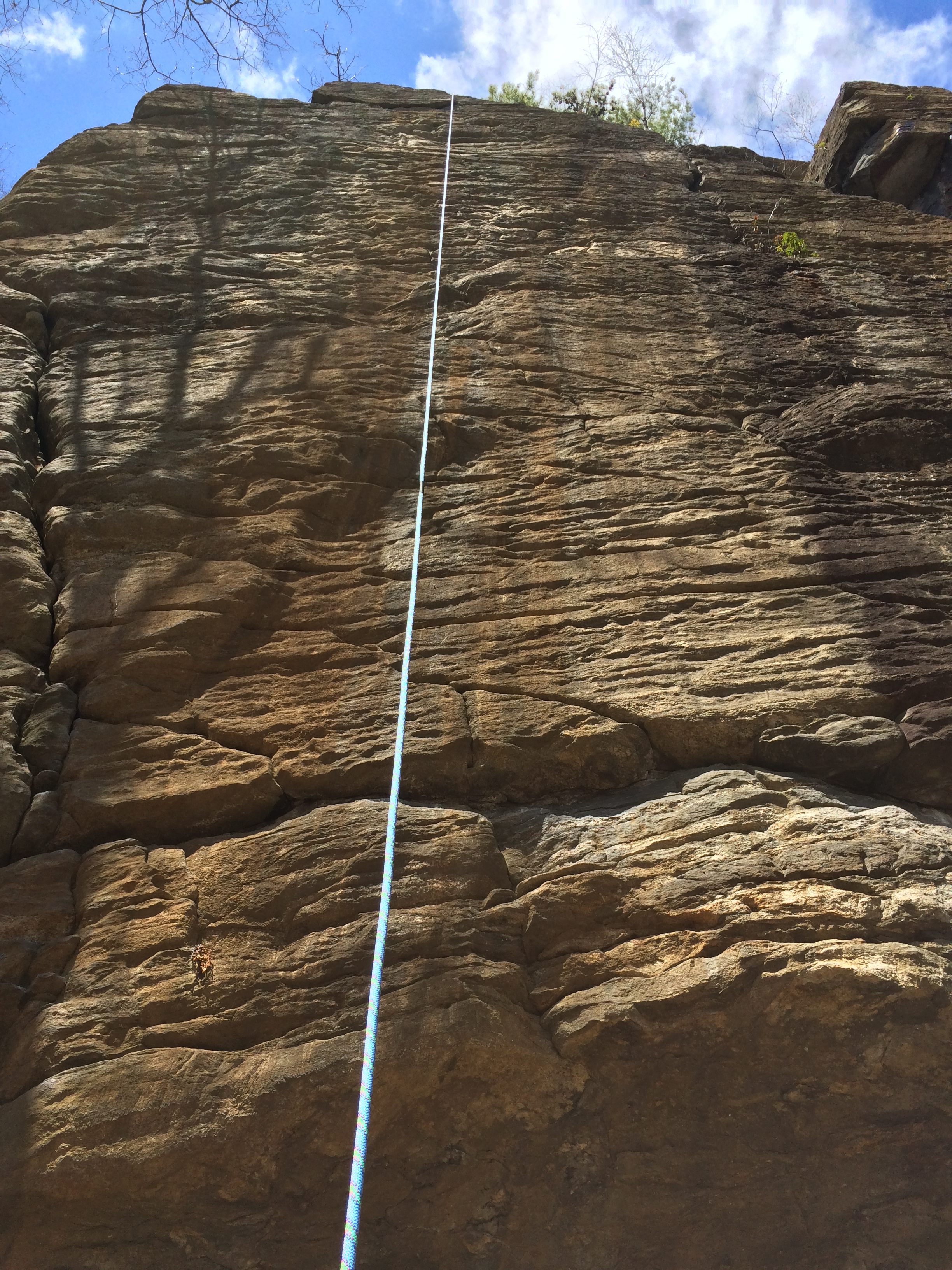
Fisherma’s Wall. The left diagonal crack is a 5.8, and it is difficult to make out in the photo, but there is a 5.11 crack on the far right of the picture. I like the shadows of the trees.

My jugged a line that fell to the left of that 5.11 crack on a less featured section of the face.

All these horizontal features are still a bit alien to me :) The rope actually falls about 20 ft away from the base, which gives some indication of the not so obvious overhang of the wall.

It took me awhile to dial in my system e.g. adjusting the daisies to the right height, getting used to pushing up with my left hand over my right one, dealing with annoying things like biner gates facing the wrong/annoying way etc. I think I worked out the kinks after the first lap or two. I decided to do five laps, then take a little break. I even allowed myself a few sips of water, despite my worries about peeing in my pants.

I then did another five laps. I was tired. I had also forgotten how much chafing action there is going with jugging (and I’m not talking about my rolls of skin :)). But the limiting factor in me deciding to make my tenth lap my last one wasn’t so much fatigue, as it was me not being at all psyched about my rope running over the edge like that. After the first lap, I moved the rope to be over a less sharp part of the edge, and would check every time I reached the top of a lap; but nevertheless, I was not enthusiastic about this and decided to cut out while I was ahead after a nice round number like Ten. Next time I will bring even longer slings and cord to run the master point over the edge.

Untitled

Hanging out.

All in all, in spite of my anxieties going into this, it was a rather successful day. I didn’t die; I didn’t get hurt; I figured out how to steeps/over-hangs again. Next steps will be building up jugging stamina, and figuring things out on non-overhanging terrain, where I will have to put my left foot in the aider and use my left leg. Also, I will have to figure out the hydration situation :( I found myself very dehydrated, even after this little affair, and I’ll have to figure out how I can drink enough to keep me hydrated without causing me to wet my pants with my incontinence issues; and how to cath myself on a wall. I am guessing there will be some trial and, unfortunately, error here.

Deflated, for no good reason…and feeling even more dejected because of it

Even though my time skiing and ice-climbing in Colorado had been tiring, Scott and I decided to head up to Jay Peak, VT the Saturday and Sunday following my return because snow conditions were looking promising: a few inches of snow throughout Saturday and some more accumulation on Sunday, and mild(er) temperatures (caveat: for New England skiing standards. On one chair ride on Saturday, when temps were still a good 10-12 degF or so, Scott and another guy were “complaining” about how they were getting so warm – #eastcoastskierproblems). Despite a 3.30am wakeup on Saturday morning after a few hours of sleep and a four hour drive up to the resort, we managed to hold it together during the day on Saturday.

I feel like I am in the odd position of having done all my skiing before my big accident in the West (and abroad), but much of my very short three-tracking experience post-accident has been in New England. Therefore, I feel like I occupy this no-man’s land of not being used to/not having a reference point for East Coast conditions but also not being used to skiing in deeper snow with one ski/leg. I do not think I will ever like East Coast skiing. As Scott puts it, when he goes out and skis in Western areas, he thinks that conditions are so amazing he doesn’t know what he did to deserve such awesomeness; whereas, I think that such conditions are the norm. When there is fresh snow on icy crust in New England, East Coast skiers think these are the best conditions ever. I merely think I am in purgatory as opposed to hell. I have never been a glades/tree skier. I mean, why on earth would I ski in between trees when I had wide open, steep bowls out West??

But, I still find myself holding myself to incredibly high standards. Just because I have this disability and ski on one ski doesn’t mean that I should struggle in tougher, less familiar conditions, right? :(

Scott and I did a lot of advanced runs off the Jet Triple Chair*. We went down a bumps run which was icy, sparsely covered with lots of exposed rock, and had me cursing as to why I was putting up with this bullshit. It wasn’t pretty. Here is a video of me emerging from that shit-show of a run, and doing some turns underneath the lift. It’s a black-diamond run; it is hard to make out the bumps and the variable conditions (ice, dust on crust, etc), which made it more challenging.

As I watched this video, I noticed people on the lift turning their heads to watch me. My first reaction is to grimace, and think, Man, they must be watching me because I look “weird” and because I am moving so ungracefully. But when I allow myself to be a bit kinder to myself, I think, Oh, maybe they are looking at me because I’m going down a less than easy run on one leg?

A few inches of snow had accumulated by Sunday morning, so we got on first tram and I decided to try my wider Volkl Auras. Things did not go well. My leg was not as fresh, and every movement felt so onerous and painful. Scott says that when I was moving, I actually looked good. But it did not feel that way. As the morning progressed, I felt increasingly dejected, thinking, this is as good as I will ever get (which is pretty fuckin’ crappy). For some reason, with every single bump, every time I pressured my right shin, I felt like crying. I later found out that I had an edema on that right shin from cranking so hard on my ski boot buckles and having that one shin bear my entire body weight, as opposed to splitting the load between two shins. But, it didn’t occur to me that I had a slight injury. All that I was thinking was, WTF Wendy, this…you…are fuckin’ pathetic. I was on the verge of tears and just called it quits by 11.30am or so because what was the point of skiing if I was hurting and just not having fun.

I continued to beat down on myself the rest of the day on Sunday and into Monday. I felt like I had ruined a great weekend with Scott, and that I just plain SUCKED at skiing and would never ski the stuff I used to ski ever again. The thing is, even if I don’t, what is wrong with that?? The answer is, absolutely nothing. It’s just skiing. But reflecting on my disproportionate reaction just made me feel even shittier and start judging myself about my lack of perspective and inability to better control my reactions/emotions.

Incidentally, I am feeling better today. I am still looking forward to skiing in Alyeska, AK in another few weeks. I am trying to approach skiing in Alaska as a learning experience, rather than something to get down on myself on, even if I suck ass. And, also, an opportunity to meet and hang out with some cool people. There are worse things I suppose.

*Scott told me on Monday that he had hoped to get me on the Jet Triple Chair by next season; so I am one season, at least, ahead of schedule. This offered me little consolation. It reminds me of this guy I know who wanted to hit the slopes with me and wrote “We can stick to blue/green runs if you like.” I suppose one could defend him and say that I’ve advanced pretty darn quickly for someone skiing on one leg. But, still, I flipped him a big, figurative bird. He can look at my behind as I zoom past him.

Wabi-sabi

I recently came across the Japanese concept of Wabi-sabi: “Wabi-sabi is the Japanese idea of embracing the imperfect, of celebrating the worn, the cracked, the patinaed, both as a decorative concept and a spiritual one — it’s an acceptance of the toll that life takes on us all.” (Source here). I like it.

For a long time, I saw myself as this completely damaged person. I thought, who would want to be with someone as broken, physically and, to some extent, mentally, as I am?? It is only in the last year or so, that I’ve finally come to appreciate the burnishing I have, and how this makes me beautiful, rather than disfigures me. I used to be very self-conscious about the long, big scars on my back and hips, especially when I was wearing a swim-suit. Now, I almost take pride in my battle-scars – I have certainly earned them. It is funny when someone will describe a scar of theirs they think is super-gnarly. I just nod and silently think, I’ve got you beat on that one.

My partner used the word “patina” very early on in our relationship; and patina is, well, beautiful. He said, before your accident you were just another pretty, smart, athletic climber chick; but having come through your accident the way you have, makes you remarkable. He says he wishes I could see myself the way he and others see me. Self-perception versus truth has always been something I’ve struggled with, and I know many people do too. I am working on getting better at seeing myself in a more objective light.

Old photos post-accident

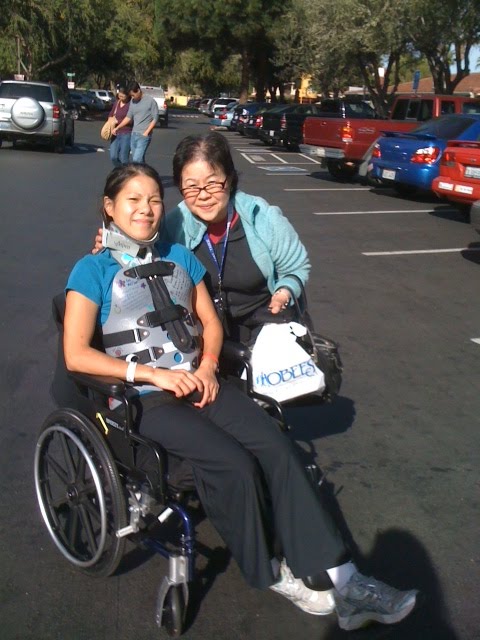
I made the conscious decision not to document myself right after my accident, because I felt like this was a part of my life I would never want to look back on and recall. I regret this decision because it would have been documentation of just how far I have come. So, I only have a few pictures. I found these two, which was my first excursion out of the hospital (acute in-patient rehab), just for lunch. It is funny how looking back, it is still very fresh how this was a really big fuckin’ deal. It took a lot of OT and PT to prepare myself to even handle leaving the confines of a hospital, and all the worries about having and handling a bowel/bladder accident. But the challenge was also largely emotional and mental, where I had to face my deep worries of anticipated self-consciousness and being in a public place where people could see me in this state. I am thankful to have my dear friend, Jen Sager, be there with me, and my mother.

You can see that I got friends to sign my turtle-suit. Eating with the full cervical neck brace was not easy either. I remember being so happy when that thing came off. It was like, wow, I have a neck!

I wore baggy sweatpants exclusively for many months because, with my paralyzed leg, I could not dress myself with any pants that were in the slightest bit form-fitting. Putting on my first pair of jeans quite a few months afterwards felt like such a triumph.


wheelchair

Smiling in this photo, but crying inside.

wheelchair2

Looking noticeably more pissed off with my Mum. She drove me bonkers (and still does) but I still love her.