Yosemite 2015 – Part 1

Well, there is quite a bit of catching up to do. I am back facing the daily grind of life, but will be posting about my time in the Valley. I was not sure what to expect, given all the uncertainty around my original objectives. There was disappointment and surprises (good and bad); but, overall, the trip was a wonderful and healing experience. Apologies in advance if the tenses are bit weird here and in the next few posts.

IMG_1963

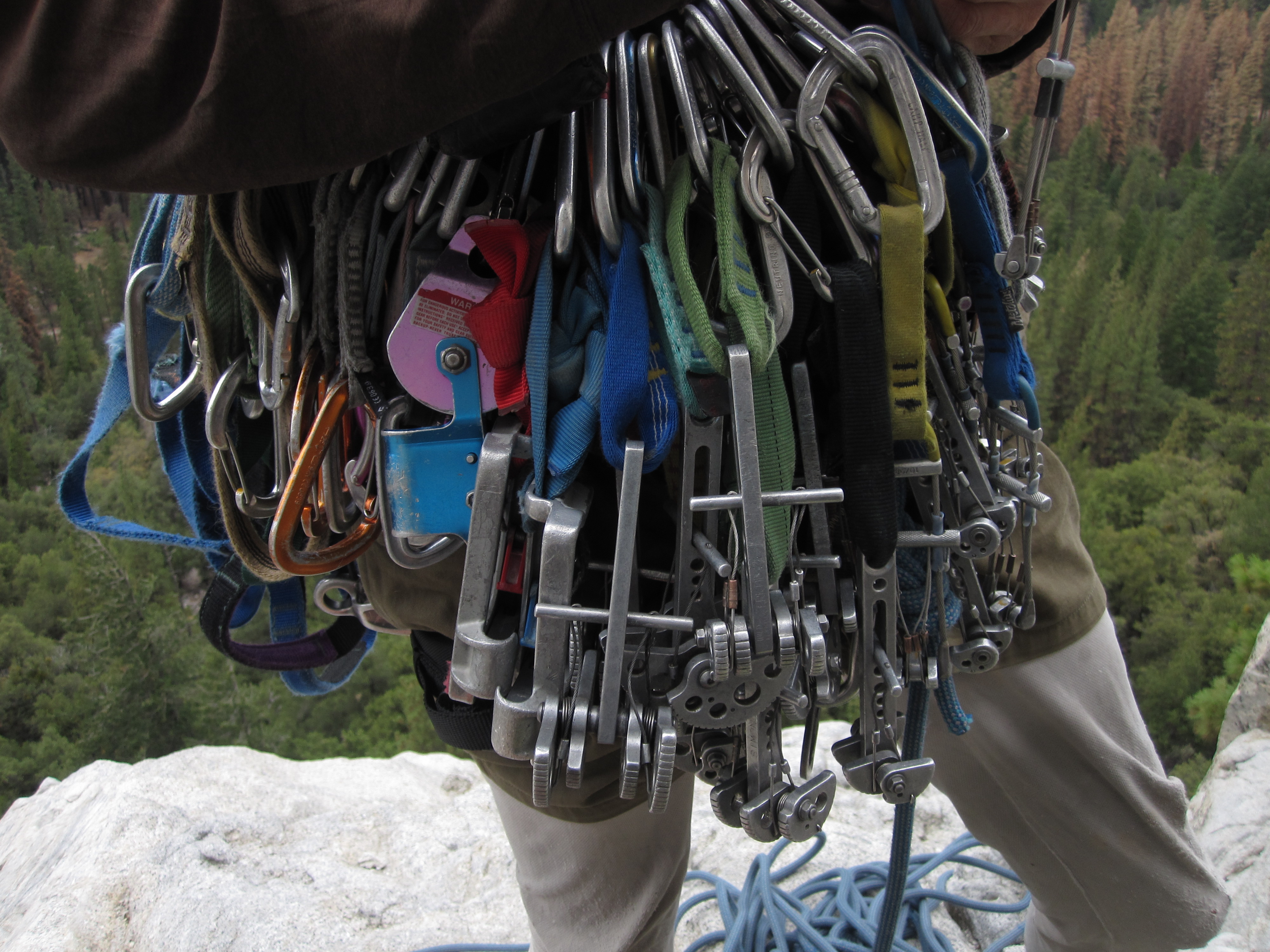
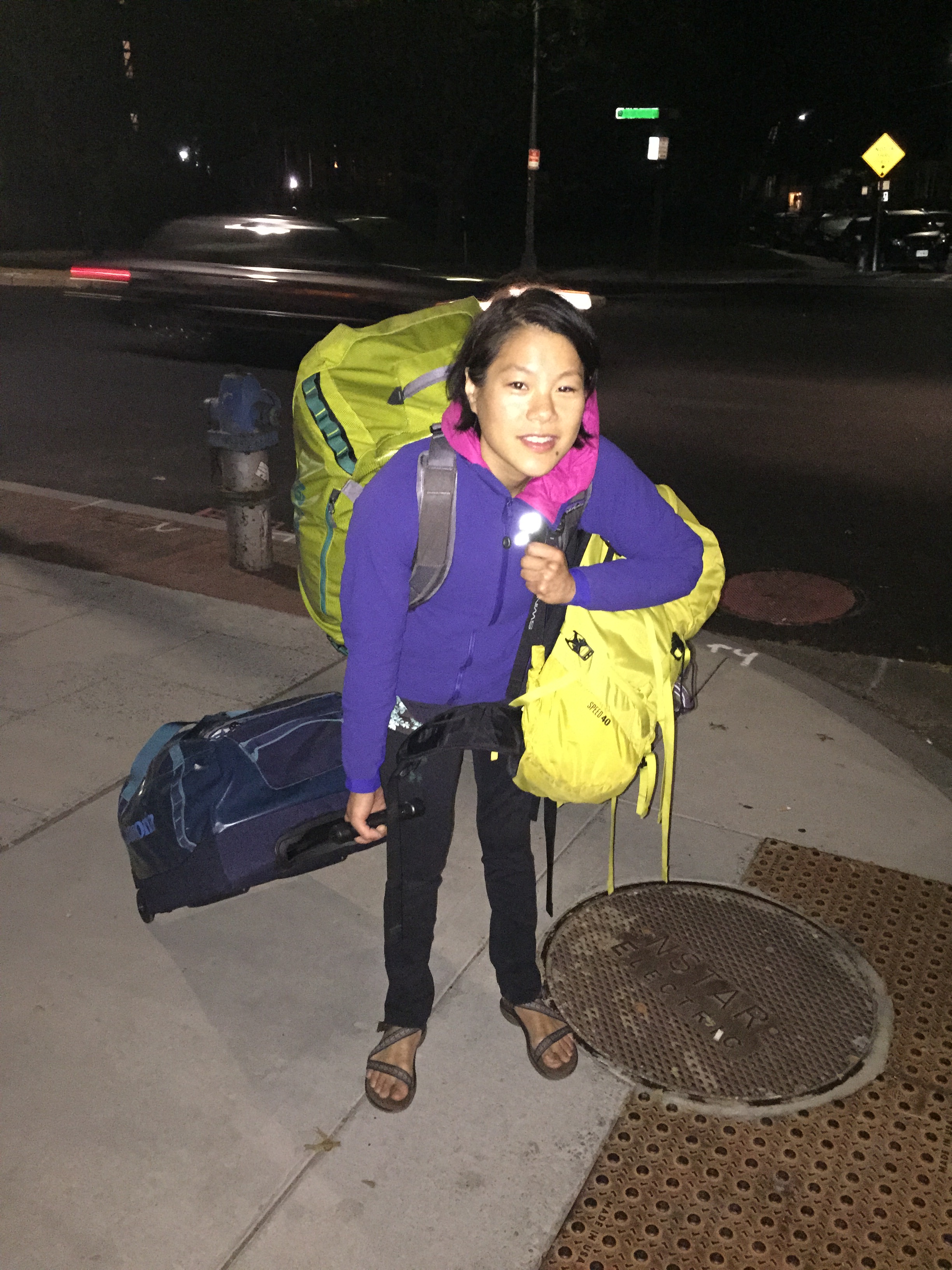
Since my plans were unclear, I ended up bringing a lot of my free and aid-climbing gear. It is hard to tell, but the rolling bag is twice the capacity of the gear bag on my back.
IMG_1962

I am carrying ~125 lbs worth of gear (and I weigh 105 lbs on a good day). So, yes, it was a bit of a circus lugging these bags around airports and rental car terminals.

So, what do you do when your original NIAD partner backs out one week before your scheduled departure? You get back on the big stone anyway, the leisurely, older than old-school way. My friend, Clint, threw out Lurking Fear and Zodiac as alternatives to The Nose, in case it was too busy. The less slabby hauling on Zodiac sounded much more appealing; but the short approach to The Nose won out, and we at least went out to see if there was a line and see if we could fix lines to Sickle Ledge.

IMG_1251

An old friend.

Older than old school.

IMG_1248

Clint starting up. The weather was unseasonably cool and the sky became less blue as the day went on.

DSCF1149

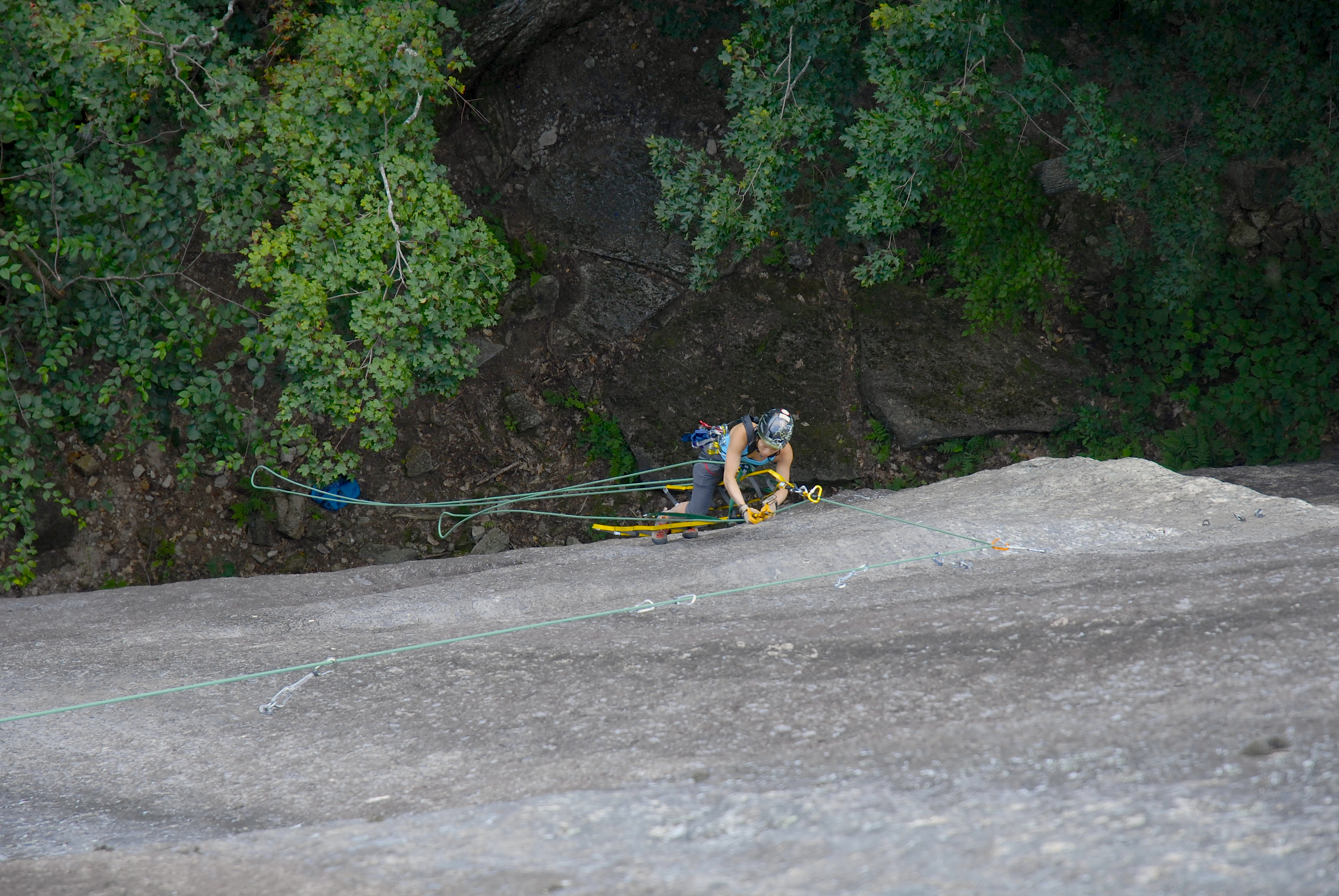
Lots of lower-outs on the route.

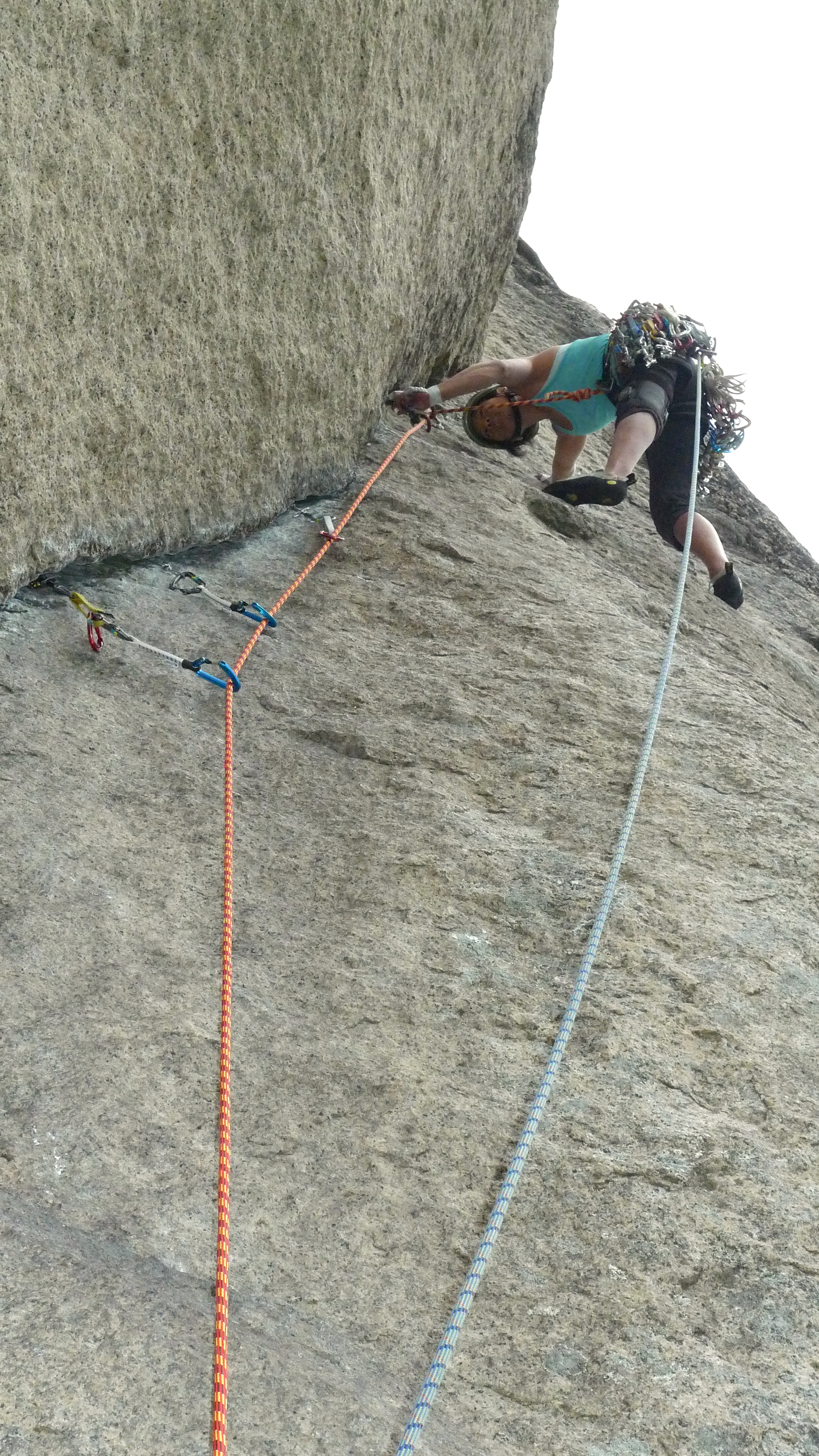
I find that even on slabby terrain, keeping just my right (good) foot in an aider works the best for me. My left foot/leg can be utilized more when it is allowed to stick out straight, and it is hard to keep that foot in step-aiders anyway. I do keep a ladder aider attached to me though, just in case

DSCF1146

(Photo: Clint Cummins)


DSCF1164_adj

We got to Sickle just as the sun was setting (Photo: Clint Cummins)

We decided not to pack the haul bag and haul to Sickle that evening, deciding to just crash and sleep on the ground instead and deal with things in the morning. This was a decision I would later regret.

The next morning started off, as usual, very leisurely. We took our time waking up and then dealing with packing the haul bag. Then we began the jug up the fixed lines to Sickle. I was curious to see how my stamina would be for non-stop jugging for quite a ways, as this would give me a better idea of how I might do jugging as fast as possible, continuously, in a NIAD attempt. To my pleasant surprise, I was not moving slowly or getting too tired too quickly.
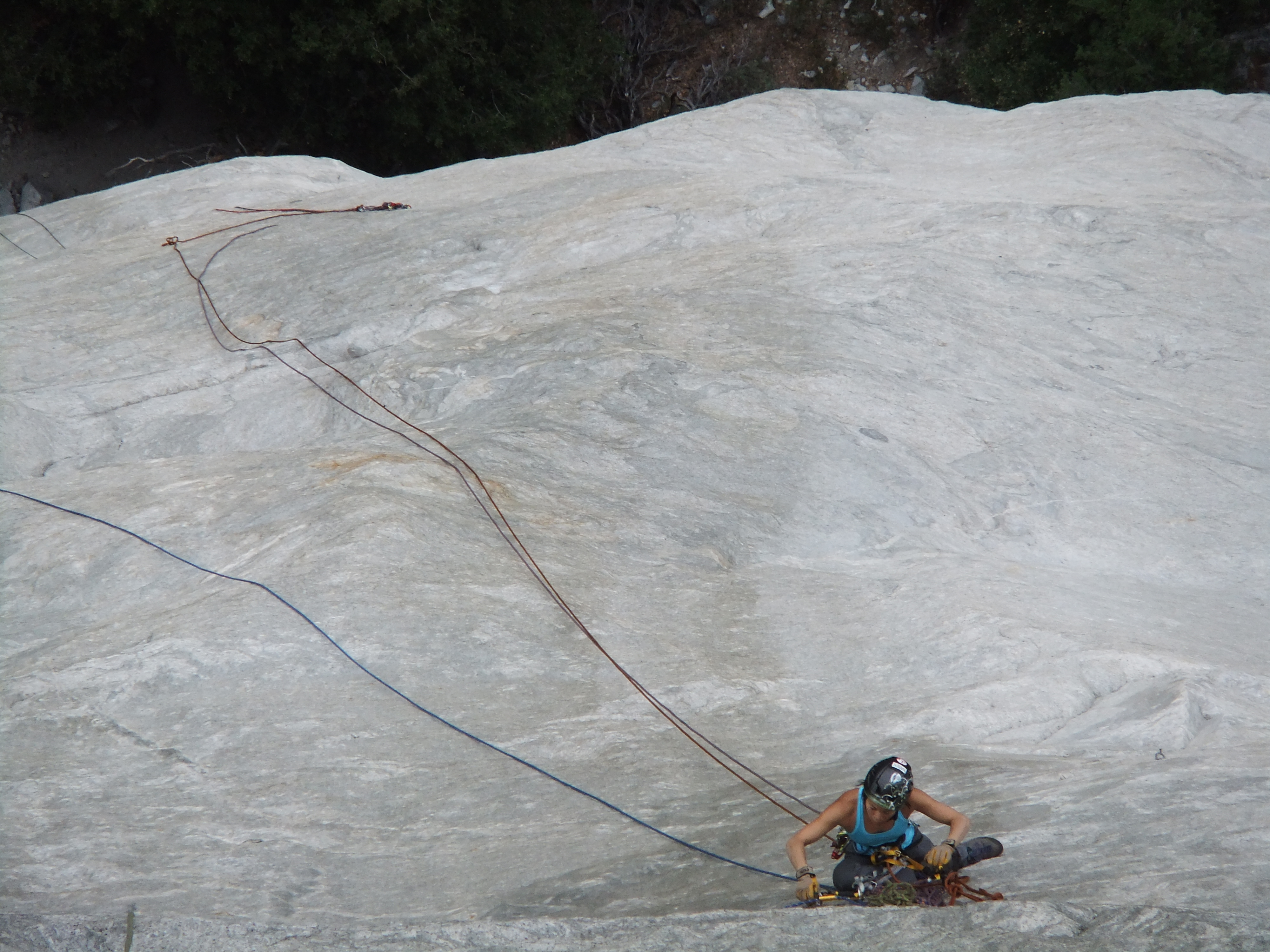
DSCF1167

Moving from one fixed line to another (Photo: Clint)


And what does one do when they are done with their extra fixed line, which is not required for the rest of the route? Why, this of course.
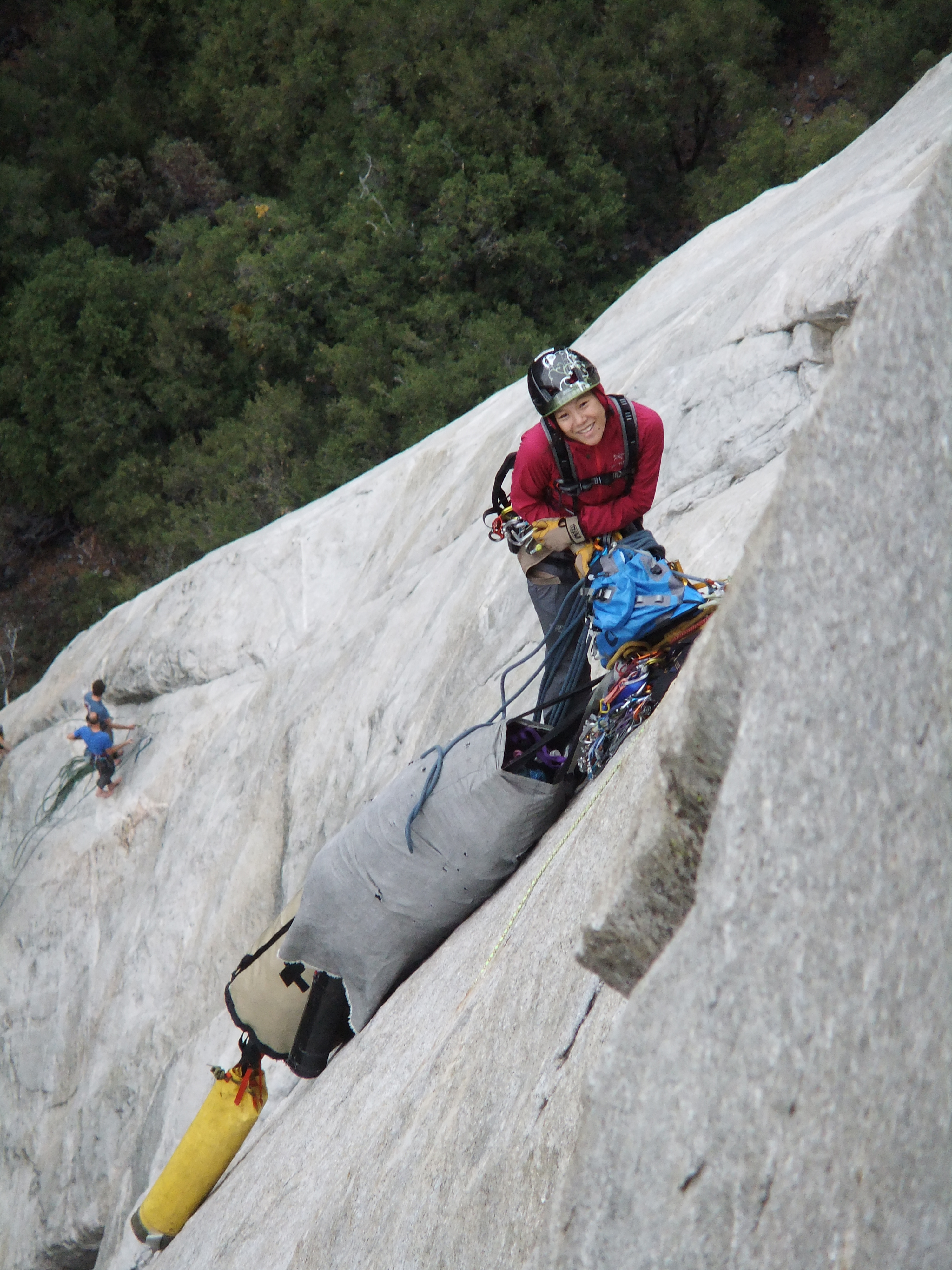
DSCF1173

Guess which one is Clint’s (our) haul bag? This was the first time I was introduced to the concept of a haul bag condom (Photo: Clint)

DSCF1175

More lower outs (Photo: Clint)

DSCF1177

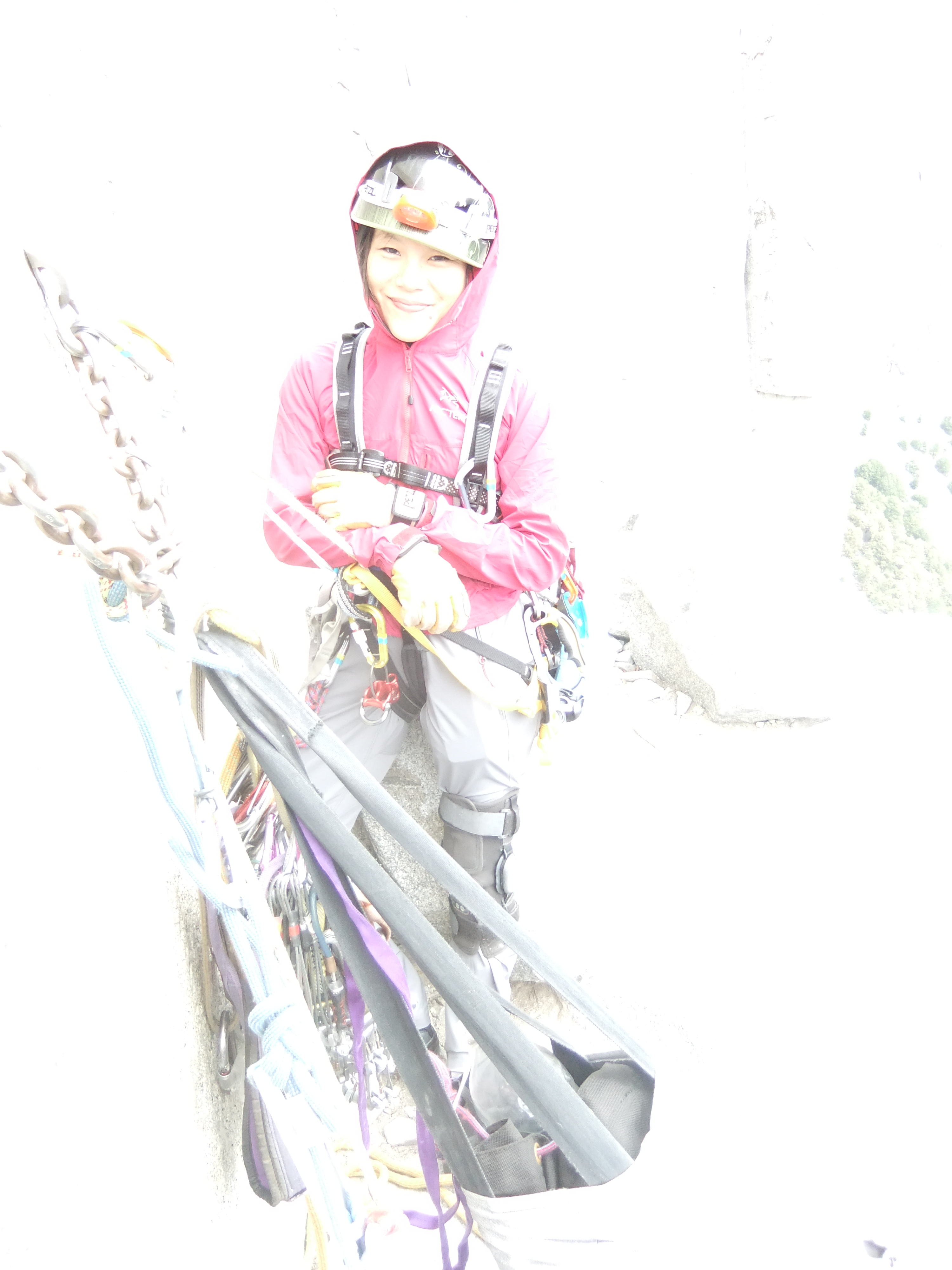
The lighting in the photo is deceptive. The fact that my headlamp is poised on my helmet, is not. (Photo: Clint)


The combination of our very leisurely start and some hauling misadventures (it took a very very long time to get our haul bag up to Sickle and beyond) led to an all night epic. Clearly, I am built for fast and light, not frigid multiple-hour, uncomfortable belays. I was struggling to keep it together in the dark and cold. Turning off my headlamp to conserve battery life just made me feel even more alone and cold. I was shivering uncontrollably at points and at one point teared up, as I do when I am very very cold. I knew I had to keep composed though and get myself, our bag and our gear to Dolt. Clint was a total chief, doing some long pitches in the dark and hauling.

As I was waiting at the hanging belays, I heard from faster parties that there was rain/thunderstorms in the forecast, which was why so many parties were trying to do their NIAD run that night/day. After napping on Dolt for a few hours, we made the decision to go down. It was not a difficult decision to make, given we had little in the way of rain gear, and climbing the route in wet, cold conditions, with lightning and thunder would have been ridiculous. The forecast did materialize and we did well to get off the route. Of course there was quite a bit of disappointment not being able to finish the route due to factors out of our control. But what can you do about weather? What would have been worse would have been to bail and then see sunny skies the rest of the time. Most importantly, we both got back to the ground safely.

Clint put the following two images together to show where along the route we reached and descended from.

POV_2743R

Nose_to_Dolt_ov

I guess there were a lot of positives to this experience. It felt good to know that I am back in the big-wall game; that my modified jumaring technique works even on vertical non-overhanging terrain; my jumaring stamina and speed are good; confident/comfortable on lower outs (found that the Deucy worked fine); and I was not the limiting factor (well, I was pretty useless for the hauling – which was a bitch. Clint and I need to find a fat person as our counterweight or at least find someone a lot heavier than the two of us to do the hauling).

I extended by trip by two days in the hopes of a possible NIAD attempt the next weekend – partner and weather-dependent. I couldn’t believe there was so much wet and cold weather in the forecast. What the hell!

Getting back on El Cap has rekindled the flame and given me perspective for future trips; if NIAD does not work out this trip, I will try to come back in the Spring when there is more daylight. I would love to solo a big wall route, but think the hauling thing will be a deal-breaker for me.
Trip update

Well, I have spent the last five days feeling extremely frazzled and dejected. Despite frantically reaching out to friends and strangers, as of now, I have not found a partner who can do NIAD with me in my specific time-frame. For reasons around time, expense, and grant stipulations, I feel like I have to attempt NIAD this trip.  I am also in good shape now and I do not know whether I will be able to maintain outdoor climbing shape through the winter months in New England.

Having the rug pulled out from under me so last minute also highlights just how poorly I deal with improvisation and lack of plans.

However, I had a slight shift in my thoughts today. As my friend Chad correctly says,  getting up a big wall is most about highs and lows, adapting to setbacks, never giving up and having some luck. This translates well to life. El Cap is not going anywhere any time soon, so there is the option of attempting NIAD in the spring if I can find someone to do it with. My friend, Clint, also suggested we go up El Cap the more leisurely way, and do a multi-day thing either on The Nose, Zodiac or Lurking Fear. The last two options will have much tougher approaches for me (especially with a heavy haul bag), and require portaledges. Worse comes to worse, I spend a day making multiple trips humping loads.

It will still be my first big-wall route since my accident, so I know just getting up El Cap, no matter how slow or fast, will be a worthy accomplishment in itself. I don’t want to feel frazzled and rushed if/when I attempt NIAD; so perhaps going the slow route this time round might be the more prudent and enjoyable thing to do anyway.

Although I was feeling completely defeated, I was somewhat heartened by the response I got from some climbers I propositioned, some of them some pretty big names! While none of them could climb with me at that time, their support for my continued journey and comeback moved me to tears.

Update to update:

There is one young kid who might be willing to do this with me. I just need to see for myself whether I’ll be able to stave off the forearms cramping or bonking on the last third of The Nose.

My (romantic) partner told me, as I was expressing to him all my feelings of complete failure:

But Wendy, so what? Really. You haven’t done a big wall for five years. You had a fall that should have killed you. So bopping out to Yosemite, walking up to El Cap, and doing NIAD on your first outing is “reasonable”?” :)

The hydration/nutrition issue will really be a key thing for me to figure out. And while I am fit and have good stamina, who knows what it will be like on a wall when one leg is getting a free ride.

Big NIAD setback

It’s been a rough month on the personal front. So, you can imagine how I felt late this morning, when I received an email from my NIAD partner that he had hurt his hamstring (on stupid plastic, no less!) and could no longer do NIAD with me. I know stuff like this happens, and we have no control over such things; but still, the timing is pretty bloody awful.

I am reaching out to my contacts to see if I can find a replacement partner; the problem is, the person has to be someone I totally trust, who can climb within a very specific time-window due to my limited time out in the Valley (and my schedule had been centered around my old partner’s availability); and who will be patient enough to do the descent with gimpy me.

I am an atheist and humanist, but it still seems like the universe is playing a pretty cruel joke on me right now. Trying not to feel totally crushed and deflated. I know I have two choices: 1) Give up; and 2) Head to the Valley and improvise. The latter is not my usual MO (neither is the first one). This is another “test of character”, when really, I just wanted a “test of climbing.”

No avoiding slab…

I have mentioned in previous posts that jugging on slabby/vertical terrain will be one of the biggest challenges for me. This is because, normally, you want your weight to be over your feet (i.e. a body position that is as vertical as possible) so that the larger muscles of the leg do most of the work; as opposed to tiring out your smaller arm muscles. However, my left leg likes to stay straight because I can lock the knee out and use it a bit. This makes my butt stick out and has my upper body doing a lot of the hard work.

I could not avoid practicing jugging on non-overhanging terrain, so off to Crow Hill I went. Again. It is worth mentioning that on my very first excursion to Crow Hill, I really wondered whether I would be able to carry my fat rope, static line and aiding gear by myself. It is not a long approach by “normal” standards; maybe 20 minutes or so to the base of the crag, and then a walk up a defined trail to the top of the ledge to set up anchors. I declined offers of help to carry my stuff because I needed to prove/see for myself whether I could do it on my own. Subsequent trips have not been a problem at all, so that is one thing to be pleased about I suppose.

I set up a fixed line on a dinky slab and experimented around with different aiders. I first tried using a Metolius Easy Aider on my right leg, and then a regular ladder aider on my left leg. This proved to be quite inefficient as my left foot kept coming out of the ladder aider step. Perhaps I could strap my left foot to a step using a velcro strap? I decided to ditch the left aider altogether and just have my left leg free to be straight. This works decently on a surface with a fair bit of friction. I have doubts about whether this will work on a smoother surface, such as El Cap. I am going to carry a spare ladder aider regardless.

There has been a slight shift in my attitude towards this goal. I am still feeling self-inflicted pressure to “succeed”, but I am also realizing that I need to take the pressure off myself and just enjoy climbing one of the sweetest lines around. NIAD is a big mission that some of the best in the world fail at; there are so many factors that play into this e.g. weather, other parties on the route, logistics etc. I received some excellent advice; to start up in the evening (while it is still light) when everyone else is settling into their bivys; then climb through the night (with multiple headlamps for the hands and feet), when traffic is lightest. Hopefully we will be high on the wall at day break, giving us daylight to finish the climb with.

So, I need to climb at night and figure out the whole lightning scene. And I will have to assess how much water I should bring and drink. I know that it can get really hot ton El Cap and underestimating the heat up there is potentially dangerous. Do I risk just peeing in my pants? Or do I just maintain a state of slight dehydration? I’m leaning towards the former…

Anyhow, the road to The Nose continues…

Thrown into the aid-climbing deep-end (photo edition)

Lots of photos for a change…

Chad happened to catch me when I was actually smiling.

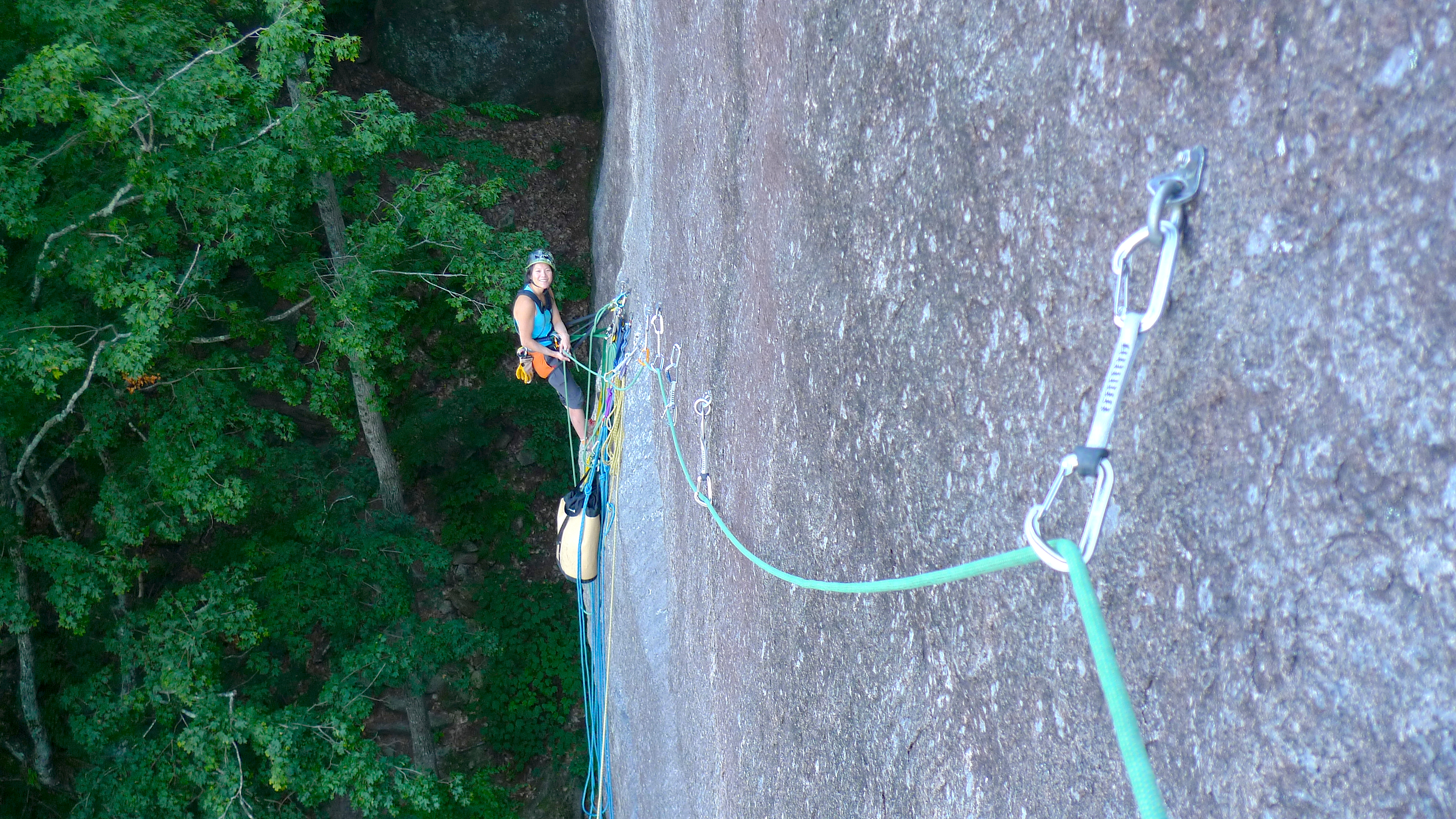
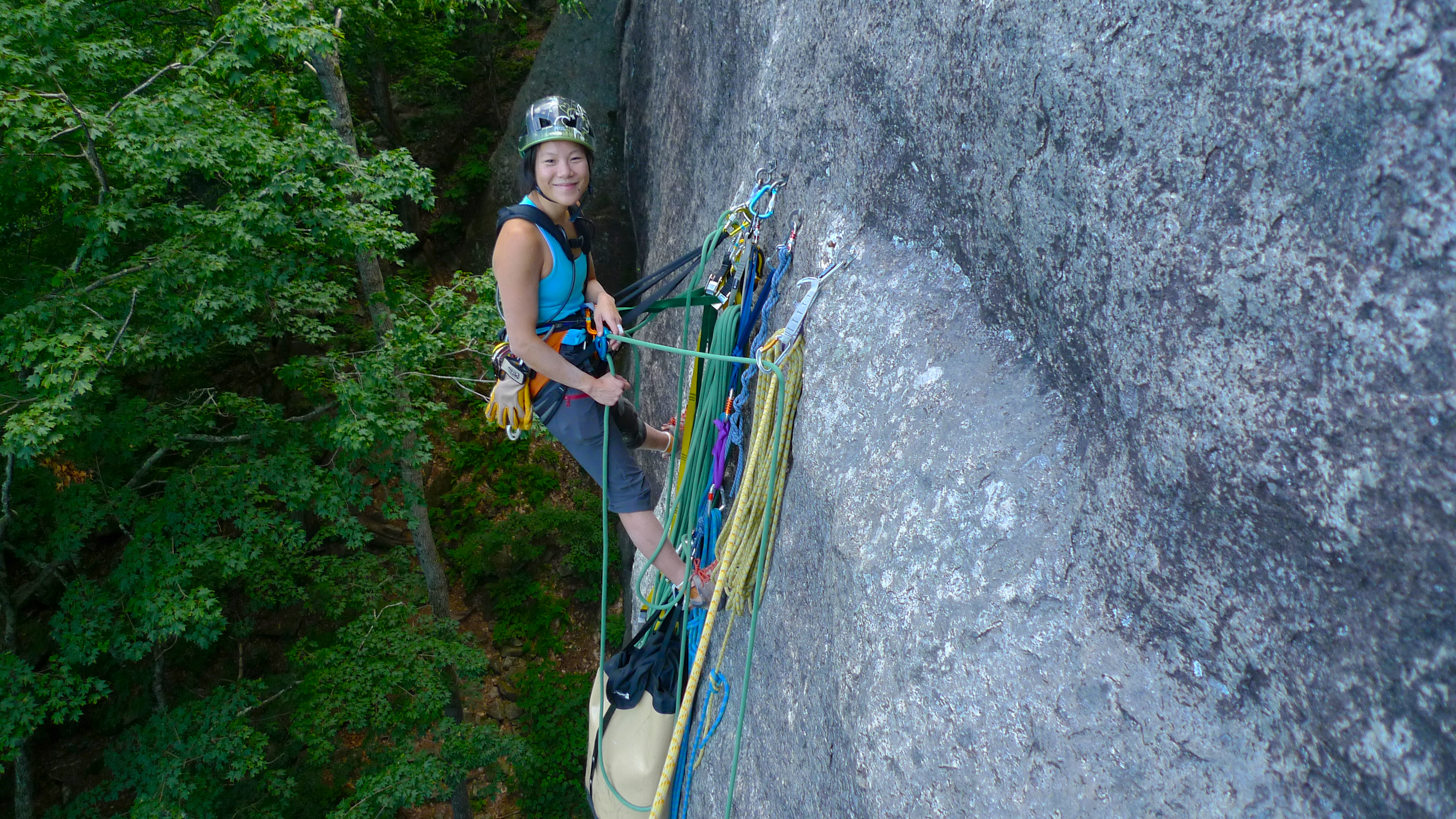
Chad happened to catch me when I was actually smiling (Photo credit: Chad Hussey)

I do not remember how Chad and I ended up arranging to climb together in North Conway this past weekend, but I am very glad we did. I first met Chad at my very first climbing experience (on any medium) post-accident: a Paradox Sports ice-climbing event in February 2013. For some reason we have kept in touch and Chad has been a steadfast supporter of mine since then.  Chad was aware of my NIAD plans, so he put forth the possibility of doing some aid-climbing together. The weather forecast was not looking good: a long weekend of straight rain. But we were committed to going, so I mentally prepared myself to spend two straight days being pretty miserable in the rain.

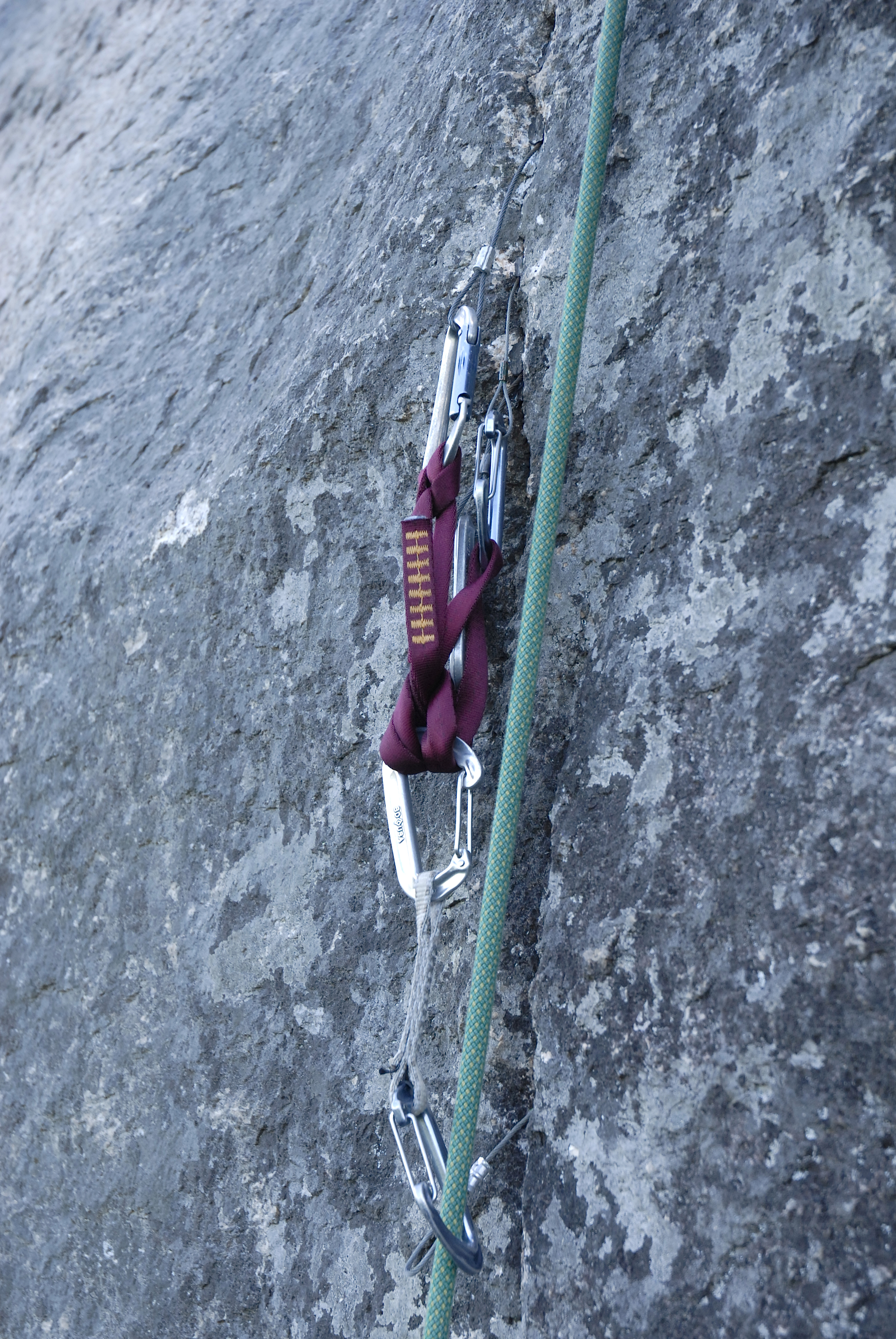
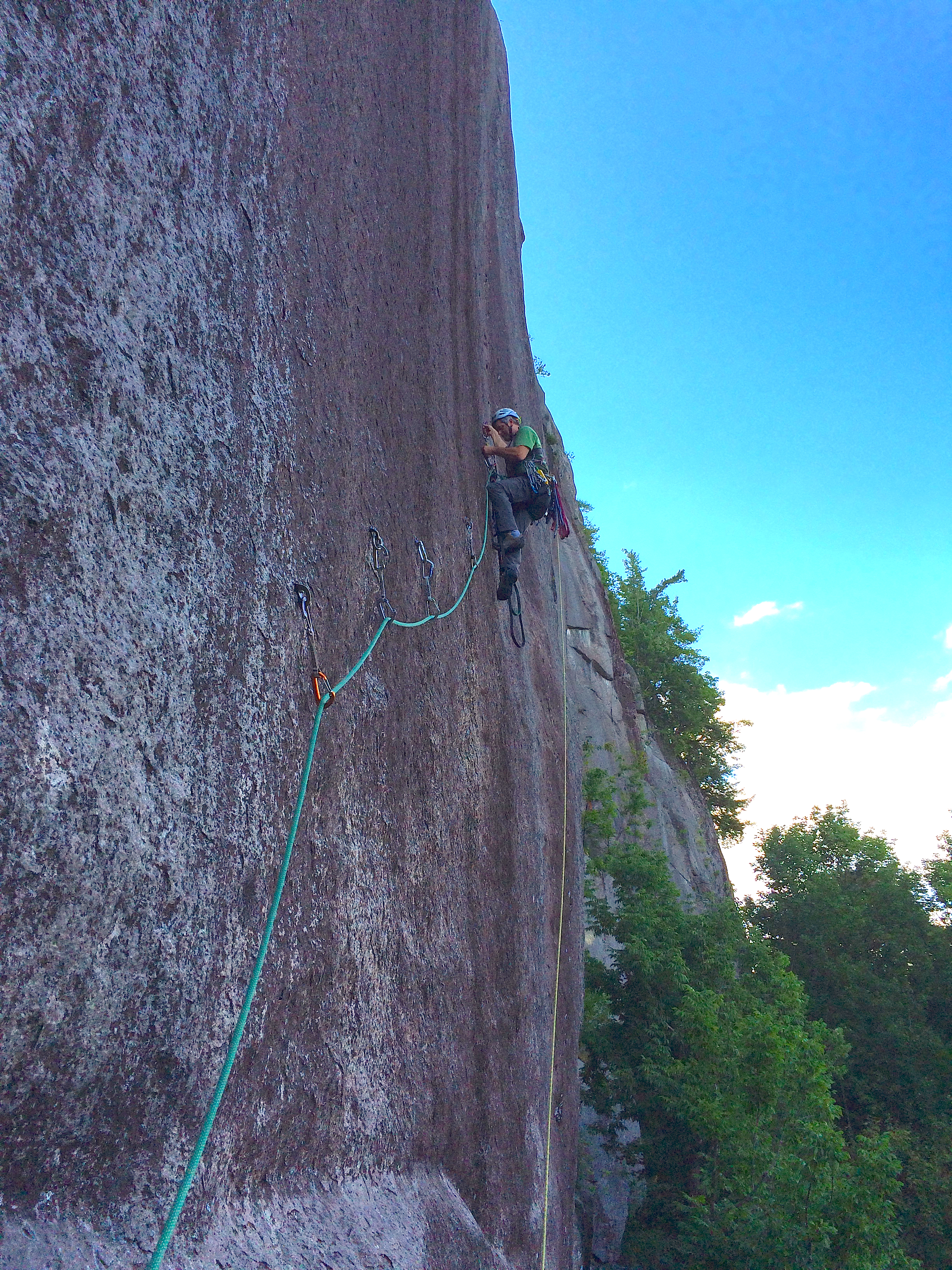
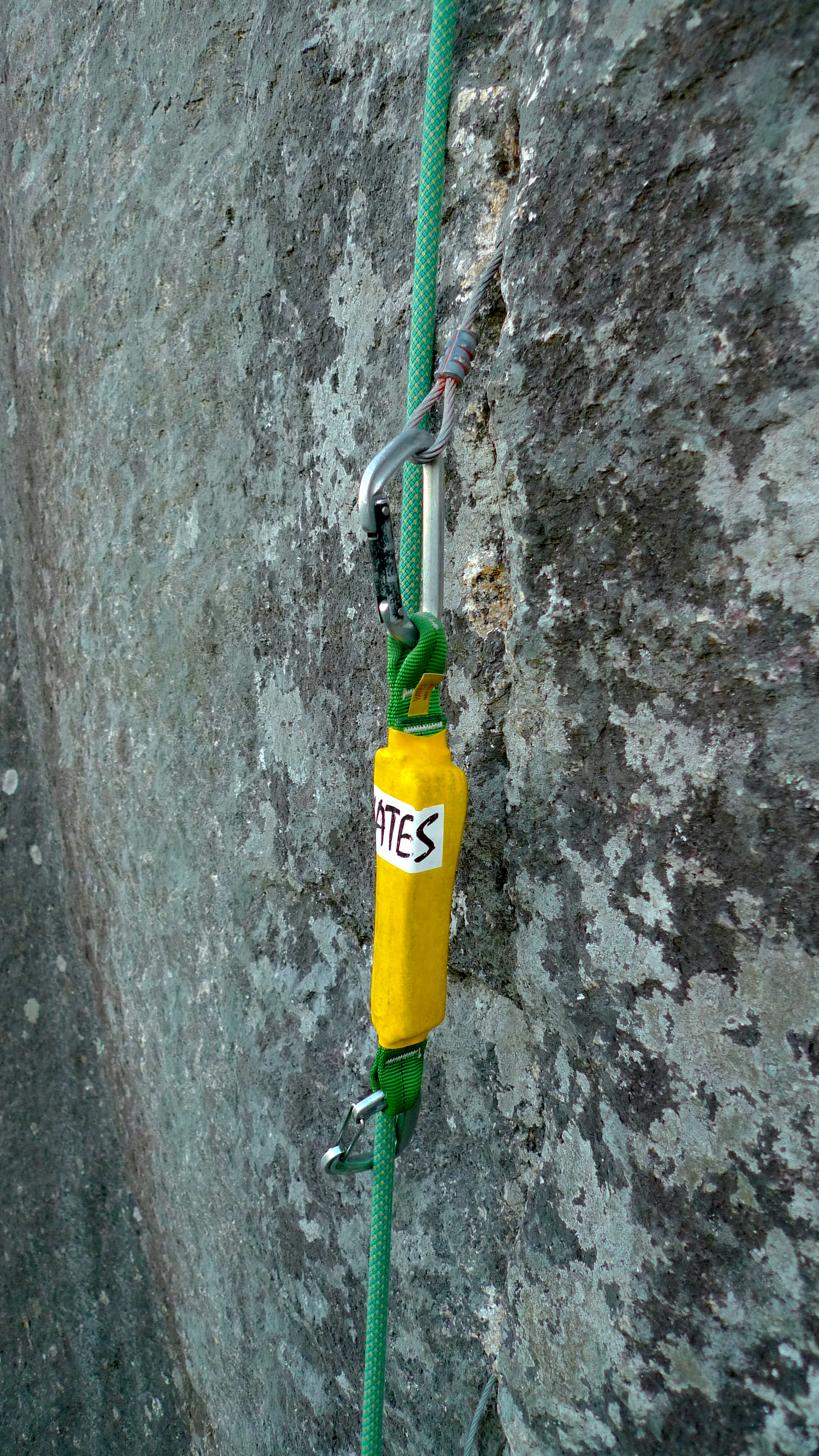
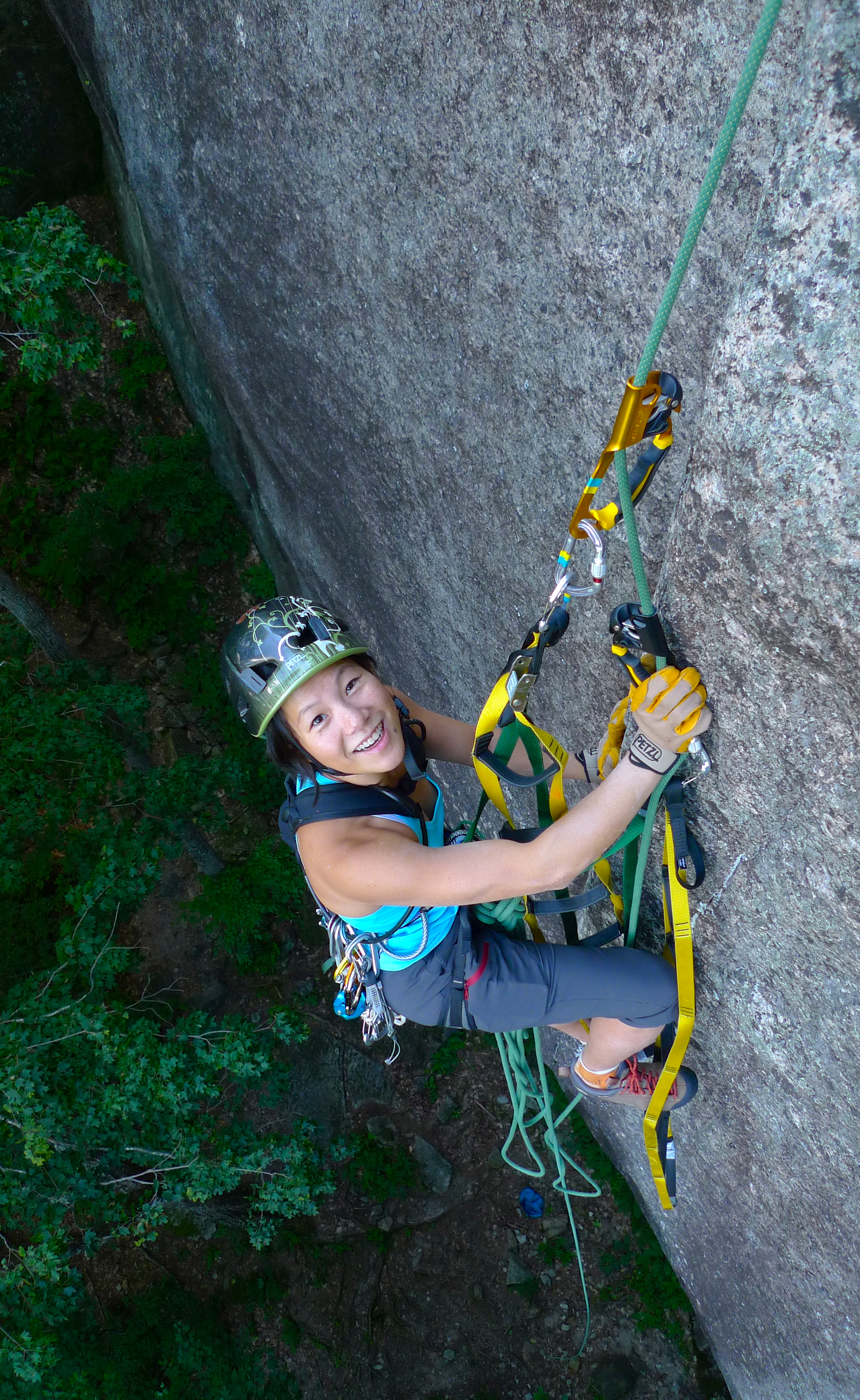
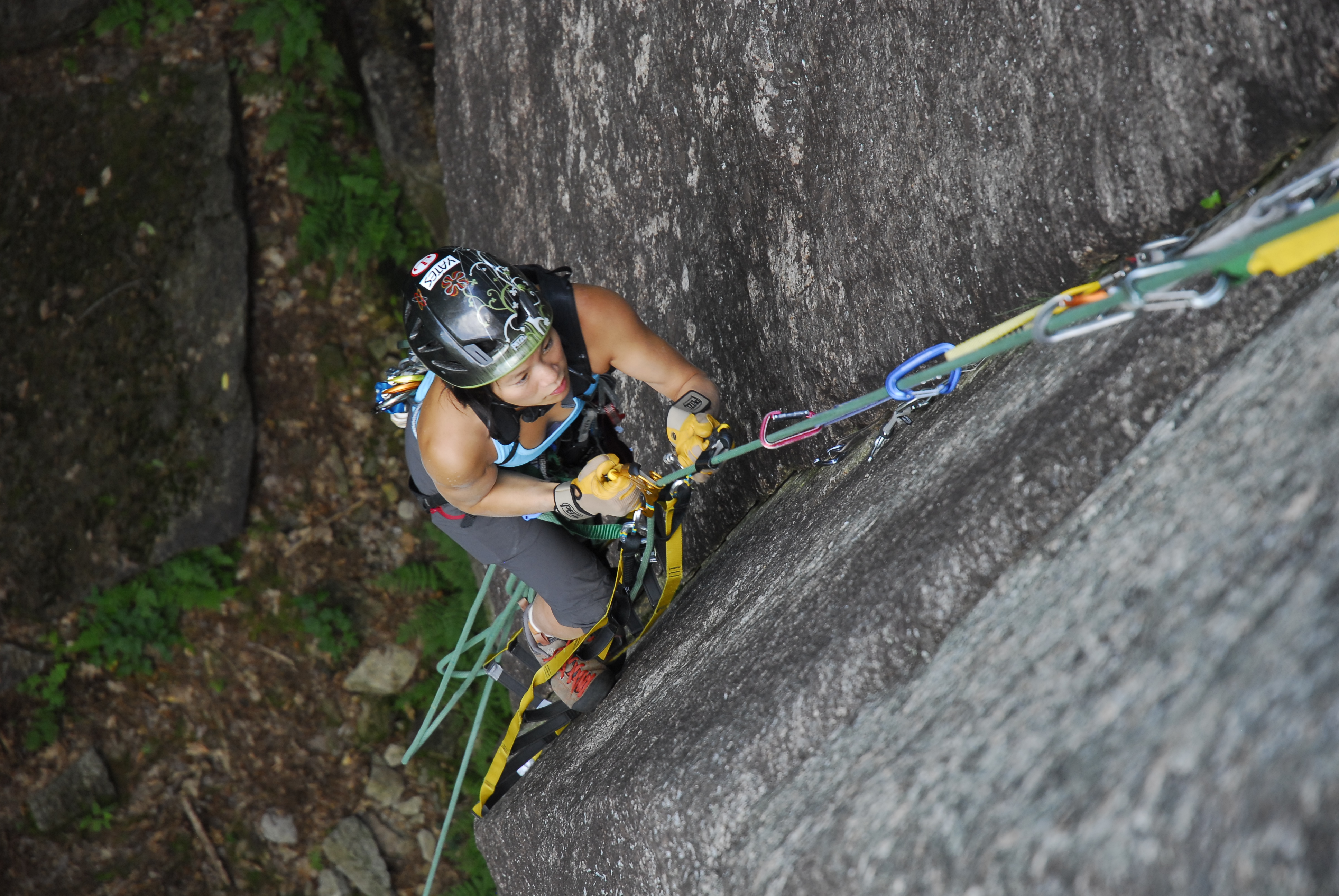
The weather forecast improved but we still decided to get on Mordor Wall with bail options. The route gets a C2-A2/A3 rating, depending on the condition of the fixed copperheads. This was my first time following and cleaning post-accident, and it was pretty disheartening to see how much I had forgotten and how slowly I moved. But, I learned a ton. The second pitch in particular contains a section known as the “Terror Traverse”; which teaches you how to get good at following and cleaning near-horizontal traverses quickly. “Traverse” is, like, two 4-letter words in one. I went with the “deucy” method and had a slow time with that. The combination of my slowness and some separate personal worries really made me think about calling off my NIAD attempt. But, while hanging out on the wall, somewhat miserable and trying to regain circulation that had been cut off by my harness leg loops and belay seat, I knew I would just beat myself up even more for not even trying.

Who knew I looked so focused? (Photo: Chad Hussey)

Who knew I looked so focused? (Photo: Chad Hussey)

The

The “Terror Traverse” on Mordor Wall (Photo: Chad Hussey)

Yay, rope management (Photo: Chad Hussey)

Yay, rope management (Photo: Chad Hussey)

Cleaning the Terror Traverse (Photo: Chad Hussey)

Cleaning/lowering out on the Terror Traverse (Photo: Chad Hussey)

Chad did an awesome job hooking his way across/up p2; the copperheads that were in place were not the most reassuring sight.

“CopperNest” (Photo: Chad Hussey)

Chad cruising the traverse (Photo: Wendy, enhanced by Chad)

Chad cruising the traverse (Photo: Wendy, enhanced by Chad)

Precautions (Photo: Chad Hussey)

Precautions (Photo: Chad Hussey)

Chad provided a lot of useful feedback on things I could perhaps improve on/eliminate/try. I will be trying to find the time to experiment with some different set-ups that might work for me and my gimpy leg. All those one legged squats will be great training for ski season, if nothing else.

Fortunately I redeemed myself by being the rope-gun on Saturday. I had never gotten on the North Conway ultra-classic Recompense, so we hopped on that.

While only three pitches long, each pitch is quite long. I'm getting quite high up on pitch 1 already.

While only three pitches long, each pitch is quite long. I’m getting quite high up on pitch 1 already (Photo: Chad Hussey)

Chad coming up p1 of Recompense

My favourite pitches were p2 and p3, by far. Fortunately, it only started raining hard and blowing when I was past the harder sections of p3. Nevertheless, things got quite atmospheric and I was plugging in a ton of pro at the top in case of slipping and falling.

First moves off the deck, p3.

First moves off the deck, p3 (Photo: Chad Hussey)

Surprisingly easy time, even though I can't stick my left foot in cracks any more.

Surprisingly easy time, even though I can’t stick my left foot in cracks any more. Small fingers help here (Photo: Chad Hussey)

Thanks to Chad for being great company and a patient and safe climbing partner. And for taking so many cool pics!

Metolius Climbing Team!

I am so pleased to announce that I am now a member of the Metolius Climbing Team! Given my love for trad climbing, this partnership is a natural one but at the same time it is so humbling to be on the same team as Beth Rodden, Will Stanhope, Jonathan Siegrist, Peter Croft (!!), and so many other talented climbers.

I basically started climbing in the Metolius Safe-Tech Womens Deluxe harness and continue to use it as my outdoor harness. For obvious reasons, I really appreciate how much thought goes into making their gear safe/bomber. But what has really touched and impressed me is my interaction with Metolius’ VP (and head of many things) Brooke Sandahl.

I first contacted Metolius in late January of this year, and Brooke responded to me. While the Metolius Climbing Team was at capacity and not accepting any new members, Brooke said, “I would like to offer you a chance to become one of our ambassadors…This would be a foot in the door to be a part of the team.  After all you’ve been through, I feel like you’ve earned the right to represent Metolius, even if it is in this modest fashion!” His kindness and empathy of what I had gone, and continue to go, through was apparent even at this early stage.

At the end of July, I pinged Brooke to give him an update of my year so far and, to my surprise, he welcomed me onto the Team! I quickly offered my thoughts on quite a few things, including their XS trad harnesses now only having two gear loops. Brooke actually listened to my feedback carefully and gave me thoughtful responses; and he also offered to customize an XS harness for me that does have at least four gear loops. I mean, it is not like I am some rockstar climber who sends 5.14’s regularly. I’m just some piddly gimp who has overcome a fair bit.

I really am humbled and honored to be welcomed into this fold of such esteemed company and what Metolius Climbing​ stands for.

Early August update

Apologies for the lack of writing. Right after Paraclimbing Nationals in Atlanta, I had to fly right back out to Denver, Colorado for a work-related trip to the National Renewable Energy Laboratory in Golden, Colorado. I was not pleased with all the flying, as sitting down for extended periods of time is painful for my back and exacerbates the neuropathy in my left-leg. Between my partner and myself, we had shuttled ourselves back and forth from the airport far too many times, and I quipped that this was like Groundhog Day, except far less entertaining.

While the training at NREL was long and tiring, I managed to fit in one day of climbing outside in Vedauwoo, WY! The place reminds me a lot of Joshua Tree, in terms of the jumbles of rocks, the abrasiveness of the rock, and the length of climbs. I came back as one big scab. While I may never regain my title of the off-width wizard, I am looking forward to getting more into the wide again. I do not think I will be able to do off-widths that are left side in though :-/

The formation Nautilus.

The formation Nautilus.

Forgot to wear my thrutching pants :(

Forgot to wear my thrutching pants :(

Trashed hand #1

Trashed hand #1

Trashed hand #2

Trashed hand #2

This past Saturday, I took a friend to North Conway to show her the ways of the crack-climbing warrior. She is not an experienced crack (or even outdoor) climber at all, so I did all the leading. It was actually a very good learning experience for me and gave me experience as to what guiding might be like. In fact, as I was belaying her up from the top of the first pitch of the day, a guide who was on that same ledge asked me “Are you guiding?” I was very pleased that 1) I didn’t look so gimpy as to preclude the possibility of me being a guide; and 2) My anchors and belay setup were guide-worthy :) It was hard work though, physically. There was a fair bit of hoisting my friend up and even though she is about the same weight as me, it was still very tiring.

The weekend was capped with a fantastically simple and delicious meal of pasta fagioli, using the sweetest tomatoes I have ever had and fresh cranberry beans. All the ingredients were grown at a nearby place called Wilson Farms.  Talk about eating/buying local!

Summer's bounty!

Summer’s bounty!

Transformed into pasta fagioli, accompanied with mozz, confit tomatoes, and a barbaresco.

Transformed into pasta fagioli, accompanied with mozz, confit tomatoes, and a barbaresco.

A pretty un-American America weekend

My friend Dave and I did a quick day-trip to North Conway, NH on July 4, before the rain was supposed to come in the mid-afternoon. Although our original objective needed to be set aside due to a slow party ahead of us and a very wet route, we managed to find a lot of good stuff to do, even if they were only 1-3 pitches long. I can’t say I truly love New England, but I suppose the place grows on you a little bit. The slick, moist rock, often seeping and sections of unprotected, mossy slab (three words I do not like to hear together), interrupted by some cool cracks in North Conway, is certainly very different to the bone-dry, friction-y rock of the Sierras. Feels harder.

It was great to feel comfortable on 10’s cracks again although, for me, it is highly dependent on how good the pro is. We knocked off a couple of really cool finger cracks, which used to be one of my fortes. I have to hang off my fingers/hands a lot, which makes things a bit spicy at times, but it was awesome to feel more confident on stuff like that again.

Conway with Dave_20150704

Warm-up lead on Raising the Roof, a surprisingly fun 5.9. The gentle arc of the rope is a metaphor for the gentle beauty of New England.

I had to be a bit careful because of my broken PIP joints in both fingers, but the finger cracks were too seductive to resist.

Currently I am on the home-stretch for training for the upcoming US Paraclimbing Nationals on July 17. I was knocked out a bit last week due to a low-grade illness, and am walking the fine line between training hard and feeling my body break-down/on the cusp of injury. In the past, I have just very quickly transgressed into injury territory and then it is pretty much game-over misery; so this state I am in feels quite strange. I don’t feel very strong, again because I am bordering on body breaking down; but I think after resting for a few days, I might be roaring again. My goal is to not only win my category (Neurological and Physical Disability/SCI), but to be the top female, again, across all categories by points. I am trying not to set myself up for disappointment; and I do feel somewhat ambivalent about these comps because they are also a function of how much function a person has versus how good a climber they are; but, I think it is a goal I will stick to. I am pretty sure I am the strongest female, in terms of upper-body strength. It seems like there are a lot of new people, so it will be interesting to meet a bunch of these folks.

AMGA SPI Course weekend

I spent Thursday to Sunday at The Gunks, NY taking the American Mountain Guides Association (AMGA) Single-Pitch Instructor (SPI) course. The course is a 27 hour long program spread over three days, with the aim of preparing an individual to be certified to guide clients in a single-pitch setting. The SPI exam is a separate 16-hour affair. Even though this kind of climbing does not interest me terribly, I had wanted to take this course because it is the prerequisite for any other kind of guiding certification (e.g. the Rock Guide program and certification). As I have mentioned in earlier posts, climbing 5.hard can be fun (feeling strong certainly is), but I think I derive much more satisfaction in acquiring the full body of skills/knowledge that, to me, make one a competent and safe climber. I had familiarity with a lot of the material covered in the course, but I learned a lot as well. I contacted the instructor ahead of time to make sure he was fully aware of my disability and talk to him about whether I would be holding the group back at all – something I always try to avoid. We discussed my climbing experience, what level I climb at now, how heavy a pack I can carry and on what kind of terrain. The scope of the SPI course covers pretty benign terrain, with approaches and descents not requiring advanced route-finding skills or even long approaches. I had some anxieties about carrying a fully loaded pack (double rack, usual pro and softgoods), 60m rope, 30m static line on my own; it was tiring but I think I managed all right. I think I can definitely slim down my rack since the kind of terrain I would be leading in is easy; and, a lot of the times, I will be dropping down a rope for the client to top-rope and/or rappel on. To my surprise, I found myself to be the most experienced/competent participant of the course, and really did not hold anyone in the group back. One thing that was both a challenge and illuminating thing about the whole experience is making the switch back and forth between being a “recreational” climber (i.e. climbing with buddies) versus being a guide and instructing and being responsible for clients. While I always feel a degree of responsibility for my climbing partner(s), being a guide takes things to another level. The single-pitch setting is also different for me. For example, I would not be carrying around a 30m static line to build anchors with if I am just climbing with a buddy, and certainly not on a multi-pitch climb. I am much faster at my bowlines and munter-mules now too :) Another thing that was new to me was the frequent and encouraged use of the Gri-gri (or any other auto-locking device). Before this past weekend, I think I leaned towards the Oh, using a gri-gri is a sport-climber thing, encourages complacency, blah blah blah attitude. I have since changed by mind. In a rock setting (as opposed to ice), it is a great tool for backing myself up when I am setting up an anchor over an edge and for belaying a climber who might need to be lowered; again, a more likely scenario as a guide instructing less experienced climbers than my climbing buddies. But, I still think I will incorporate using a Gri-gri more even in my own multi-pitch climbing. The end of the course had us doing a group and individual de-briefs. My instructors offered kind words, saying that I may have some of my own perceptions of my disability, but it really did not show at all in the course, and that my participation in the course really added to the experience of the other participants. One of the instructors said he would have no problem offering me a job, which was nice to hear. I know enough people who guide to not have an overly-romantic view of the profession. The instructors were also very candid in sharing the realities of guiding. There are all the injuries, the lack of health insurance, the risks, the limited income; I mean, there are only so many days in the climbing season, most of your clients will be on weekends…that isn’t very many days of actual work a year. One of the instructors is actually starting nursing school this summer for the aforementioned reasons, and also because he wants to interact with more people than just the 1%. There are also the very real physical limitations and realities that I face, and the fact that I probably will never be able to make guiding a full or even part-time career; the lack of good health insurance is particularly problematic as getting private health insurance with a pre-existing condition(s) such as mine, would be painfully expensive. This left me feeling quite depressed on Monday, as having options removed from me always does. It was nice to hear from my SPI instructors that they felt like I was pretty ready to take the SPI exam. One guy did say, yeah, the Rock Guide exam could be tough for you physically, but I think you can do it. I was a bit surprised by how little is required to be a Single-Pitch climbing guide. But it also makes me realize how much more there is to learn and how eager I am to take the full Rock Guide course (that is a 10 day course, followed by a 6 day Advanced Rock Guide Course). The Rock Guide exam is 6 days long. I am facing a bit of a dilemma in deciding whether I care about being certified and taking all the AMGA exams, or am I just happy to be exposed to and practice the content of these courses. The courses and the exams are expensive; and, I would need to invest a fair chunk of change and time into a Wilderness First Responder (WFR) course as well, if I am to be a certified Rock Guide. I’m trying not to fixate on all these somewhat amorphous, longer-term options. My next steps for the next few months are to focus on winning the 2015 Paraclimbing Nationals, train for NIAD in the Fall, and perhaps look into WFR courses if I am to keep the Rock Guide course an option. I am totally pulling this out of my ass, but I suspect there are not many SCI’s who are certified as full AMGA Rock Guides (there are quite a few who are AMGA Climbing Wall Instructors); it would be pretty neat to be the first.

Fatality at Owens River Gorge

There was a climbing fatality at Owens River Gorge earlier this month. For obvious reasons (or maybe not so obvious for those who do not know me – my accident in 2010 was at Owens River Gorge), I read about this with some interest, and sadness, of course. It also led me to a very long thread regarding bolts.

One poster said this: “Grief never ends….but it changes. It’s a passage, not a place to stay. Grief is not a sign of weakness, nor a lack of faith. It is the price of love.”

Yes.