Tourist overload mode

We found ourselves unexpectedly in tourist mode yesterday, just because we could piece together a number of things along the way to our final stop, dinner.

A large part of me is just not all that interested in seeing the usual tourist sites. It is not the lines and crowds (those suck too). It is worse; I just do not always grasp the significance of a lot of these sites. This is something that worries me quite a bit because I think, wow Wendy, if visiting these places/sites does not make you happy, what will? The explanation is pretty obvious though: a) I tend to be drawn to natural wonders and b) I have experienced so many beautiful/majestic/awesome places and things that I am somewhat jaded to places/things that many people would consider beautiful/majestic/awesome. And that sucks right? I will say though, there are many non-conventional experiences that I enjoy and value.

Is there a difference between being unimpressed (which I often am) and being unappreciative/not realise how lucky you are (which I am often not, but sometimes do forget)? I think so.

With that being said, we found ourselves unexpectedly in tourist mode yesterday. It just so happened we could piece a number of things between our first stop and our final stop (dinner).

We started off at the Marche aux Puces (so literally, a flea market). I realize I do not have as fine an appreciation of some antiques, furniture etc. , but even with this in mind, I was soon bored. The perimeter was just like an oversized Stanley Market, and the interior did not appear to be a place to find deals. The one exception was a shop owner showing us really cool stone implements, the oldest being 24,500 years old. And these.

A Curta: a small mechanical calculator

A Curta: a small mechanical calculator (Photo credit: Scott McKay)

Makes total sense.

Makes total sense. (Photo credit: Scott McKay)

We found out a lot of the following sites are along the number 1 (yellow) metro line, aka the Tourist line, so why not?

Arc de Triomphe. You can probably make out all the people who are at the top of the structure

Arc de Triomphe. You can probably make out all the people who are at the top of the structure

Sacre Coeur Basilica is rather unsightly. It has a somewhat interesting history.

Sacré-Cœur Basilica, located at the highest point in the city (it's not very high).

Sacré-Cœur Basilica, located at the highest point in the city (it’s not very high). Photo credit: Scott McKay

Today was considerably more relaxed. For once, we did not get a croissant or other pastry from Blé Sucré (baguette, cannele and madeleines don’t count) and had breakfast closer to the March d’Aligre. We went to the market to shop for a light Sunday night and Monday night dinners (we have been frequenting this fromagerie) because we have the lunch tasting menu at Arpege in between! I honestly have no idea how I will fit 12+ courses in me.

Scott had to have his falafel sandwich at L’As du Fallafe, so off we went.


The fallafel shrine

The fallafel shrine (Photo credit: Scott McKay)

Scott’s tolerance for lines is about as bad as mine, so the fact that he would wait in this line says something about the fallafel.

This is the takeout line in front of us. Not pictured is the takeout line behind us and the restaurant seating line. All are very long.

This is the takeout line in front of us. Not pictured is the takeout line behind us and the restaurant seating line. All are very long.

It was good. Very good.

OLYMPUS DIGITAL CAMERA

Behold. The best fallafel sandwich in Paris (to some/most)

Our next stop at the Musée des Arts et Métiers isn’t really touristy at all, but it felt like it as our feet grew more tired.

It was worth it though. I mean, it’s not every day you get to see this.
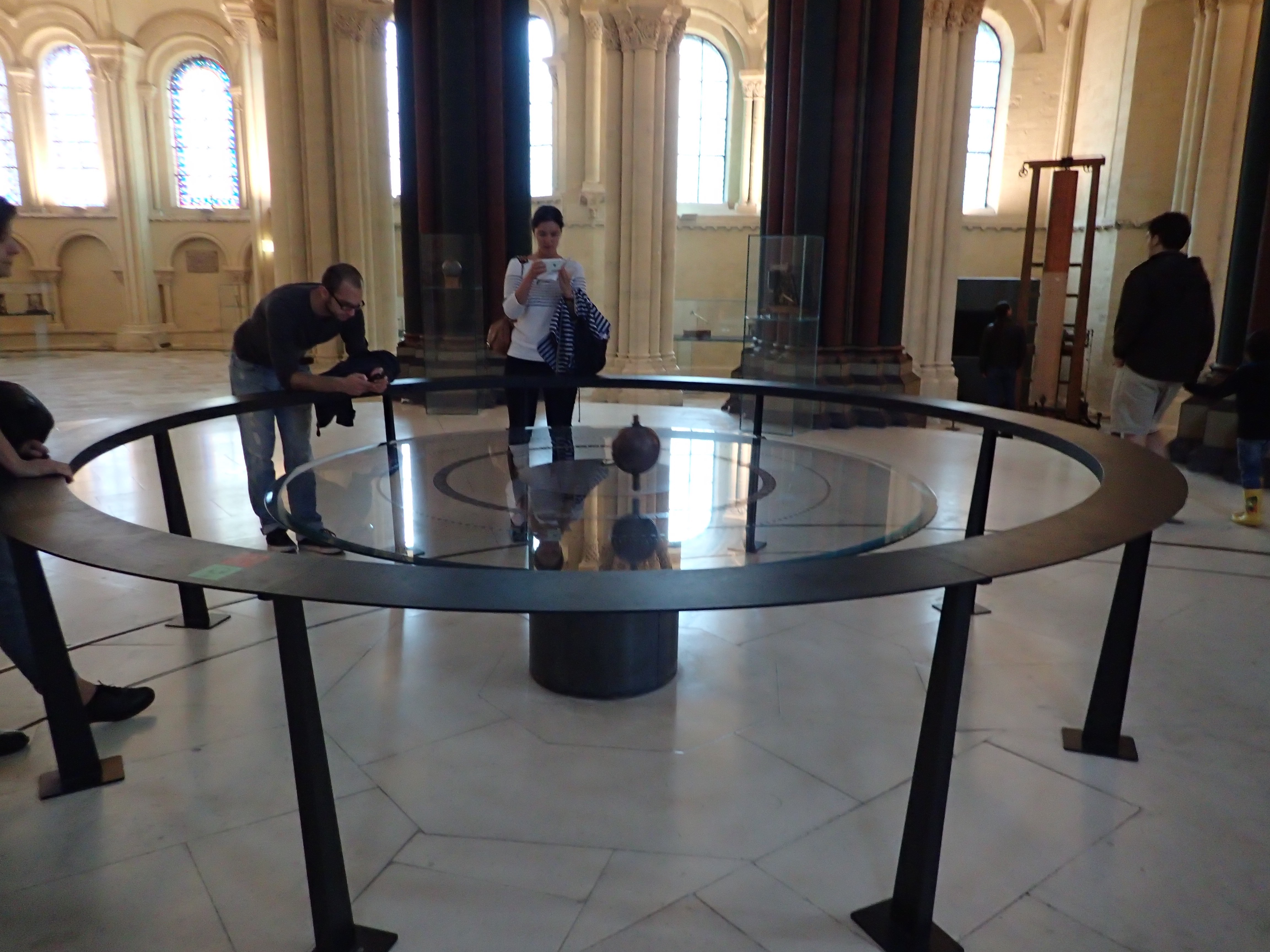
Foucalt's ACTUAL pendulum!!

Foucalt’s ACTUAL pendulum!!

Or this.

Pascal's calculator. I mean, that's pretty f'ing cool.

Pascal’s calculator. I mean, that’s pretty f’ing cool.


Another side of Paris

After the disappointment of just how poorly I had done in Qualifiers (future post on this), Scott proposed walking along Canal Saint Martin. With the lovely weather, I thought this was a very good idea. We decided to start our walk out of the metro station Juares (look along orange line 5 on the right bank side), and were immediately struck by all these tents right outside the station and all along the canal. These tents went on a fair distance and looked like fairly long-term residences for what seemed to entirely Middle Eastern people. My first thought was, are these refugees?

There were tents both at canal and street level (Photo: https://c2.staticflickr.com/8/7012/26979091772_3732fd8b95_b.jpg)

There were tents both at canal and street level (Photo: https://c2.staticflickr.com/8/7012/26979091772_3732fd8b95_b.jpg)

It turns out they are. I had no idea such a large encampment could exist so visibly and in a gentrified area such as Canal Saint Martin.

This picture gives you a bit of a clue of the litter around the camps (Photo: wikimedia.org)

This picture gives you a bit of a clue of the litter around the camps (Photo: wikimedia.org)

As I approached each section of tents/men, I quickened my pace, clutched my handbag, to get past them. It made me wonder, why do you feel threatened by these refugees? Part of the answer is I did not know for certain they were refugees. And I think that a long row of men, of any race/status is threatening. Except for frat boys or guys at a American football game.

canal-saint-martin

One of the locks along the canal.

While our walk was not as scenic as we expected, it yielded information on one of the many issues Paris deals with.

Pre-competition

Having one of Paris’ best croissants at Ble Sucre: Check

Purchase produce at Marche d’Aligre for tonight’s dinner: Check

Visit Notre Dame: Check

Obligatory ice-cream stop at Bertillon: Check

Attempt to go to Centre Pompidou to see the Beat exhibit , and find that it is closed on Tuesdays: Check

Go to the AccorArena for medical check: Check

Try and get a decent night’s sleep: Uhhhhh…


How do Paralympians make a living?

After I was approached by a Paralympian monoskier about getting into ski racing, I started to look more into how to get the ball rolling on this and see how far I can take it. Once I saw the cost of all the camps, the travel expenses to camps and competitions and, of course, the time it might take to train, I wondered how on earth can a person with his/her eyes set on making the U.S. Paralympic Team (Winter or otherwise) manage to support themself??

First off, Paralympians are probably  not being bombarded with sponsorship offers. Secondly, I don’t see many Paralympians doing manual labour jobs for companies like UPS and Home Depot; which I am guessing pay Olympians minimum wage and don’t mind if they have to take a good chunk of time off for training, events etc.

This is something I am struggling to reconcile. For example, could it come to having to make the choice between pursuing this Paralympic goal or, say, buying a house? If anyone has any ideas or knowledge about this, please let me know!

Wilderness First Responder training recap

There was no one reason why I decided to take a Wilderness First Responder (WFR) course and get WFR certified. There are many descriptions for the WFR program, but all follow this rough description:

“The definitive wilderness course in medical training, leadership, and critical thinking for outdoor, low-resource, and remote professionals and leaders.

The Wilderness First Responder program is the ideal medical training for leaders in remote areas including outdoor educators, guides, military, professional search and rescue teams, researchers, and those involved in disaster relief. The curriculum is comprehensive and practical. It includes the essential principles and skills required to assess and manage medical problems in isolated and extreme environments for days and weeks if necessary.” [1]

In the U.S., WFR is the nationally recognized standard for outdoor professionals. I knew a WFR certification was a prerequisite for becoming an AMGA Rock Guide, so that was certainly a consideration. But, more importantly, I wanted to feel like I was prepared to deal with a medical situation in the wilderness and/or backcountry. While my days of spending a lot of time many hours/miles/days away from a road are somewhat behind me, there are still a number of situations I can be in, either alone or as a group, where medical attention is delayed.

So when my friend and frequent climbing partner asked if I wanted to take a WFR course, I said, Sure! even though a WFR course is a significant time commitment (70 to 80 hours) and a fair chunk of change.

We had some constraints: the course had to be within 300 miles of the Boston area, and it had to be in January 2016. I suggested the condensed 5-day WFR course  (WFR courses typically take place over 7 days) offered by Wilderness Medical Associates since a) it would require less vacation days, and b) overall costs (accommodation etc) would be cheaper. Dave, being the good sport he is, agreed to my plan.

The condensed version of this course made for very long days. But I learned a ton. Aside from theory, the course really focuses on scenarios and the practical aspect of rescues. I found the latter to be the most useful thing for me.  It is one thing to learn, have the knowledge and understanding of what you should do given a particular circumstance. But it is a different think to be able to make decisions in a very stressful situation (severity of injuries, poor weather conditions, shitty evac options etc.)

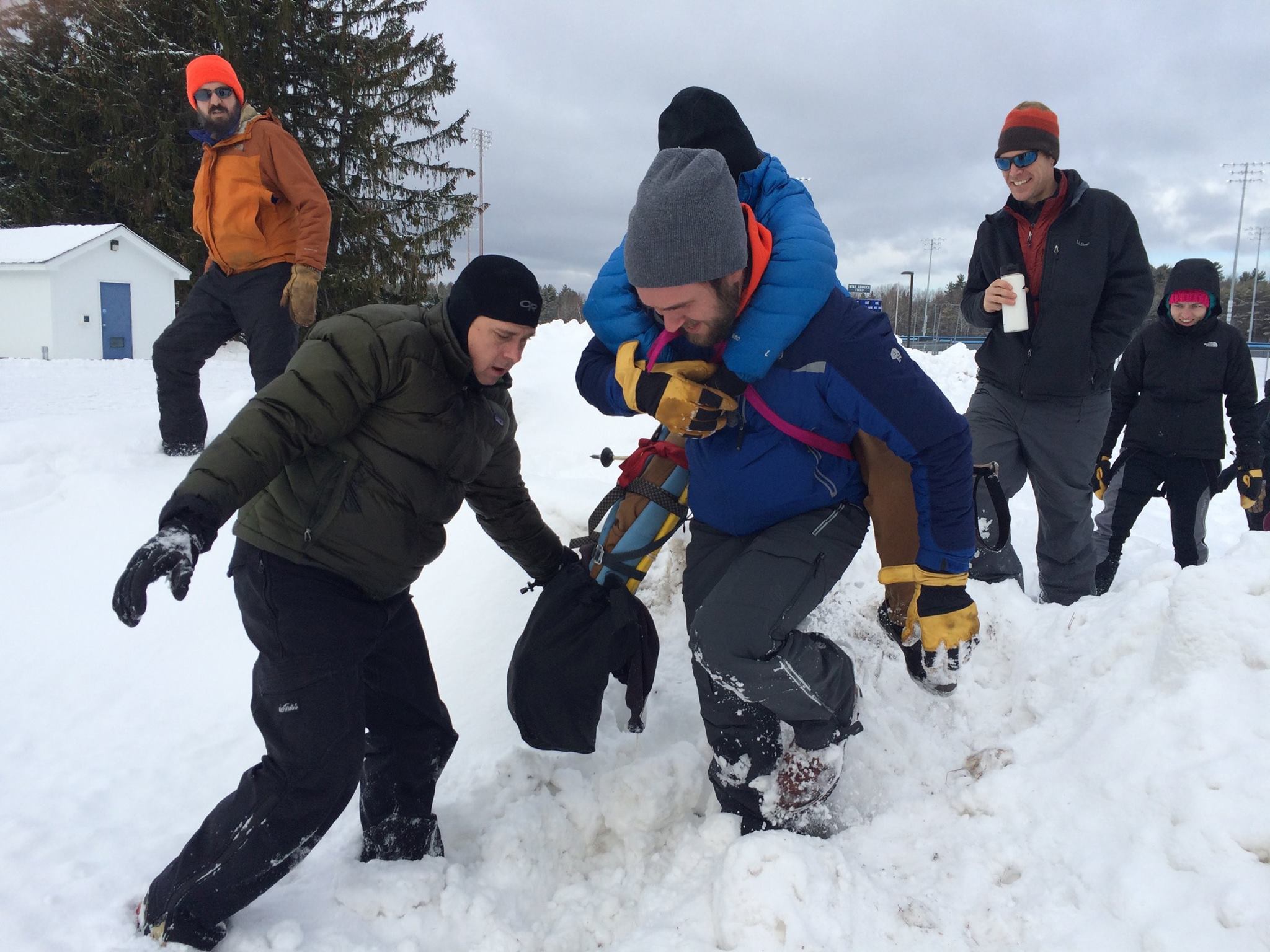
Making a body splint for a full pelvic and leg fracture out of sticks, foam and paracord. I am the one in dark blue. Oh, I didn't bring a brush with me so I ended up looking like a Gremlin towards the end of the course.

Making a body splint for a full pelvic and leg fracture out of sticks, foam and paracord. I am the one in dark blue. I didn’t bring a brush with me so I ended up looking like a Gremlin towards the end of the course.

One benefit to taking the course in Central Maine in the middle of January is that we got a lot of practice working through these scenarios in very cold, snowy conditions. That is probably more realistic, and it also helped me practice how to make and apply decisions under stressful and inclement conditions. I definitely get stupid and shut-down when I am very cold.

WFR pic_splinting

Here I am splinting an injured skiers fractured and heavily wounded leg. Since I neither have a beard, nor am I blonde, you can guess who I am in the photo.

I learned how to do the appropriate scene and patient assessments, how to record this information and relay it to a rescue team (e.g. medical/helicopter dispatch); different techniques to treat injuries in the field, different evacuation options. And, most importantly, how to put all this together to maximize the likelihood that the patient has his/her best possible outcome.

I did realize, however, how important being able to lift and carry a person/people is. I felt bad that I was limited here. I could manage carrying a litter with other people, but I still could pull my “full” weight. Obviously, I have a pretty good explanation for this, but I still felt bad.

My buddy is 6’4″ and around 210 lbs; so he is a total clydesdale and was able to be the workhorse in a lot of these practice scenarios.

Practicing a carry-out.

Practicing a carry-out.

Later, in the car ride back, Dave asked me, so, do you think you could carry me out in a rescue situation. I said, hell no and that he was fucked. While there is some truth there, perhaps, I am aware that having the skills to perform basic life support and treat illnesses and injuries in remote settings is a very useful skill for myself and my partners. And it feels pretty good to be WFR certified.

[1] https://www.wildmed.com/wilderness-medical-courses/first-response/wilderness-first-responder/

Realization (of the not-so-great kind)

A personal motto of mine, and one that is quite apparent as I climb, ski, and live life is “No excuses.” This past weekend, I realized that I was being hypocritical. I realized that I was using my introversion as an excuse to not go to large social gatherings, not hang out with friends sometimes, not do this and that. I realized that I was using the argument of “this is just who I am” as an excuse for avoiding certain things.

These kinds of realizations do not feel good. But shitty as it feels, I believe that one outcome of this is that I try and take ownership of my introversion, be in control of it, and turn it on/off when need be. It might be the only way I can fully maximize Wendy and, hopefully, the people around me.

Happy Thanksgiving

Happy Thanksgiving.

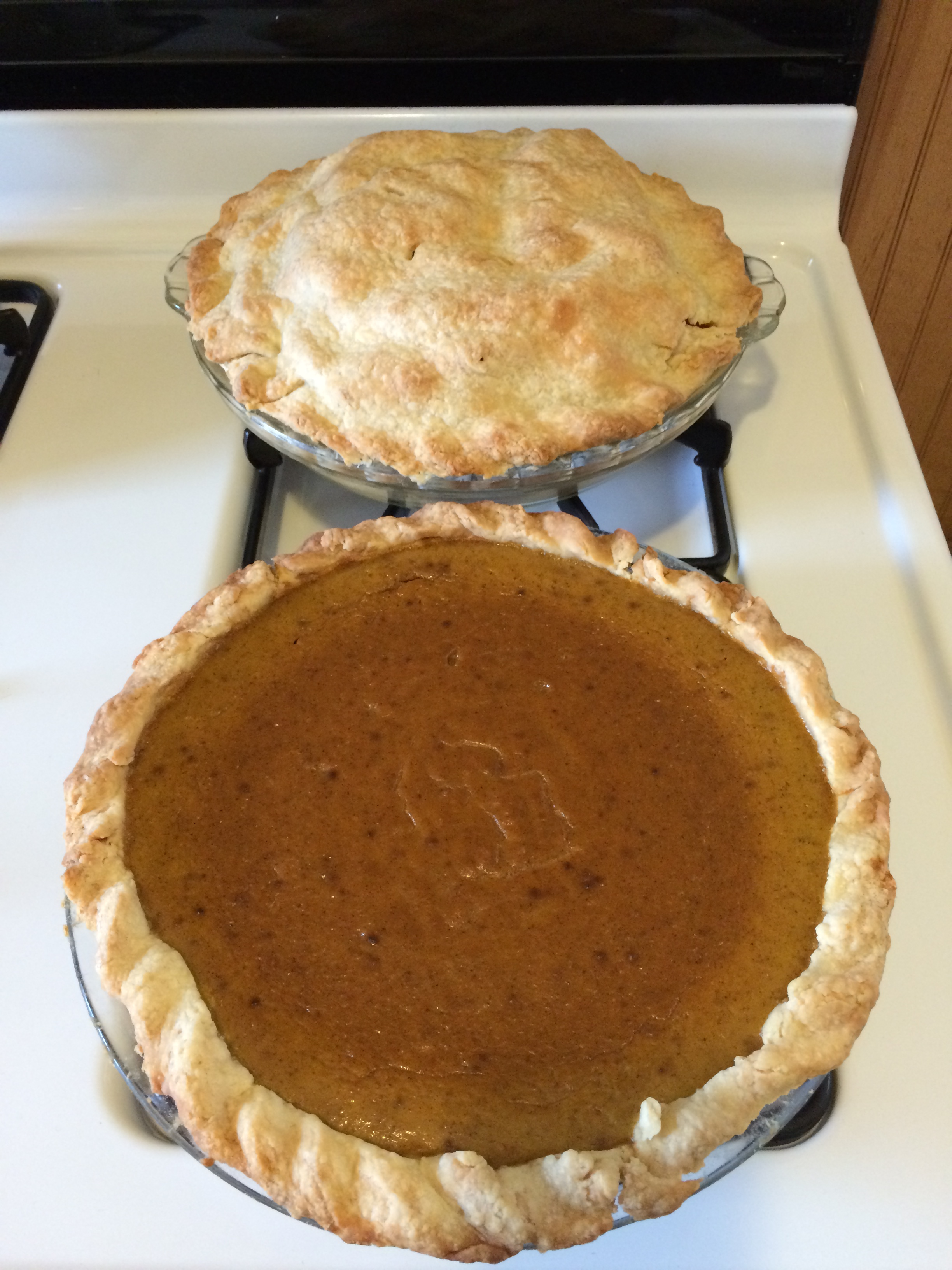
Our contribution to the Thanksgiving meal.

Our contribution to the Thanksgiving meal.

It is interesting that even though I have spent half of my life in the U.S., it is only in the last year or two that I have embraced some American traditions. Well, “some” meaning one: Thanksgiving. It is not a holiday that holds much significance to me as I grew up in Hong Kong. But having a true Yankee as a partner, and my sister and her family living fairly close by, has made it hard to avoid celebrating this occasion. I find it interesting to see what traditions I, and other people who arrive in another country as students and adults, choose to partake in, and which ones we do not. And what guides our choices?

Also, I never had a conventional Thanksgiving because previous Thanksgiving weekends prior to my accident were always spent on climbing trips, or some road-trip or vacation abroad. Work and insufficient vacation time to go to warmer climes; and temperatures that are too cold to rock climb but too warm to ski or for ice to have formed for ice-climbing have made me stay in town and actually do the whole Thanksgiving meal thing. I am trying not to stew too much for the next month or two. I am trying not to lose to much of my climbing gains this past season. The goal is just maintenance, or even just maintenance at a level from where I can bounce back/improve quickly. I am, however, thankful to be able to spend time with my sister’s family who live relatively close by (closer than, say, Hong Kong, Southeast Asia, Europe…). Time with family is precious, and I do not take it for granted.

Anxieties and preparations for NIAD

The last month has been incredibly stressful, due to balancing family and personal issues with preparations for NIAD. It has been challenging to train for NIAD around here because of 1) lack of long pitches and similar terrain, 2) the capriciousness of New England weather, and 3) pressing family matters that have sucked time away from this endeavour. While I am lucky to have a relatively flexible job, it is nonetheless, an office-job with an energy economics consulting firm that makes it hard to take days off in the middle of the week when the weather is good. The release of the EPA’s Clean Power Plan final rule has made August and September especially busy at work. My short time in the Valley and really only having one shot at this over one weekend is adding to the pressure I am feeling.

My main concerns are around my jugging stamina and not having my forearms and biceps cramp-up because I will have to rely on them more given the inability to transfer weight between my legs. While I have my set-up down for overhanging terrain, I am still not sure what I will do on slabbier/vertical terrain.

I have experimented around with some different equipment and set-ups, and for overhanging terrain at least, I am going to go with a Metolius Easy-Daisy attached to my top ascender (left for me, even though I am right-handed), a regular daisy-chain and Metolius Easy-Aider attached to my lower (right) ascender, and a Metolius pocket-aider or shortened Metolius ladder aider.

The closest place for me to set up a fixed line to practice jugging on has been Crow Hill in Central Mass. I’m going to try getting out there before I leave for the Valley at the end of the month.

I really should have started my bicep-increasing training plan earlier.

WTF.

WTF.

Despite my anxieties, I know I am in pretty good trad climbing shape. But, the length, exposure and all the other variables on a big-wall temper this a bit.

Sporadic posting over next month

I think it is easy for climbers, as a group, to lose perspective on things and forget that there is a lot more to life than climbing. I have certainly been guilty of this in the past and still have a tendency to have my moods be dependent on my climbing “performance” or how much/little I have been climbing etc. Part of this, I am sure, is due to climbing being such a time-intensive activity (staying in climbing shape, let alone training and improving; driving to/from climbing areas and actually doing the climbing). Part of it is perhaps due to climbing being an escapist pursuit for some of us, where we can put on ice the stresses and worries of everyday life, and focus on the very simple task of climbing a route without injuring ourselves/dying.

But life has a habit of throwing things at you that make you realize how unimportant climbing is in the scheme of things. I have been thrown such an object and while I will try my best at compartmentalizing my worries/fears/anxieties about this thing and keep myself well by doing things that I enjoy in my spare time, I have been, historically, very poor at this. I will certainly not be posting a ton as I will be emotionally and time-wise unavailable for awhile.

On a more light-hearted note, I leave you with this picture of me in an over-sized (Small) Metolius shirt and team cap.

How to look like a flat-chested 12 year old boy, yo. The photo also highlights how much skinnier my left leg is than my right.

How to look like a flat-chested 12 year old boy, yo. The photo also highlights how much skinnier my left leg is than my right. Hot stuff, eh.

It’s On(g) like Donkey-Kong!

I was just notified by the American Alpine Club that I was one of the recipients of the 2015 Live Your Dream Grant, for the Northeast Region in the U.S. My grant application was to help offset the costs of attending the 2015 American Alpine Club International Climbers Meet (I had to defer my participation last year because of the numerous broken fingers and right foot), and a Nose-in-a-Day (NIAD) attempt too.

For a number of reasons, I hesitated before accepting the award. I was not sure how I would find the time to train to do all those pitches and dial in a system with my prospective partner (who lives in California). The Northeast does not have long aid-routes or places where I can climb to the top of an area and drop down 1-2 full rope lengths and practice jugging. Ideally, I would make a trip before the planned one, to practice aid (I have not done a wall since before my accident), figure out how I can jug efficiently on slab (I suspect that will be far harder for me than steep overhangs). But, I have a partner (that is, a life/romantic one) who does not climb outside, and I feel bad about spending time away from him because that affects how much time we can spend together. Being in a relationship with a non-climber (he boulders on plastic inside) is a new experience for me, as I had always been with guys who climbed since I started climbing (before my big accident). I had dated lots of non-climbers post-accident, but that was before I got back into climbing outside more seriously again.

I heard a great quote the other day, from the host of the Enormocast podcast. He said something along the lines of, “Sport climbing is like chocolate cake. It’s great, tasty and awesome, but you can’t live on it. Long trad and aid routes are like the juicy hamburger.” Even though I do not eat land-based meat, this is exactly how I feel :) This is how I feel about pulling on plastic inside too. It has its place, but it doesn’t feed my soul. It did make me question living around here though, where I can’t fulfill my potential as a trad/aid-climber, because there just is not that much around here along those lines (ha ha, groan). But, I tell myself, there is more to life than climbing, including love and being with someone you are crazy about, who is crazy about you, and who you are so compatible with.

I went ahead and accepted the grant award. I knew if I rejected the award, I would regret it and be resentful of Scott. I’ll be putting thought into how to go about achieving my objectives this Fall. One possibility is practicing on Dolt Tower; and it would be prudent to get the Traverse from Sickle to Stovelegs down too. If anyone has any ideas of places not too far from Boston where I can easily drop a fixed line and do jugging laps (this would mean a place where getting to the anchors (ideally, fixed bolts, or places where I can put in very solid natural anchors), please let me know!